The Bering Strait Gateway - Arctic Routes, Rivalry and North American Readiness

Input
Modified
The Bering Strait connects Arctic shipping rivalry with continental defence
US–Canadian coordination faces a persistent infrastructure challenge
Chinese–Russian cooperation combines routes, resources and military reach
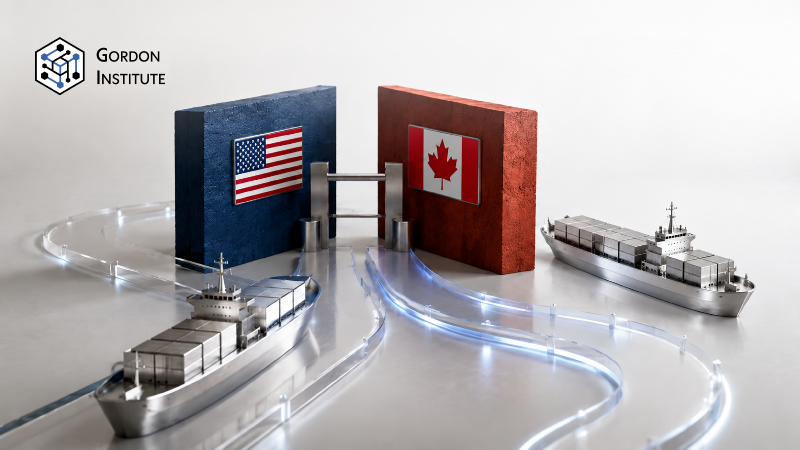
The Bering Strait is becoming a meeting point for two Arctic agendas: North American security and access through the Canadian Arctic toward the Atlantic, and Chinese–Russian cooperation along Russia’s northern coast toward Europe. These are not equivalent territorial claims. Russia is an Arctic coastal state, China is a commercial and strategic partner without Arctic coastal sovereignty, and the United States and Canada have distinct responsibilities and legal positions. Greenland belongs to the Kingdom of Denmark and forms part of the wider North Atlantic security geography rather than a US or Canadian possession. What connects the agendas is the gateway through which Pacific traffic reaches Arctic routes. The recent US–Canadian maritime strike scenario and the commissioning of USS Ted Stevens in Alaska illustrate growing attention to the region. They also expose the difference between conducting a visible operation and maintaining the ports, surveillance and logistics required for a persistent presence.
Joint Operations Test the Ability to Detect, Decide and Respond
Northern Command’s account describes a maritime strike scenario north of Dutch Harbor during September 18–22 under Operation TUNDRA MERLIN. Air, surface and subsurface units practised tracking targets, sharing information and conducting simulated strikes. Alaskan Command separately clarified to The Economy that TUNDRA MERLIN is an enduring operation and the combined maritime activity was a Flexible Deterrent Option, rather than an exercise limited to those dates. That correction matters because repeated coordination contributes to readiness differently from an isolated training event. It also needs to remain within scope: the clarification establishes the terminology supplied by the command, not official endorsement of an article’s wider geopolitical conclusions. The policy question is what recurring activity contributes to surveillance and response, and what additional capacity is needed to sustain those functions.
The northern air picture provides part of the context. The source reports NORAD detection of Russian aircraft in the Alaska Air Defence Identification Zone during February and March, followed by US responses using fighter and airborne-warning assets. An ADIZ is not sovereign airspace. Entry into it can trigger identification and monitoring without constituting a territorial violation. That distinction is essential when interpreting the rising frequency and range of military activity. A patrol may demonstrate reach, collect experience or communicate intent without crossing a national border. North American forces still need to identify it promptly and decide whether a response is warranted. Persistent awareness therefore has value independent of whether each observed approach is judged a direct threat. The challenge is maintaining that awareness across a large, difficult operating environment.
The September scenario made the information chain concrete. A Canadian CP-140 Aurora and HMCS Corner Brook tracked USCGC Aspen and supplied data for a simulated strike. In another phase, USCGC Stratton supported HMCS Ottawa during simulated engagements coordinated with Alaska-based F-35As. An E-3 Sentry contributed warning and control, while an Alaska Air National Guard KC-135 supplied aerial refuelling. These were training targets and simulated engagements, not attacks on another state’s vessels. Their significance lies in combining sensors, communications, platforms and sustainment into a usable sequence. Possessing aircraft and ships separately does not guarantee that a force can detect the same target, share a usable track and act within the required period. The operation tests that integration across services and national boundaries.
The later strike scenario must also be separated from the September 8–9 combined sail involving USCGC Munro and HMCS Max Bernays. Both activities fell within TUNDRA MERLIN, but Northern Command did not identify those two vessels as participants in the later scenario. Together, the events show repeated coordination rather than one undifferentiated exercise. The policy relevance is cumulative experience in a shared theatre: procedures can be practised, communication problems identified and operational data collected. None of that alone establishes an ability to maintain continuous coverage across the Bering Strait and Arctic Ocean. Readiness involves the reliability of the wider network and the resources available between publicised events. That is the distinction a strategy must address when translating successful combined activity into a durable regional posture.
Two Routes Toward Europe Create Different Security and Legal Questions
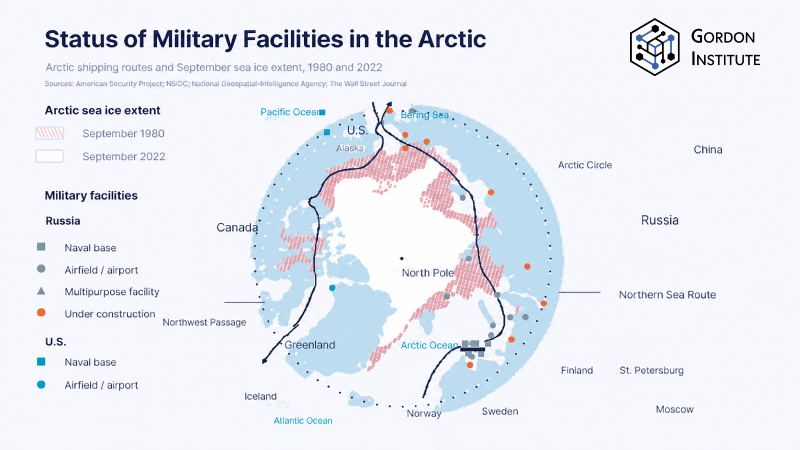
After entering the Arctic from the Pacific, traffic can follow the Northern Sea Route along Russia’s coast or seek passages through the Canadian Arctic Archipelago toward Baffin Bay, Davis Strait and the North Atlantic. The latter connects the discussion to Greenland and onward access to Europe, but it is not one simple, permanently navigable US–Canadian corridor. The Northwest Passage contains alternative channels with significant depth and ice limitations. Canada regards the relevant waters as internal waters; the United States disputes that treatment and regards the passage as an international strait. Russia’s Northern Sea Route depends heavily on coastal infrastructure, icebreaker services and its administrative regime. These differences prevent a straightforward division of the Arctic into two exclusive blocs. They do, however, create competing interests in access, route reliability and the authority exercised over transit.
Navigation remains constrained by conditions that diminishing ice does not automatically remove. The hydrographic warning discussed in the source identifies waters lacking modern surveys, multiyear ice and gaps in digital communications. Sparse repair, rescue and refuelling facilities add uncertainty. A faster nominal route can carry higher operating and insurance costs, while seasonal variability prevents a shipping company from treating one successful voyage as evidence of dependable year-round service. Military operations face those constraints alongside greater requirements for secure communications and timely support. For policy, the relevant comparison is therefore the operating system around each route: charts, weather and ice information, suitable vessels, accessible ports and emergency response. Geographic proximity to the entrance creates strategic importance, but infrastructure determines how much practical use can be made of it.
The competing claims should be specified rather than reduced to a struggle for possession of the entire Arctic. Canada emphasises sovereignty and administration in its archipelago, while the United States emphasises homeland defence and navigational freedoms. Greenland’s authorities and Denmark have their own interests in territory, development and North Atlantic security. Russia claims regulatory authority along its coastal route and has developed the facilities that make transit possible; the United States contests some requirements as excessive. China presents its activity through commercial cooperation, research and the Polar Silk Road rather than an Arctic coastal entitlement. The tension arises when access, military reach and commercial dependence overlap. A service that enables transit can also create leverage, while a defensive network can be perceived by another actor as limiting its freedom of operation.
Operational Presence Depends on Ports, Power and Logistics
The October 3 commissioning of USS Ted Stevens at Whittier connects naval capability with Alaska’s public and strategic role. The visit was reported as the first US Navy destroyer port call there in roughly eighty years. The Flight III ship’s SPY-6 radar and Aegis Baseline 10 system improve its ability to handle air and missile threats, supported by substantial electrical and cooling infrastructure. That technical capability matters, but the commissioning does not establish permanent stationing in the Bering Strait or continuous Arctic patrol duty. Whittier lies in southern Alaska, well away from the strait. Its role in the discussion is to demonstrate naval presence and the requirements of a modern combatant, while the policy task remains establishing where such ships can be supported over sustained operations.
Nome is more directly relevant to the western Alaskan approach. The port-expansion account describes a $399.4 million Phase 1A contract awarded in August 2025 and plans for a causeway extension of roughly 366 metres and a 183-metre dock, with deeper dredging as a later phase. The proposed approximately 12.2-metre basin would improve access for larger vessels, including Coast Guard icebreakers, compared with the present outer-harbour depth around 6.7 metres. Construction phases and usable capability should not be conflated: awarding a contract or holding a groundbreaking does not mean ships can already rely on the final design. Yet the project illustrates the central readiness constraint. Refuelling, provisioning, repair and emergency support determine whether a vessel’s theoretical range becomes a sustainable presence near the Arctic gateway.
Airpower follows the same logic. The deployment of 54 F-35As at Eielson was completed in 2022, while subsequent activity tests dispersed operations and inter-service support. The source describes F-22 alert-response operations from Kodiak during Tropic Tundra 26, runway-recovery work at Joint Base Elmendorf-Richardson and Marine–Army refuelling and transport coordination during Kodiak Mace. These examples extend beyond the exact geography of the strait but address the regional capacity on which a response depends. Aircraft need fuel, maintenance, usable airfields and a functioning command network. An adversary need not challenge the strongest platform directly if the supporting system is fragile. The American capacity gap is therefore better described through logistics, persistence and coverage than through a blanket claim that the United States lacks capable forces. Operating in the Arctic requires those components together. Sensors without communications cannot provide timely warning; aircraft without support cannot sustain sorties; ships without suitable ports must devote more time to distant replenishment. The source describes Canada modernising over-the-horizon radar, satellite surveillance, fighter capability and command systems through NORAD-related programmes. These investments address a vast domain where sparse infrastructure magnifies the burden on each asset. Russia’s concentration of bases, ports and icebreakers along its coast gives it a different regional support position, while China can contribute finance, vessels and research through partnership. Comparing the sides should therefore distinguish capability available in a particular location from overall military strength. Local advantages can matter even when the wider balance is very different.
Chinese–Russian Cooperation Extends from Commerce to Military Reach
Cooperation along the Russian route has become more institutionalised. The Polar Silk Road proposal emerged in 2017 and entered China’s Arctic white paper in 2018; the source describes a dedicated shipping-cooperation body established following the 2024 leaders’ statement. Vessel projects, resource financing and joint sea-ice observation add practical depth to that relationship. A survey of ice conditions can improve ship design and route planning without being a military operation, but the same environmental knowledge can have broader operational relevance. The growth of Arctic cooperation therefore needs to be understood across economic, scientific and security activities, without assuming that every commercial voyage or research project is a covert military action. Its cumulative importance is the creation of a route-dependent network in which Russia supplies local infrastructure and China supplies demand, capital and additional capacity.
Joint patrols add a separate security dimension. Eleven Chinese and Russian naval vessels approached the Aleutian area in 2023, prompting US tracking with destroyers and maritime aircraft. In July 2024, two Russian Tu-95s and two Chinese H-6s entered the Alaska ADIZ together; NORAD reported that they remained in international airspace. A combined coast-guard formation was also observed in the Bering Sea in September 2024. These activities demonstrate expanding cooperative reach without themselves proving unlawful territorial incursions. They nevertheless require North American monitoring and create more opportunities for misunderstanding or escalation. The Arctic’s role as an approach for aircraft, submarines and long-range weapons means that commercial interest in the gateway coexists with a defence problem. That overlap is why repeated patrols draw attention beyond their immediate navigational legality.
North American Coordination Must Survive Wider Political Tensions
US–Canadian tariff disputes and Canada’s closer European partnerships do not remove the operational interdependence created by geography. Defence-industrial cooperation with Europe can broaden procurement and production choices, while the binational warning and response network serves a different function. Canada depends on US assets and information from Alaska and beyond; the United States benefits from northern Canadian territory, facilities and local knowledge in detecting approaches farther from its population centres. Greenland and the wider North Atlantic add another allied geography, involving Denmark and Greenland’s own authorities. The resulting system is not reducible to one bilateral trade relationship. A regional posture needs cooperation across those responsibilities even where governments disagree on tariffs, spending or the legal status of a passage.
Canada’s efforts to diversify commercial and defence relationships can consequently coexist with continuing continental coordination. The source reports a lower US share of Canadian merchandise exports, retaliatory tariffs and expanded European engagement. Those developments concern economic dependence and procurement options; they do not by themselves show a dismantling of NORAD. A supplier can be European while equipment remains integrated with North American information systems, subject to the necessary interoperability work. Policy should avoid assuming either that every trade dispute will fracture military cooperation or that military necessity guarantees political harmony. The practical test is whether agreed capabilities, information exchange and operating procedures remain funded and usable. The Bering Sea activities supply evidence of continuing cooperation, not assurance that every political risk has disappeared.
NORAD’s permanent binational arrangement is also different from a high-level advisory channel. The underlying account distinguishes tensions surrounding the Permanent Joint Board on Defense from continued operational warning and control. That distinction matters because institutional disruption can occur at one level without stopping another. Sustained coordination nevertheless needs policy support to resolve procurement, investment and responsibility for new capabilities. The military account is therefore best read as evidence of an operating relationship that governments must maintain and develop. It cannot establish that Canada has no choices or that every future system will fit automatically. Decisions about data, communications and engagement procedures remain material, particularly when new equipment comes from different suppliers or must operate under degraded connectivity.
The Bering Strait gateway brings these choices into one strategic setting. Russia and China are developing the commercial and operational depth of the Russian coastal route; the United States and Canada are working to strengthen a northern response network while infrastructure catches up with ambition. Greenland and the Canadian passages connect that network to the Atlantic and Europe without making the routes legally or operationally equivalent. A sustainable policy combines deterrence, reliable navigation, support infrastructure and clarity about where rights are contested. The recent operations and commissioning are meaningful steps, but the decisive capacity is what can be maintained between them. This adaptation preserves the received Air Force clarification; it does not imply that additional comment on the Navy article has already been supplied or that either command endorses the wider analysis.
This article presents analysis published by Gordon Institute’s Policy Forum. It does not constitute policy advice or an official position of any military command or affiliated institution.
Source clarification retained: On 24 September 2026, The Economy updated its reporting following clarification from Capt. Kitsana Dounglomchan, Director of Public Affairs for Alaskan Command. TUNDRA MERLIN is an enduring operation, and the combined maritime activity was a Flexible Deterrent Option rather than a standalone exercise. The clarification concerns operational terminology and does not constitute endorsement of this Policy Forum analysis.
Source update retained: The account of the September 18–22 scenario follows Northern Command’s September 23 after-action release and distinguishes it from the September 8–9 combined sail. The participating ships and aircraft described here follow those separate accounts.
Official notice of the source correction: Alaskan Command Clarifies Description of Operation TUNDRA MERLIN — The Economy.
Similar Post
















