The Price of Fear: How Gas Supply Uncertainty Fueled Europe’s Inflation

Input
Modified
Chinese competitiveness combines manufacturing capability with state support
Trade remedies need evidence about the distortion they address
Critical-mineral dependence requires resilience as well as trade enforcement

China’s reported 2025 trade surplus of $1.189 trillion, up from $993 billion in 2024, has intensified a debate that is often framed too simply. Exports to the United States fell sharply while sales to other destinations supported the aggregate result. One interpretation attributes this performance primarily to an extensive subsidy system; another sees the emergence of a manufacturing advantage comparable to earlier Japanese and Korean success. Neither explanation is sufficient on its own. Chinese firms have developed productive capability, dense supply chains and rapid product development, while state financing and control over critical inputs can alter the conditions under which they compete. For trade policy, the distinction matters because the remedy for a subsidy is different from the response to a genuinely more efficient producer. A large surplus identifies an imbalance to investigate, not a complete accounting of its causes.
Manufacturing Capability Cannot Be Dismissed as a Subsidy Effect
The development of Japanese and Korean industry provides a useful historical comparison. Japan’s expansion in cars, electronics and semiconductors led to significant trade conflict, including the 1981 limit on car exports to the United States and the later appreciation of the yen following the Plaza Accord. South Korea subsequently built global positions in memory chips and vehicles, with Samsung leading DRAM and Hyundai developing beyond its earlier role as a low-cost manufacturer. Those advances involved learning, investment, supplier coordination and wages considered relative to productivity, alongside varying forms of state assistance. The historical parallel does not make China’s policies identical or automatically legitimate. It shows why foreign success cannot be explained adequately by a fiscal transfer alone: productive organisations and technical knowledge must still convert resources into goods that customers choose.
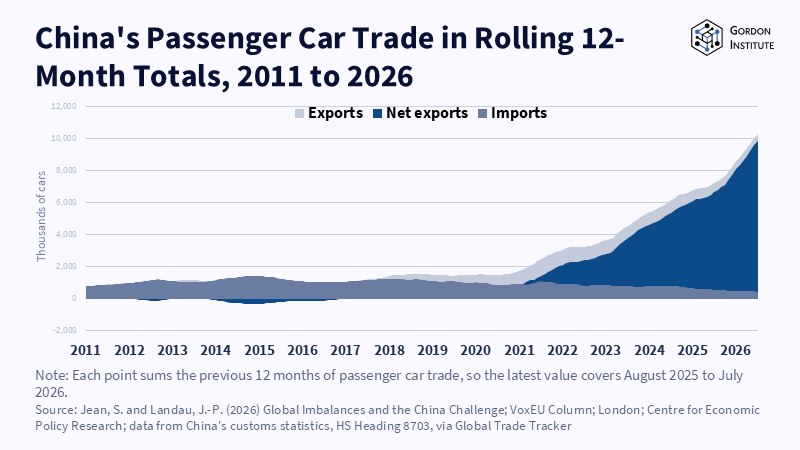
China’s automotive rise illustrates that distinction. It became the largest vehicle exporter in 2023, supported by integrated battery supply, engineering capability and development cycles that established competitors have struggled to match. Kiel’s estimate of €2.1 billion in direct subsidies to BYD in 2022, roughly 3.5 percent of revenue, demonstrates meaningful assistance without measuring every advantage in the value chain. Nor does that percentage by itself establish how much of the final price gap reflects subsidy. Indirect support, product mix, input costs and margins also matter. The manufacturing-efficiency argument is therefore credible without requiring the conclusion that all price advantages are commercially earned. Trade authorities need to separate observable operating strengths from support that changes the competitive benchmark, and industrial policy at home needs to respond to the former as well as contest the latter.
Subsidy Rules Require a Specific Case About Support and Injury
The WTO subsidy framework distinguishes prohibited assistance, including subsidies contingent on export performance, from other support that can be challenged under specified conditions. A countervailing investigation must examine the subsidy, its specificity and the injury or threat relevant to the legal test; high public expenditure alone does not prove that every supported firm violates the rules. Comparative studies nonetheless identify the scale of the Chinese system as substantial. CSIS’s conservative estimate puts industrial-policy spending at 1.73 percent of GDP in 2019, against 0.67 percent in South Korea and 0.39 percent in the United States. Kiel’s 2024 analysis found direct subsidy receipts at more than 99 percent of listed Chinese companies in 2022 and estimated support several times above major OECD comparators. Those findings justify close scrutiny while retaining the differences between definitions and years.
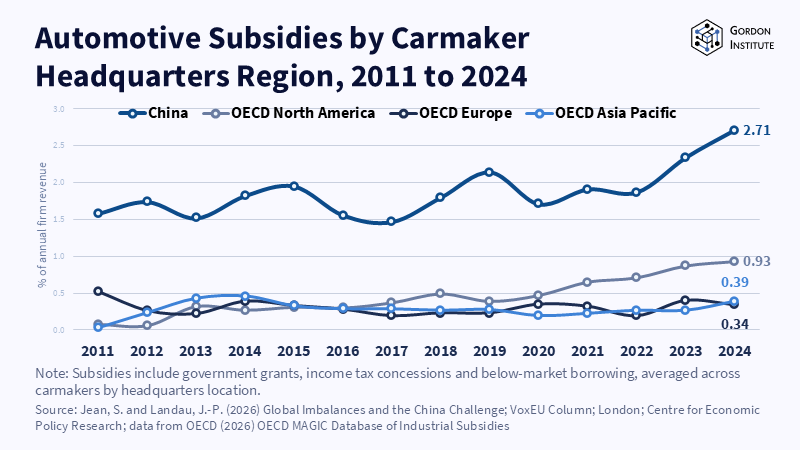
Support can redistribute resources from taxpayers and savers to producers and foreign buyers, and can encourage investment beyond commercially sustainable demand. Its overall welfare effect depends on learning benefits, distortions, market structure and the response of trading partners, rather than a universal theorem that every intervention reduces prosperity. The European Commission’s 2024 electric-vehicle investigation found countervailable support and imposed differentiated additional duties, including 17 percent for BYD, 18.8 percent for Geely and 35.3 percent for SAIC. These historical rates should be read in their regulatory context rather than as a live quotation of every current trade condition. The difference between BYD’s direct subsidy-to-revenue estimate and the duty assessment does not make either measure meaningless: they cover different instruments and calculations. Batteries, finance and land can transmit support below the final assembler’s recorded cash receipts.
Critical Minerals Create a Different Form of Leverage
Rare-earth restrictions raise a related but distinct policy problem. The 2010 interruption in shipments to Japan during the maritime dispute and the WTO’s 2014 ruling on Chinese restrictions on rare earths, tungsten and molybdenum demonstrate the significance of concentrated supply. China removed the measures covered by that ruling in 2015, but later export-control arrangements need to be assessed on their own terms. The April 2025 licensing requirements covered seven medium and heavy rare-earth categories and relevant materials, followed by a broader October regime described in the source. The policy concern is not simply that a Chinese producer has lower costs. It is that administrative control over access can become bargaining power for the state, especially where alternative processing or qualified substitute materials cannot be supplied quickly.
The concentration gives that concern practical force. The cited 2025 mining estimate assigns China around 69 percent of extraction and a processing share close to 90 percent. A temporary suspension of the October measures does not remove dependence on licensing under the earlier regime. The source places the suspension’s expiry at November 10, 2026 and distinguishes it from statements about a wider trade truce; those are different instruments and should not be assumed to share an extension. Uneven export recovery after an agreement also warrants scrutiny, although variation among destinations can reflect commercial composition as well as administrative decisions. What makes the issue strategic is control over permission, timing and eligible shipments. Trading partners must prepare for possible restriction without assuming every short delivery is evidence of deliberate coercion.
Comparative Policy Must Use Consistent Standards
Western governments also subsidise strategic industries. The CHIPS and Science Act authorised substantial US semiconductor support, while the Inflation Reduction Act introduced incentives tied to investment and production. Japan’s earlier industrial development involved directed finance and technology policy. These examples prevent an honest debate from treating state intervention as an exclusively Chinese practice. They do not establish equivalence in scale, design or legality. The CSIS comparison concerns 2019, before the major US measures just mentioned, so it cannot prove that the same spending ratio persists after them. A defensible comparison uses aligned dates, similar definitions and the economic effect of each instrument. The appropriate standard is whether assistance distorts competition or advances a legitimate objective proportionately, rather than the nationality of the government supplying it.
Consumer costs are equally central. A tariff can protect domestic producers while increasing prices for households and firms purchasing their goods. Kiel’s warning that duties on Chinese electric vehicles can slow or raise the cost of Europe’s green transition identifies a real trade-off. Differentiated countervailing measures attempt to address assessed support more precisely than a blanket tariff, but their precision is limited by information, estimation and pass-through. They do not perfectly extract an observable subsidy component from the retail price. Policy therefore needs to consider injury, competition, affordability and environmental goals together. Protecting every incumbent from every low-cost competitor would penalise genuine productivity improvements, while ignoring demonstrable support can undermine investment under fairer conditions. Neither objective is served by treating the entire price advantage as one undivided phenomenon.
These distinctions imply separate instruments. Trade authorities can investigate support, challenge measures through available procedures and calibrate remedies to the evidence. Critical-input resilience requires inventories, qualified alternatives and investment in processing capacity, not merely a tariff on finished goods. Projects involving Lynas and MP Materials illustrate the type of diversification at issue, while their economics depend on costs, customer commitments and the risk of volatile prices. Public support for alternatives should face scrutiny too: it needs a clear security rationale and protection against permanently subsidising inefficient production. Finally, domestic manufacturers must improve the capabilities that trade measures cannot supply—process design, automation, product development and supplier coordination. A temporary remedy may create time for that work; it cannot perform the work itself.
Separate Competitive Strength from Policy-Created Advantage
The record surplus is an aggregate outcome shaped by savings and investment, exchange rates, demand, production capability and public policy. It cannot be decomposed accurately by assigning all of it either to efficiency or to unfair assistance. The practical task is narrower: identify which advantages arise from better production, which from support and which from control over essential inputs, then match the response to the mechanism. The rare-earth suspension deadline described in the source offers one near-term test of access conditions, but does not resolve the wider industrial debate. Gordon Institute’s Policy Forum argues for a consistent standard that accepts genuine productivity gains while scrutinising distortions and preparing for strategic dependence. Fair competition requires evidence and effective domestic capability, not the assumption that every successful foreign producer is subsidised or that every subsidy can be dismissed as ordinary development.
The views expressed in this Policy Forum article are those of the author(s) and do not necessarily reflect the official position of Gordon Institute or its affiliates. This article does not constitute legal or policy advice.
References
Bickenbach, F., Dohse, D., Langhammer, R.J. and Liu, W.-H. (2024) Foul Play? On the Scale and Scope of Industrial Subsidies in China. Kiel Policy Brief No. 173. Kiel: Kiel Institute for the World Economy.
DiPippo, G., Mazzocco, I. and Kennedy, S. (2022) Red Ink: Estimating Chinese Industrial Policy Spending in Comparative Perspective. Washington, DC: Center for Strategic and International Studies.
European Commission (2024) Commission Implementing Regulation (EU) 2024/2754 of 29 October 2024 imposing a definitive countervailing duty on imports of new battery electric vehicles designed for the transport of persons originating in the People’s Republic of China. Official Journal of the European Union, L 2754.
General Administration of Customs of the People’s Republic of China (2026) Annual Import and Export Statistics, 2025. Beijing: GACC.
Global Trade Alert (2026) Divide and Rule: Chinese Export Management of Rare Earths since the Busan Accord. St. Gallen: St. Gallen Endowment for Prosperity through Trade.
GlobalData (2026) Global Rare Earths Mining: 2026 Review. London: GlobalData.
Ministry of Commerce of the People’s Republic of China and General Administration of Customs (2025) Announcement No. 70 of 2025 on the Suspension of Export Control Measures. Beijing: Ministry of Commerce.
Reuters (2026) ‘China’s trade ends 2025 with record trillion-dollar surplus despite Trump tariffs’, Reuters, 14 January.
ThePrint (2026) ‘US declares two-month trade truce with China as Xi Jinping lands in Washington’, ThePrint, 24 September.
World Trade Organization (2014) China: Measures Related to the Exportation of Rare Earths, Tungsten and Molybdenum. Reports of the Appellate Body, WT/DS431/AB/R, WT/DS432/AB/R, WT/DS433/AB/R. Geneva: WTO.
Similar Post
















