Strategic AI Infrastructure Without Sovereign Guarantees

Input
Modified
Hidden AI lease obligations now surpass Big Tech’s officially reported debt levels.
National security rationale protects AI infrastructure operations, not private financial stakeholders.
Regulators must comprehensively map financial obligations before considering public rescue.

As of mid-2026, leading AI and cloud service providers—Alphabet, Microsoft, Amazon, Meta, and Oracle—collectively carry approximately $1.65 trillion in off-balance-sheet liabilities. These obligations predominantly consist of data center leases not yet operational and processor purchase agreements pending delivery, a figure nearly eight times greater than four years prior and exceeding their combined officially reported debt of about $1.35 trillion. Public discourse commonly focuses on uncertainties regarding AI’s market valuation and long-term revenue potential; however, this substantial off-balance-sheet exposure signals a complex challenge in allocating potential financial risks between private investors and the public. Crucially, these commitments are detailed only in dense financial statement footnotes, hindering transparent assessment of stakeholders’ fiscal responsibilities in scenarios where market expectations fall short.
Balancing Strategic Necessity with Fiscal Boundaries: Two Perspectives on AI Infrastructure Financing
One perspective anticipates inevitable public bailouts to cover private losses. This view regards government intervention as nearly unavoidable given market dynamics.Advocates from institutions like the Political Economy Research Institute argue that substantial risks have already shifted into bond markets and private credit sectors. Government entities closely linked with AI firms may face intense pressure to absorb losses when they materialize. Supporting this, Bain & Company projected in 2025 that achieving estimated AI revenues of $2 trillion by 2030 would still leave a financing gap of around $800 billion annually, even after accounting for operational efficiencies. Further cautionary insights, such as Ray Dalio’s warnings at the 2026 Forbes Global CEO Conference, highlight rising interest rates and borrowing levels that may precipitate the bursting of this investment bubble, underscoring that technological strength does not guarantee attractive investment returns at current valuations. These financial factors could trigger a collapse of the bubble. Strategic technological dominance does not ensure investment profitability at present market valuations.
An alternative perspective challenges comparisons between AI investment and historical financial bubbles, emphasizing that artificial intelligence is now a fundamentally strategic domain. This view frames AI development as a locus of geopolitical and technological power competition. Accordingly, investment in AI infrastructure is propelled by national security and strategic considerations, especially amid the US-China rivalry, ensuring sustained funding regardless of short-term financial returns or market valuations. This implies that a sudden financial collapse akin to the 2008 crisis, which would necessitate a government bailout, is unlikely because neither government will permit critical capital flows to cease. Acknowledging this, some industry leaders have openly referenced the need for federal guarantees—for example, OpenAI’s CFO in late 2025 spoke of potential federal backing for chip financing, depicting AI as a near-national strategic asset. Though officially denied swiftly by White House advisors, such statements reveal implicit tensions around public financial involvement and the perception of AI as a strategic technology warranting government support.
National Security Imperatives Shape Infrastructure Preservation but Do Not Extend to Financial Claims
Much of the critical discussion around an AI investment bubble tends to overlook that major technology companies driving this expansion continue to demonstrate substantial revenue growth and profitability. For example, Microsoft reported on April 29, 2026, an AI-related annual revenue run-rate exceeding $37 billion, reflecting a 123% increase from the previous year. Its Azure cloud platform grew by 40%, and its quarterly net profit reached $31.8 billion. These financial indicators suggest that segments of the AI sector are commercially thriving rather than speculative flurries. Furthermore, AI's economic footprint is evident in labor market changes. Research by Stanford’s Digital Economy Lab, drawing on data from a leading American payroll software provider, indicates a 13% relative decline in employment among 22- to 25-year-olds within occupations most exposed to generative AI since late 2022. Meanwhile, more experienced workers in the same roles have maintained or expanded their employment levels. Such shifts imply that AI technologies are actively transforming workforce dynamics and hiring practices, especially among entry-level positions. financial sustainability at current deployment and investment scales, however, requires further validation over the longer term.
Geopolitical dynamics firmly reinforce the strategic framing of AI infrastructure as a national priority. In July 2025, the U.S. government unveiled its "Winning the Race" AI action plan and swiftly followed with an acquisition of approximately a 10% stake in Intel, signaling direct public investment in critical technology supply chains. Meanwhile, China’s State Council announced ambitious targets to achieve 70% penetration of intelligent agents and devices by 2027, with financing increasingly sourced through sovereign debt, state investment funds, and bank lending. Moody’s noted in August 2026 a 176% year-over-year increase in Tencent’s capital expenditures, highlighting growing public-sector involvement in Chinese AI infrastructure development. a geo-technological rivalry with sovereign interests at stakeneither the United States nor China appears prepared to cede ground, indicating that public financing and state support will continue regardless of market returns; this supports the view that the anticipated AI investment bubble is unlikely to collapse due to sudden withdrawal of government backing.
A fundamental flaw in the national security rationale is the failure to clearly delineate what elements of AI infrastructure merit protection. Historical experience, such as the telecommunications sector collapse with Global Crossing in 2002, provides a useful precedent: although the company declared bankruptcy, its physical submarine cable network remained operational under new ownership acquired at a fraction of original construction costs. This illustrates that safeguarding critical infrastructure for uninterrupted service does not necessitate preserving the financial interests of existing private investors. Similarly, while it is strategically justified for governments to ensure data centers continue operating to maintain computing capacity, extending this protection to shield bondholders or investors in highly leveraged special purpose vehicles—such as those managing data centers in Louisiana—risks implicitly committing public resources to cover private financial risks. Without transparent knowledge of the full contingent liabilities, governments may unknowingly assume sovereign risk by backing private sector leverage under the guise of national security, a practice with significant fiscal and governance consequences.
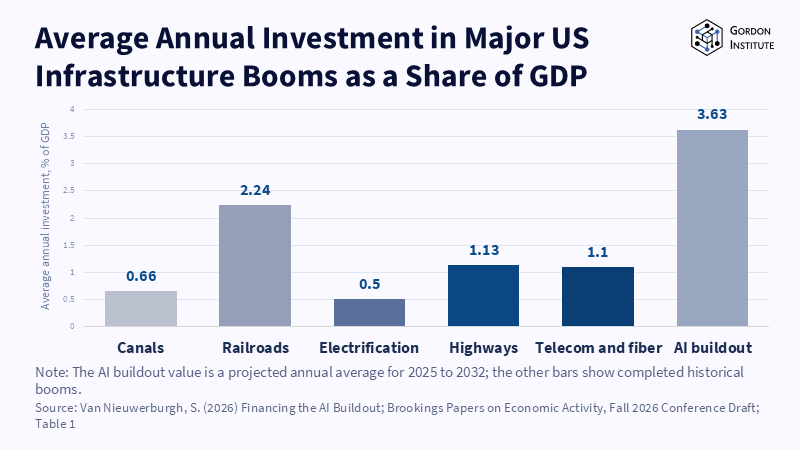
Off-Balance-Sheet Commitments Amplify Fiscal Risk Exposures
The Bank for International Settlements (BIS), in its March 2026 Quarterly Review, identified the rise of "shadow borrowing" structures financing AI infrastructure expansion. These include consortia and special purpose vehicles (SPVs) that either construct or acquire data centers, funding their operations through private credit and institutional investment. Typically, debt servicing is covered by rental income from major tenants, while the SPVs often benefit from guarantees extended by investment-grade rated corporations. Banks provide additional liquidity via credit lines to these SPVs, creating complex interconnections that facilitate potential channels of financial contagion, including refinancing challenges or sudden guarantee calls in periods of stress. BIS reports highlight the rapid growth of private credit lending to AI-related firms, escalating from around $3 billion in 2010 to over $40 billion in 2025, underscoring the increasing systemic relevance and risk exposure embedded in these off-balance-sheet financing arrangements.
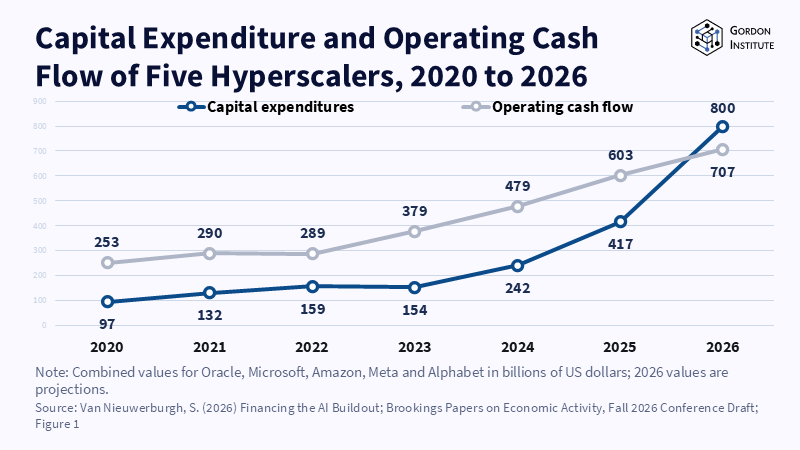
Meta exemplifies the opaque financing structures in play. It holds only a 20% stake in a joint venture managing a Louisiana data center campus valued at over $50 billion. According to Nikkei Asia, Meta has provided guarantees to cover investor losses should the facility’s lease be terminated as unnecessary. Meta’s off-balance sheet liabilities thus total around $420 billion—almost triple its on-statement debt. Oracle’s corresponding liabilities reached $273.3 billion by mid-2026, aligned with the Stargate project alongside OpenAI. S&P Global Ratings downgraded Oracle to BBB-, just above speculative grade, underscoring elevated credit risk. Accounting standards deflect lease liabilities to footnotes until operational commencement, which compresses leverage visibility precisely when investment commitments are undertaken and inflates it only upon asset activation. leading to a credit rating downgrade to BBB-,just above speculative status. This accounting treatment delays recognition of liabilities until operational phases, obscuring early-stage financial risk and burdens investors with sudden leverage shifts at critical junctures.
Visible debt levels among major AI and cloud firms remain substantial. An analysis by Reuters, drawing on London Stock Exchange Group data, shows that Alphabet, Amazon, Meta, and Oracle had collectively issued close to $194 billion in corporate bonds by July 7, 2026, marking a 79% increase over the previous year’s $108 billion. Goldman Sachs projects combined issuance for these four firms plus Microsoft to reach $250 billion in 2026 and escalate further to $400 billion in 2027. Of 91 similar bonds issued this year, 78 traded at yields above their issue prices as investors price increased credit risk. Concurrently, SpaceX is seeking $40 billion to acquire Nvidia chips, with its thirty-year bonds trading around 85% of face value. Any significant disruption in this financing ecosystem would extend beyond equity holders to insurance companies and pension funds holding these investment-grade securities, thereby potentially elevating borrowing costs for the U.S. Treasury itself through contagion in financial markets.
Comprehensive Regulatory Oversight Is Essential to Map Financial Interconnections
The 2008 AIG crisis starkly illustrated the perils of incomplete regulatory knowledge. In that instance, the Federal Reserve extended an $85 billion emergency credit facility without comprehensive insight into the web of counterparties dependent on AIG’s credit default swaps. The ensuing public outrage was largely fueled by the delayed transparency about where those funds ultimately supported counterparties, eroding trust. This episode underscores the critical importance of preemptive, detailed mapping of financial interconnections in complex markets such as today’s AI infrastructure financing. For any swift and cost-effective governmental intervention to be feasible, regulators must have a clear, real-time understanding of the ownership structures of AI infrastructure assets, the identities and exposures of debt holders, and the capital cushions available to absorb losses before financial distress cascades into the public sector. Currently, no regulatory body aggregates or publicly discloses this comprehensive exposure data. Instead, investigative efforts like those of the Nikkei Asia have had to painstakingly reconstruct approximately $1.65 trillion in off-balance-sheet liabilities solely through detailed review of corporate disclosures filed with the U.S. Securities and Exchange Commission—a practice that ideally should be centralized within dedicated supervisory authorities to ensure transparency and informed risk management.
To enhance financial transparency and risk oversight, the Securities and Exchange Commission should require each publicly traded company to submit a consolidated disclosure table enumerating all significant uncommenced leases, residual value guarantees, equipment purchase obligations, debt refinancing timelines, and tenant concentration details. This standardized reporting would facilitate cross-company comparisons without reliance on external research. Meanwhile, the Financial Stability Oversight Council should establish comprehensive mappings of banks’ credit exposures to special purpose vehicles and of bond holdings within insurance company portfolios, illuminating systemic vulnerabilities. Pension fund and insurance reserve managers face additional complexities, as bond credit ratings heavily depend on the operational solvency of the data center tenants. Moreover, much of the collateral underpinning these financings—such as advanced processors—may depreciate or become obsolete well before bond maturities, due to rapid shifts in AI model architectures and subsequent hardware generations, thus embedding latent risks that warrant continuous, detailed regulatory scrutiny.
Institutionalizing Predefined Rules to Manage Intervention Risks Amid Strategic Competition
Halting AI infrastructure development is unnecessary; instead, policymakers should proactively establish clear frameworks delineating the nature and scope of potential government interventions before any fiscal distress occurs. Applying Walter Bagehot’s principle—providing support solely to solvent entities, secured by adequate collateral, and priced at a penal interest rate—can be concretely operationalized by mandating that all federal guarantees, loans, or equity participations in AI infrastructure come with rigorous disclosure of off-balance-sheet exposures. Furthermore, private capital, particularly equity and subordinated claims, must be the first to absorb losses to preserve market discipline. Informal public assurances—such as social media declarations against bailouts—lack the legal clarity and credibility of explicit statutory rules that specify eligibility conditions and loss-sharing arrangements. Given the U.S. government’s ownership stake in Intel and its framing of AI infrastructure as a national security matter, the financial markets inevitably infer an implicit guarantee, irrespective of formal commitments; thus, codifying intervention parameters is vital to mitigate moral hazard while ensuring the continuity of strategically critical infrastructure.
The $1.65 trillion figure reported by Nikkei predates the earnings announcements expected in October 2026, which are likely to reveal even higher off-balance-sheet liabilities. As Oracle’s Stargate data centers become operational across states like Texas, New Mexico, Michigan, and Wisconsin, the associated lease obligations will shift onto Oracle’s balance sheet, which currently holds a BBB- credit rating reflecting elevated risk. Should the intensifying U.S.–China strategic competition continue to support ongoing financing, such high leverage is expected to persist over an extended period. Conversely, if this state-backed support falters, decisions about who ultimately bears the financial burden will have to be made swiftly by policymakers who presently lack a consolidated and transparent overview of these complex obligations, complicating timely and informed response.
The views expressed in this article are those of the author(s) and do not necessarily reflect the official position of Gordon Institute or its affiliates.
References
Aldasoro, I., Doerr, S. and Rees, D. (2026) ‘Financing the AI boom: from cash flows to debt’, BIS Bulletin, no. 120. Basel: Bank for International Settlements.
Bain & Company (2025) Bain’s Technology Report 2025. Boston: Bain & Company.
Board of Governors of the Federal Reserve System (2008) Press release on American International Group, 16 September. Washington, DC: Federal Reserve.
Brennan, A. (2026) ‘“Debt Burden Overshadows Growth Prospects”: U.S. Big Tech Credit Risk Surges Amid AI Investment Race, OpenAI IPO Stalls as Uncertainty Mounts’, The Economy, 29 July.
Brynjolfsson, E., Chandar, B. and Chen, R. (2025) Canaries in the Coal Mine? Six Facts about the Recent Employment Effects of Artificial Intelligence. Stanford, CA: Stanford Digital Economy Lab.
Duffy, C. (2025) ‘Why OpenAI went into crisis PR mode Thursday’, CNN Business, 6 November.
Eren, E., Krohn, I. and Todorov, K. (2026) ‘Financing the AI infrastructure boom: on- and off-balance sheet borrowing’, BIS Quarterly Review, March. Basel: Bank for International Settlements.
Hansbrough, T. (2026) ‘“Borrowing to Fund AI Investment”: U.S. Big Tech’s Debt Buildup Puts Upward Pressure on Corporate Bond and Treasury Yields’, The Economy, 8 October.
Intel Corporation (2025) Intel and Trump Administration Reach Historic Agreement to Accelerate American Technology and Manufacturing Leadership. Press release, 22 August. Santa Clara, CA: Intel Corporation.
Microsoft Corporation (2026) Earnings Release FY26 Q3, 29 April. Redmond, WA: Microsoft Corporation.
Murugaboopathy, P. (2026) ‘Hyperscaler debt binge pushes yields up as investor demand cools’, Reuters, 29 July.
Polychroniou, C.J. (2026) ‘Taxpayers Must Not Be on the Hook for Bailing Out the AI Industry’, Truthout, 2 September.
Proactive Investors (2026) ‘Ray Dalio warns AI bubble is nearing a breaking point as debt and rates rise’, Proactive, 7 October.
State Council of the People’s Republic of China (2025) Opinions on Deepening the Implementation of the “Artificial Intelligence+” Action. Beijing: State Council.
TechNode Global (2026) ‘Chinese hyperscalers ramp up AI spending but trail US rivals: Moody’s’, TechNode Global, 28 August.
The White House (2025) Winning the Race: America’s AI Action Plan. Washington, DC: Executive Office of the President.
Van Nieuwerburgh, S. (2026) Financing the AI Buildout. Brookings Papers on Economic Activity, Fall 2026 Conference Draft.
Yamada, K. (2026) ‘Five US tech giants’ hidden debts soar to $1.65tn on opaque AI funding’, Nikkei Asia, 21 July.
Adapted from The AI Bubble Must Be Contained Before It Becomes a Bet on Hegemony.
Similar Post
















