Building AI-Augmented Capability - Causal Reasoning and the Entry-Level Pipeline

Input
Modified
Exceptional AI-assisted work combines domain knowledge with causal reasoning
Training and task design can develop the human contribution
Entry-level opportunities are necessary to renew expert capacity

The policy significance of superhuman labour lies in whether an exceptional human–AI combination can become a reproducible capability rather than a privilege confined to people who already possess it. The term describes unusually strong performance on particular tasks, not proof that one worker replaces several complete jobs or acquires general expertise from software access. A useful model of the combination requires valuable human input: framing a question, explaining a mechanism and recognising when the proposed answer fails. A randomized Bocconi experiment involving 1,053 first-year students provides evidence on one teachable part of that input. Its findings distinguish the value of ChatGPT access from the value of causal-thinking instruction. For education and labour policy, the next question is how institutions can develop those capabilities through realistic practice, and whether doing so preserves the route by which newcomers become the experienced reviewers on whom reliable AI use depends.
What Causal Training Added to Assisted Performance
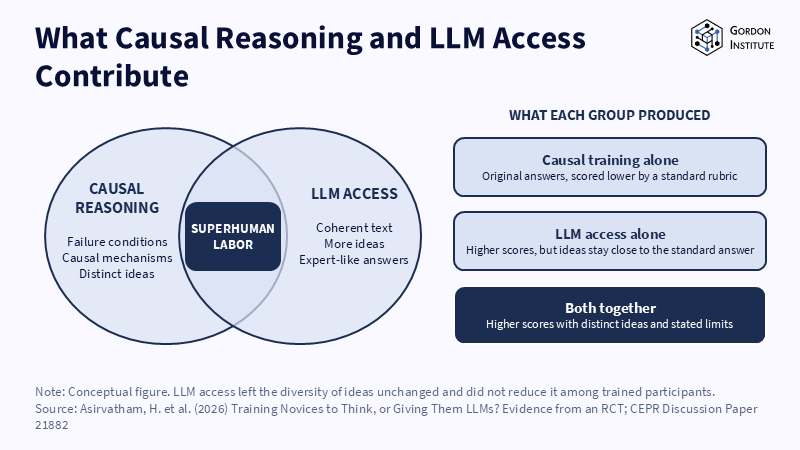
The study assigned thirteen sections of an introductory management course to four conditions: causal-thinking instruction, ChatGPT access, both or neither. The training used a twelve-question game with feedback, asking students to articulate causal chains, mechanisms and conditions under which a claim would cease to hold. Participants then completed a 45-minute assignment proposing how to increase awareness and use of the university’s merchandise shop in an 180-word recommendation. Graduate assessors unaware of treatment condition scored the texts, while comparison with three expert solutions supplied another reference point. Eight measures covered aspects including logical coherence, explanation of mechanisms, failure conditions and diversity. This was a short, defined task involving novice students. That scope makes the experiment informative about a particular intervention without establishing how it performs across occupations or over a working lifetime.
The results show why one performance score is insufficient. ChatGPT improved conventional scores and similarity to expert answers, while causal training did not raise those scores further. On reasoning depth and diversity, however, trained participants more clearly explained mechanisms and failure conditions and generated less similar ideas. ChatGPT alone did not provide those improvements. The combined condition outperformed controls across all eight measures and was not inferior to the single-intervention conditions. That pattern supports the complementarity of technical assistance and a trained reasoning habit within this setting. It also gives no evidence that access erased the benefit of prior instruction during the task. The findings should not be extended into an assurance that prolonged delegation never weakens expertise. They identify a useful learning mechanism to investigate at longer horizons.
Useful Human Input Is More Specific Than Prompt Fluency
The experiment sharpens an otherwise vague account of judgment. Asking when a proposal would fail forces the user to identify assumptions, connecting a suggested action with the circumstances that make it effective. That is different from requesting a polished version of an answer already circulating in model outputs. AI can improve the speed and presentation of a conventional response while causal instruction changes the questions brought to it. The resulting distinction matters to policy because an education system cannot develop high-value capability merely by teaching users to operate an interface. It must preserve responsibility for explaining and testing claims. This is a trainable component of reasoning, not evidence that every learner reaches expert performance after a short game. It nevertheless creates a route beyond simply selecting people who already demonstrate exceptional ability.
SIAI’s work on the value of human labour emphasises that verification requires substantive knowledge. Recognising a plausible error may demand understanding comparable to producing the correct result, sometimes with additional difficulty because the reviewer did not generate the original reasoning. The professional-task evaluation discussed in that work found approximately four in ten outputs required correction or repetition. A separate developer-learning experiment showed better comprehension among users seeking conceptual explanations than among those delegating writing or debugging, with the reported score ranges of 65–86 percent and 24–39 percent respectively. Those ranges describe behaviours in a specific study, not universal treatment effects for prompt styles. They nevertheless support an educational distinction: asking the model to do the work can remove the practice through which the user learns to evaluate it. Development requires evidence that understanding survives outside the supported interaction.
Build Capability Through Selection, Training and Workflow
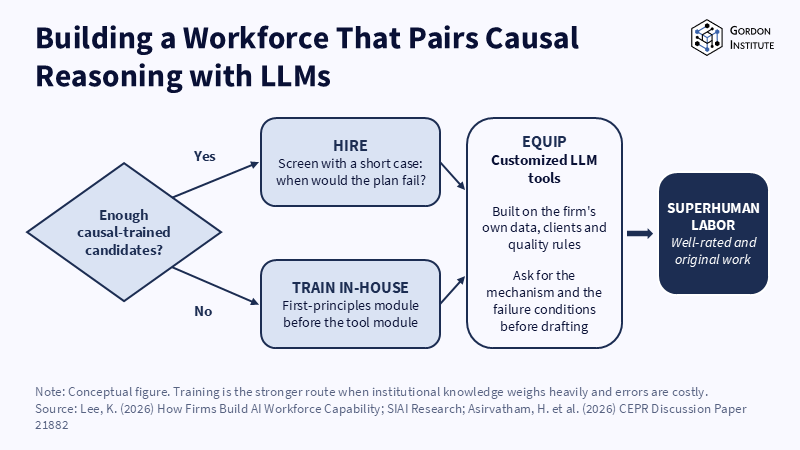
Recruitment can identify some of the required capacity, but a qualification or confident interview is not enough. A written case asking a candidate to explain a mechanism and identify failure conditions tests a more relevant behaviour than generic enthusiasm for AI. The supply of experienced candidates remains limited, and external hiring carries costs. Bidwell’s investment-bank evidence records an initial pay premium around 18 percent, lower early ratings and greater departure among external hires than internal movers. It is a specific setting, not a universal price for expertise. Survey evidence adds a reason to consider development: the US Census figures cited show 20.8 percent of AI users training existing staff compared with 2 percent hiring already-trained workers; EU firms considering but not adopting AI frequently cite missing knowledge. Institutions need credible development routes as well as selection procedures.
SIAI’s Workforce Strategy Working Paper compares seven options in a hypothetical twenty-person insurance service centre processing 6,000 monthly cases. Over 24 months, its scenario assigns domain-professional training a net contribution near €80,000 relative to the existing workflow, compared with minus €163,000 for hiring an applied AI engineer and minus €101,000 for tools alone. The training route reaches two-thirds of capacity in about five months, against eight for recruitment. These are scenario outputs, not measured returns from a real implementation. Their usefulness lies in making assumptions explicit. The result depends strongly on avoided errors: setting the cost of errors to zero reduces the training contribution to approximately €16,000. A programme teaching when and why an answer fails addresses that mechanism more directly than instruction measured only through faster generation.
Workflow design is the third component. The customer-support assistant associated with larger gains among beginners drew on the firm’s own successful conversations and offered suggestions employees could modify or reject. A comparable reasoning-oriented system would use relevant data and quality criteria while asking for mechanisms and failure conditions before a final recommendation is accepted. This is a design proposal, not a finding that a particular prompt guarantees a superhuman workplace. The organisation must still evaluate whether users engage with the question or merely copy the generated explanation. TO THE NEW’s October 2026 announcement of Coursera access and role-specific routes for more than 2,200 employees illustrates investment in development, but does not establish that those routes teach causal reasoning or deliver sustained improvements. The outcome needs separate assessment.
Preserve the Entry Pipeline While Testing Long-Term Results
Entry-level employment matters because experienced judgment must be produced somewhere. The resume and vacancy analysis cited covers around 62 million workers at 285,000 US businesses and reports a 7.7 percent decline in junior employment among generative-AI adopters over six quarters after early 2023, with no corresponding senior effect. The association should not be read as a precise count of jobs causally eliminated by the technology. Its relevance is the possible erosion of the pipeline that renews expertise. If firms retain senior reviewers while delegating the tasks on which juniors previously learned, short-run efficiency can consume a stock of knowledge without replacing it. SIAI’s longer-horizon scenario introduces this concern beyond the two-year budget. Early reasoning instruction may help, but it does not eliminate the need for domain practice, feedback and gradually increasing responsibility.
The Bocconi result lasts for the assignment observed; it does not demonstrate a durable career advantage. A policy programme based on it should test transfer to unfamiliar problems, unaided understanding and performance over time. Recruitment may still be preferable when the knowledge gap is too large or the deadline shorter than the learning period, as the SIAI scenario also recognises. Nor does a course catalogue demonstrate that a workforce has acquired the needed capability. Gordon Institute’s Policy Forum therefore treats superhuman labour as a development question: which human skills complement the model, how can they be taught and what institutional arrangements allow newcomers to practise them? Expanding access without answering those questions can improve immediate output while leaving the most valuable judgment concentrated. A credible strategy develops and renews that judgment, then measures whether the combined system performs reliably.
This article presents analysis published by Gordon Institute’s Policy Forum. It does not constitute policy advice or an official position of any affiliated institution. Financial comparisons described in the SIAI working paper are hypothetical scenarios, not observed implementation returns.
Similar Post
















