War’s Inflation Divide: Why Some Conflicts Send Prices Soaring and Others Push Them Down

Input
Modified
Conflict affects prices through both energy supply and weaker demand
Large shocks can activate uncertainty and expectation channels
Policy needs a diagnosis of the mechanism rather than a conflict label

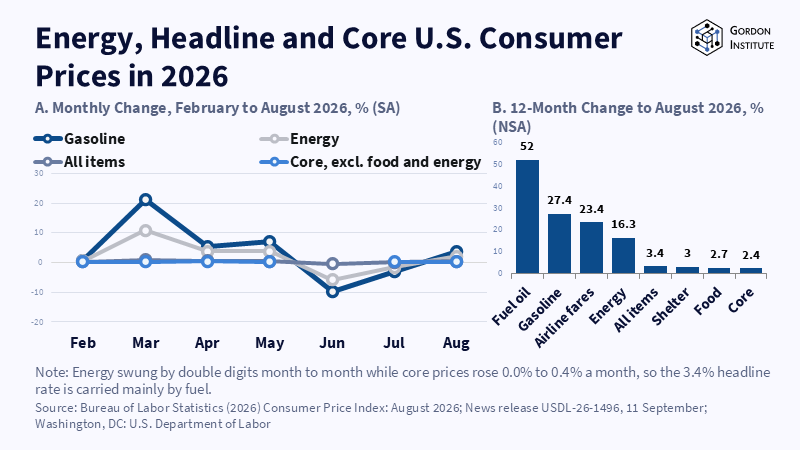
A geopolitical crisis does not have a single predictable effect on inflation. It can make energy scarce, raise precautionary demand and increase production costs, while simultaneously discouraging spending and investment. The balance depends on the location, transmission channel and magnitude of the event. The March 2026 figures cited in the source—US gasoline up 21.2 percent in one month and the energy index up 10.9 percent—illustrate a strong immediate energy response. Later reported inflation measures, including euro-area energy prices, show why that channel remained central to the discussion. They do not justify applying the same forecast to every war or escalation. For monetary and fiscal policy, the useful question is which constraint has changed and whether the resulting price movement remains concentrated or propagates into broader expectations and spending decisions.
Supply Constraints Complicate a Demand-Management Response
The development of modern monetary policy established interest rates as a principal instrument for influencing demand and anchoring inflation expectations. Volcker’s 1979 shift toward monetary restraint and the later period of lower inflation form part of that history. It would nevertheless be misleading to say central banks had regarded all inflation as demand-driven or assumed supply disturbances had disappeared. Their problem is that interest rates cannot directly replace a missing input. They can influence the demand for goods, services and credit, affecting how strongly an initial price increase spreads. When a conflict restricts energy or other necessities, the central bank must judge the persistence of the constraint and the risk that expectations and wage-setting amplify it. That judgment determines the balance between stabilising prices and avoiding unnecessary contraction.
The 2022 experience made this trade-off visible. US annual inflation reached 9.1 percent in June and euro-area inflation 10.6 percent in October. Energy and food disruptions associated with Russia’s invasion interacted with pandemic bottlenecks, changing demand and prior policy support; the episode cannot be assigned to one cause in every country. Europe’s exposure to Russian gas made the supply channel especially important. Higher interest rates could not restore pipeline flows or unblock grain routes, but they could restrain subsequent demand and influence expectations. The cost could appear in employment and output. Identifying that difficulty is more useful than treating every later conflict as a repeat inflation episode, because a crisis that mainly reduces confidence may create pressure in the opposite direction.
Energy and Demand Channels Can Move Prices Oppositely
The fall in oil prices after September 11, despite a sharp rise in measured geopolitical risk, demonstrates that risk and inflation need not move together. The research discussed here examines 31 major events since 1986 using a short window around each to compare the risk index with crude prices. An increase in both is interpreted as a geopolitical energy shock, whereas rising risk with falling oil suggests deteriorating activity and demand expectations. This classification is informative but depends on identification assumptions: oil prices reflect several influences, and a three-day window does not reveal every later mechanism. Its contribution is to separate events that public discussion often groups together. A heightened risk index is not sufficient to determine whether the supply or demand effect will dominate prices.
In the estimated responses, both types weaken industrial production while their price effects differ. The energy-channel shock raises the consumer price index by around 0.2 percent at its peak, while the demand-oriented shock lowers it by approximately 0.1–0.4 percent over the horizons examined. Those are responses to the study’s normalisation, not forecasts for a named future conflict or percentage-point changes in annual inflation. Sectoral results strengthen the distinction: basic metals and refining show larger output losses and producer-price increases after energy shocks, whereas the contrast is weaker for the other channel. The same global event can therefore have different consequences across economies depending on import dependence, energy use and substitution options. National policy needs those exposure measures as well as the international event classification.
Shock Size Can Activate Additional Transmission
The ECB working paper adds a nonlinear dimension using monthly US observations from 1970 to 2023. A one-standard-deviation risk shock, associated with an index increase around 20 percent, has relatively limited estimated effects; a linear approximation performs more adequately for smaller shocks. Larger disturbances show stronger departures from that approximation. The authors identify eighteen episodes above two standard deviations and four at or above four, including the Yom Kippur War, the Gulf War, September 11 and the Iraq war. This distribution also imposes a statistical limit: extreme-event estimates depend on relatively few observations. The finding is not that one numerical threshold applies to all countries, but that scaling an average response proportionately can understate the consequences of exceptional uncertainty.
The estimated financial and activity responses illustrate the difference. At four standard deviations, the initial stock-price decline is around 3 percent rather than the linear model’s 0.8 percent, while volatility rises by about three points instead of less than one. At eight standard deviations, the reported responses include a volatility increase near fourteen points, a stock decline around 10 percent and weaker consumption and industrial production. These are model-based impulse responses, not quantities that every sufficiently large war must generate. The mechanism is nevertheless plausible: households and firms delay decisions when uncertainty becomes consequential, and financial repricing tightens conditions further. A major crisis can therefore operate through confidence and financing even where the physical supply interruption is limited. Size and channel interact rather than provide interchangeable explanations.
The distinction between threats and realised acts offers another layer. In the decomposition described, threats raise expectations of future scarcity and precautionary oil demand, while realised events can coincide with a stronger contraction in expected activity. The reported price responses differ accordingly, with some expectation effects becoming more pronounced for large shocks. It would go beyond the research to conclude that every invasion lowers oil prices or every threat increases them. An attack on a major energy route can directly constrain supply too. The policy lesson is to examine what uncertainty has changed, what disruption has occurred and how expectations respond. A label based only on whether the event has happened cannot replace the underlying economic diagnosis.
Average Findings and Event-Specific Analysis Answer Different Questions
Caldara, Iacoviello and colleagues use a much broader historical and international sample and find that geopolitical risk typically raises inflation while reducing output. Their estimated shock comparable in size to Russia’s invasion adds about one percentage point to global inflation and reduces output by roughly 1 percent. These results need not invalidate the channel-specific findings. A pooled effect describes the mix of events and policy responses in its sample; it does not show that every constituent event has the same sign. The researchers also discuss fiscal and monetary responses that contribute to the observed outcome. Military spending, financing and demand support can change inflation after a crisis. Policymakers should therefore distinguish the initiating disturbance from the institutions’ reaction rather than attribute the full resulting price path to the conflict itself.
The ECB decomposition of the US experience after Russia’s invasion assigns only a limited net contribution to its identified geopolitical shock, with broader supply factors contributing more. That result concerns one economy, identification procedure and period; it does not establish that the invasion was unimportant to European energy prices. The United States was less reliant on Russian energy and was simultaneously emerging from pandemic disruption. A crisis centred on the Gulf and threatening the Strait of Hormuz creates a different exposure. Oil’s global role can transmit the effect well beyond countries directly involved. An event-specific assessment therefore needs the transport route, affected commodities and capacity for replacement. An average historical estimate is useful context, but cannot perform that diagnosis.
The 2026 figures in the source describe considerable movement in energy alongside lower core inflation. The US energy index rose 10.9 percent in March, fell 5.7 percent in June and rose 2.1 percent in August; the cited annual core rate was 2.4 percent despite a much larger gasoline increase. The September euro-area comparison similarly placed core inflation below the energy-driven headline measure. These observations are consistent with a concentrated energy disturbance, though they do not prove that no wider pass-through has occurred or will occur. Core measures exclude direct energy prices but can still incorporate energy costs through goods and services. The next stage depends on contracts, wage-setting, margins and expectations. The distinction between a price-level jump and continuing inflation is equally important when interpreting the path.
Policy Should Match the Diagnosed Mechanism
The source’s account of the ECB’s September decision and its projections illustrates a forward-looking response to inflation risk under weak growth. Such a decision cannot be evaluated solely by observing whether energy prices rose on the announcement date. Authorities must consider persistence, expectations, wage developments and the economy’s ability to absorb costs. Tightening can be appropriate when a supply shock risks broader inflation; easing may be appropriate when demand contraction dominates and expectations remain contained. Neither follows as an automatic rule from the event category. The nonlinear research makes the dilemma harder because very large shocks can intensify both activity losses and uncertainty. Historical policy-rate declines after severe events show how authorities have responded, not necessarily what an optimal response would be in a different setting.
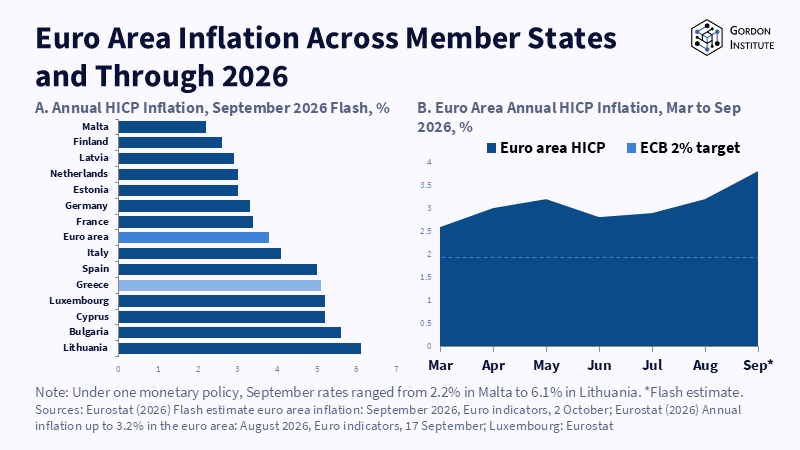
Country and sector differences deserve equal attention. The September comparisons cited include inflation of 5.1 percent in Greece and 5 percent in Spain, against 2.2 percent in Malta and 2.6 percent in Finland under a common monetary framework. Energy dependence is one influence among taxes, price interventions, consumption weights and domestic conditions. Governments can address specific vulnerabilities through credible supply arrangements and well-targeted support while considering the fiscal and demand consequences. Energy-intensive firms need contingency planning and attention to input contracts and financing. The relevant question is whether an escalation has changed available fuel, future delivery confidence or expected final demand. A response to actual transport disruption should differ from a response to higher press-measured risk with no comparable physical constraint.
The sharp March gasoline increase identifies an energy channel in the episode discussed. It does not, by itself, prove that the event crossed the nonlinear threshold estimated in a different historical model. That conclusion would require a comparable risk-shock measure and application of the study’s assumptions. The stronger policy proposition is that an energy-route crisis combines direct cost exposure with possible confidence and expectation effects. A similarly serious event away from essential supply networks could instead produce a larger demand contraction, though its outcome would remain conditional. Gordon Institute’s Policy Forum therefore treats magnitude and mechanism as separate questions that must be joined empirically, rather than assume that intensity alone determines the sign of inflation.
The remaining issue is persistence. A projection in which core inflation exceeds headline inflation in a later year can indicate expected energy easing while indirect pressures remain, but it is not proof of an irreversible spillover. Subsequent releases on prices, wages, expectations and activity must test that interpretation. The source identifies the next US CPI release as one near-term observation; no single release will resolve the full mechanism. Durable policy rests on distinguishing direct energy movements, indirect costs and demand effects over time. That discipline allows authorities to respond to a genuine inflation risk without assuming every conflict requires the same action or that a temporary fall in fuel prices has ended the wider adjustment.
The views expressed in this Policy Forum article are those of the author(s) and do not necessarily reflect the official position of Gordon Institute or its affiliates. This article does not constitute policy advice.
References
Board of Governors of the Federal Reserve System (2026) Federal Reserve issues FOMC statement. Press release, 16 September. Washington, DC: Board of Governors of the Federal Reserve System.
Brignone, Davide, Gambetti, Luca and Ricci, Martino (2025) Geopolitical risk shocks: when size matters. ECB Working Paper Series No. 2972. Frankfurt am Main: European Central Bank.
Bureau of Labor Statistics (2026) Consumer Price Index: August 2026. News release USDL-26-1496, 11 September. Washington, DC: U.S. Department of Labor.
Caldara, Dario, Conlisk, Sarah, Iacoviello, Matteo and Penn, Maddie (2026) 'Do geopolitical risks raise or lower inflation?', Journal of International Economics, 159.
European Central Bank (2026) Monetary policy decisions. Press release, 10 September. Frankfurt am Main: European Central Bank.
Eurostat (2026) Flash estimate euro area inflation: September 2026. Euro indicators, 2 October. Luxembourg: Eurostat.
Pinchetti, Marco (2026) 'Geopolitical risk and inflation: the role of energy markets', Journal of International Economics.
Similar Post
















