AI and Employment - Why Job Creation Can Coexist with Closed Entry Routes

Input
Modified
AI changes the balance of tasks within jobs before aggregate employment
Substitution and complementarity require separate measurement
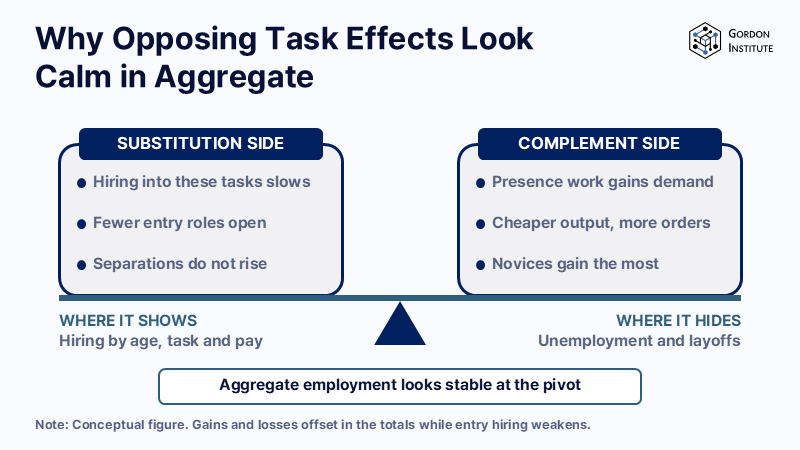
Reduced hiring can weaken entry routes without increasing dismissal rates

An occupation-level AI score can conceal the mechanism most relevant to employment policy. Medical secretaries and secondary-school teachers sit only 0.027 points apart in the AIOE measure discussed here, yet task-based analysis assigns roughly two-thirds of the former’s duties and one-fifth of the latter’s to potential substitution. Similar exposure therefore need not mean similar labour demand. A technology can remove some activities while making the remaining human contribution more valuable, generating opposing employment pressures within the same job. Policy based on the average may miss both. The important questions concern which tasks are changing, whether demand expands and who can enter the redesigned occupation. A stable unemployment total is compatible with substantial redistribution of opportunity, particularly when employers adjust through fewer new appointments rather than dismissing existing staff.
Measure Tasks Before Inferring the Future of an Occupation
The task approach has long been central to the economics of technological change. An occupation combines activities with different requirements; producing a draft memorandum is not the same as appearing in court or assuming responsibility for advice. Nonetheless, many AI exposure measures assign one number to the occupation because assessing thousands of individual task descriptions is expensive. Language models can help classify the 17,536 descriptions in the US occupational database, but they introduce a measurement problem of their own. A multi-model analysis published in May 2026 found the share of occupations labelled highly exposed ranging from 2.7 percent to 51.5 percent across models. That variation indicates sensitivity to the assessor and procedure. It is not a forecast interval for actual displacement. Employment policy needs a defensible classification and clear separation between technical feasibility, organisational adoption and observed outcomes.
The medical-secretary and teacher comparison shows why greater precision still needs a better conceptual structure. Summarising, transcribing and scheduling may be technically easier to automate than classroom supervision and interaction. The task analysis assigns teachers a much larger complementary component even when the aggregate exposure scores are close. Those classifications remain assumptions about capability and work design, not proof that all secretarial duties can be delegated legally or reliably. Taken together, the two occupations employ almost two million people, making the distinction material. A retraining programme, education budget or staffing plan needs to know whether AI removes part of the role or improves an input to work that still requires the professional. One scalar cannot reliably answer both questions.
Distinguish Substitution, Complementarity and Limited Direct Exposure
The framework developed by researchers at Liminal Capital divides tasks by the role of human contribution. Substitutable activities can, under the classification’s assumptions, be completed by AI with little further input. Complementary activities retain a human requirement while benefiting from cheaper or better supporting work. Other activities, including much physical work, have limited direct exposure to language-model capabilities. The labels should not be treated as permanent properties: drafting a contract may still require professional verification, and an apparently unexposed trade may use AI for scheduling or customer communication. Within the framework, the employment-weighted shares are 32 percent substitution, 15 percent complementarity and 53 percent limited direct exposure. These are modelled categories for examining effects, not percentages of workers certain to lose, gain or retain their jobs.
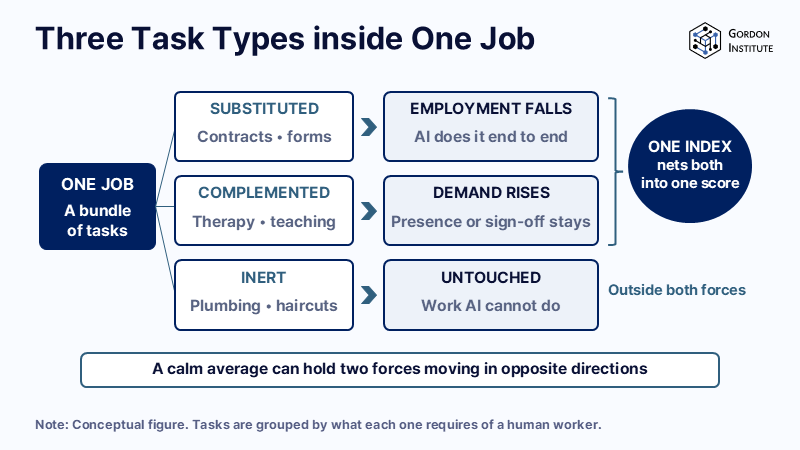
Entering the two affected components separately produces opposite associations in post-2021 employment data. The analysis reports substitutable work growing 3.3 percentage points more slowly per year than the relatively unaffected benchmark, and complementary work growing 3.3 points faster. Its translation into job quantities is approximately 1.5 million fewer positions annually on the substitution side and 0.7 million more on the complementary side, relative to the benchmark. These are counterfactual comparisons, not administrative counts of layoffs directly caused by AI. The unequal quantities reflect the different sizes of the classified pools. Placebo comparisons in 2019–2021 and 2015–2019 find neither margin predicting the earlier employment pattern. That supports the timing interpretation while not removing every possible confounder or establishing that the estimated gradients will persist.
The framework also helps explain conflicting exposure studies. An index combining both components can be positively or negatively associated with employment depending on the share of each it captures. In comparisons reported by the researchers, conventional indices lose significance when the separate margins are included. Independent time-use work likewise finds substitution and complementarity associated with working hours in opposing directions. For policy, this suggests a measurement requirement rather than a declaration that one study resolves the labour-market debate. Statistical agencies should publish enough detail to distinguish fewer routine tasks from more demand for human-completed services. Without that distinction, a change in the sign of an aggregate association may reflect composition rather than contradictory evidence about the same mechanism.
Stable Totals Can Conceal Changes in Opportunity
The SIEPR policy brief published in July 2026 offers a warning against treating exposure as observed unemployment. Since 2022, unemployment rose by 0.77 percentage points in the most exposed quintile and by 0.85 points in the least exposed. That comparison fits a wider easing of labour demand more readily than a simple exposure-driven unemployment surge. It does not show that AI has no effect. Aggregate unemployment reflects departures, hiring, participation and movements between occupations, as well as multiple economic influences. Opposing task effects can also offset. The appropriate interpretation is that the headline outcome does not validate a forecast of widespread immediate displacement, while more detailed flows may reveal pressure that the total obscures.
Productivity findings similarly depend on the setting. The customer-support study cited reports average gains around 15 percent, with roughly 30 percent among beginners and little change for experienced agents. A GitHub Copilot experiment found developers completed a defined task 56 percent faster. Neither result is an estimate of national productivity or of the number of employees required by every firm. Complementary investments in software, training and organisation can delay broader returns, a pattern described by the productivity J-curve. The computer era’s earlier experience is instructive about timing, not a guarantee that AI will follow the same path. During adjustment, a firm can change hiring before its measured productivity fully improves, or record faster work without reducing jobs. Employment policy should track those possibilities separately rather than infer one from the other.
Entry Routes Can Contract Before Existing Jobs Disappear
The most consequential early change may occur at recruitment. Liminal Capital reports no comparable rise in departure rates within the most substitutable occupations after ChatGPT’s release, while hiring among 22–25-year-olds in the most substitutable quartile fell by one-third. This is evidence about the adjustment channel in that analysis, not proof that all technology-related change avoids layoffs. The pressure on younger workers is consistent with Stanford Digital Economy Lab findings for junior customer-service and software roles, where older colleagues’ employment was steadier. Recent-graduate unemployment reached 5.6 percent in early 2026, 1.6 points above three years earlier. That aggregate measure has other causes too. Timing tests addressing the interest-rate cycle and post-pandemic recovery strengthen the reported relationship but do not justify assigning every lost entry opportunity to AI.
The distribution across pay bands is also important. The substitution association appeared first in lower-paid occupations with high turnover and later became significant in middle-paid work. If an employer replaces vacancies with software rather than replaces incumbents directly, the immediate burden falls on people attempting to enter or move between roles. Young workers may lose both income and the practical experience through which future expertise develops. Policy monitoring should therefore include appointments, vacancies, age, pay and the task composition of the position. These measures can reveal whether entry-level work is being redesigned, eliminated or transferred to another occupation. They also distinguish a temporary cyclical hiring decline from a persistent erosion of the learning route.
Transition Policy Must Address Skills, Location and Credentials
Longer-run scenarios describe redistribution rather than a single employment total. McKinsey’s Workforce in Motion analysis estimates that automation could absorb around 54 percent of current hours by 2035, with offsetting mechanisms reducing the implied impact: relief in shortage occupations, additional demand from cheaper production, new oversight activities and barriers to immediate substitution. Its scenario leaves a net reduction around 21 percent of hours before considering demand arising from ageing, construction, higher living standards, energy and digital activity. These are projections based on assumptions, not measured future outcomes. Many workers may adapt within an existing occupation, while a smaller group faces harder occupational moves. The policy challenge is whether the affected people can reach the growing work on acceptable terms, not whether the projected economy contains jobs in aggregate.
The same analysis suggests that only about one in seven movers has a relatively direct route to a growing occupation without substantial retraining or income loss. Approximately 85 percent of growing roles require a credential and 76 percent cannot be performed remotely. Those features create barriers that a generic online AI course will not remove. Transition support may need accredited training, access to placements, relocation or commuting assistance and income protection during learning. Historical creation of new occupations provides a reason to expect adaptation, but it does not establish that the necessary moves will occur quickly or without substantial cost. Policy should preserve entry opportunities in existing fields while enabling credible routes into new ones. Otherwise an economy can report sufficient labour demand while many of the people displaced remain unable to meet it.
Gordon Institute’s Policy Forum therefore treats job creation and job loss as parts of the same adjustment, not mutually exclusive accounts. The evidence supports looking beneath occupation averages and national unemployment to task mix and recruitment flows. It also cautions against presenting exposure classifications as settled forecasts. The immediate policy priority is to observe where access to work is narrowing, especially for new entrants, and determine whether training and institutional arrangements can restore it. Physical presence, licensing and professional responsibility may protect some activities, but they do not automatically preserve every task or entry route inside the occupation. A useful transition policy addresses that internal change before the loss of hiring experience becomes a shortage of qualified people later.
This article presents analysis published by Gordon Institute’s Policy Forum. It does not constitute policy advice or an official policy position of Gordon Institute or any affiliated institution.
Autor, David H., Levy, Frank and Murnane, Richard J. (2003) 'The skill content of recent technological change', Quarterly Journal of Economics, 118(4).
Brynjolfsson, Erik, Chandar, Bharat and Chen, Ruyu (2025) Canaries in the coal mine? Stanford Digital Economy Lab.
Brynjolfsson, Erik, Chandar, Bharat and Chen, Ruyu (2026) Canaries, interest rates, and timing. Stanford Digital Economy Lab.
Brynjolfsson, Erik, Li, Danielle and Raymond, Lindsey (2025) 'Generative AI at work', Quarterly Journal of Economics, 140(2).
Brynjolfsson, Erik, Rock, Daniel and Syverson, Chad (2021) 'The productivity J-curve', American Economic Journal: Macroeconomics, 13(1).
Felten, Edward, Raj, Manav and Seamans, Robert (2021) 'Occupational, industry, and geographic exposure to artificial intelligence', Strategic Management Journal, 42(12).
Jiang, Wei, Park, Junyoung, Xiao, Rachel J. and Zhang, Shen (2025) AI and the extended workday. SSRN Working Paper.
Mahoney, Neale, McEntarfer, Erika and Wahal, Karsen (2026) What is really happening to jobs? SIEPR Policy Brief.
Peng, Sida, Kalliamvakou, Eirini, Cihon, Peter and Demirer, Mert (2023) 'The impact of AI on developer productivity', arXiv.
Ramírez, María Jesús, Ellingrud, Kweilin, Catlin, Tanguy, Castresana, Diego and Kortis, Anna (2026) Workforce in motion. McKinsey Global Institute.
Solow, Robert M. (1987) 'We'd better watch out', New York Times Book Review, 12 July.
Verschuere, Benjamin and Cameron, Angus (2026) Hiding in the mean. SSRN Working Paper 7195359.
Yin, Michelle (2026) 'When the ruler is made of the thing it measures', VoxEU, 12 May.
Similar Post
















