AI Growth and Public Debt - Rebuilding the Fiscal Transmission Mechanism

Input
Modified
AI growth can support debt sustainability without guaranteeing it
Income composition and taxation determine the public revenue dividend
Budgets must distinguish realised receipts from anticipated productivity

The expectation that AI will make an economy richer is not a debt-stabilisation strategy. The US fiscal position described in the underlying debate combines federal debt approaching $40 trillion, annual deficits around $2 trillion and interest expenditure exceeding defence spending. These magnitudes describe a period-specific fiscal setting rather than an updated live balance sheet, but the structural question is clear. A productivity improvement helps the budget only through identifiable channels: higher taxable income, stronger revenue collection, lower spending needs or a more favourable relationship between growth and borrowing costs. None follows automatically from a faster model or a more profitable technology company. The Policy Forum’s focus is therefore the financial transmission from AI-enabled activity to public resources. Its Science Forum companion examines who possesses the human capacity to generate the gains; this article asks whether those gains reach the tax base, when they do so and what governments commit to spend before that happens.
Debt Sustainability Depends on Growth, Interest and the Primary Balance
The low-rate environment following the financial crisis made high borrowing appear easier to sustain. That experience supported legitimate arguments about weak demand and secular stagnation, but it did not establish that favourable financing conditions would persist indefinitely. Governments borrowing at low rates still acquired obligations that could later be refinanced at higher rates. The historical lesson is not that interest rates have equal probabilities of rising and falling; their behaviour depends on inflation, monetary policy, saving, investment and perceptions of risk. It is that a fiscal plan should survive less favourable conditions than those prevailing at its inception. AI optimism introduces a comparable temptation. An expected future increase in output can be treated as if it already supplies the resources needed to finance current decisions, even when the timing and magnitude remain uncertain.
The comparison between interest costs and defence expenditure makes the financing burden visible, but the core arithmetic concerns debt relative to output. When the effective borrowing rate exceeds nominal growth, a sufficiently strong primary balance is needed to offset that differential. A continuing primary deficit adds pressure; stronger growth can ease it without cancelling the deficit itself. The relationship is sensitive to maturity, refinancing schedules and the rate actually paid on outstanding debt, rather than merely the yield on a new bond. Political difficulties in changing taxes or spending explain the appeal of a technological solution, yet they do not alter this arithmetic. A responsible forecast needs to specify the AI contribution to growth and revenue separately, and test whether the projected primary balance remains compatible with debt stabilisation if that contribution is smaller or slower.
A Productivity Gain Must Be Converted into Fiscal Resources
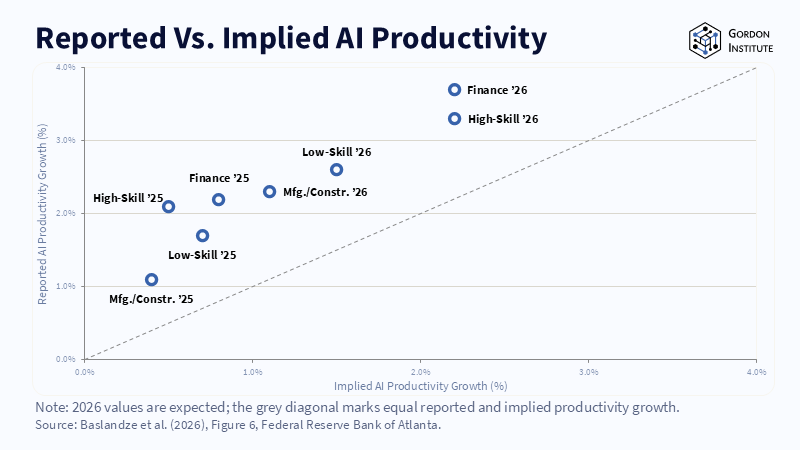
There is a defensible economic case for an AI dividend. Faster service delivery, improved quality and new activities can raise real output and taxable incomes. Evidence from customer support, professional writing and consulting demonstrates measurable gains in selected tasks. In customer support, less experienced workers can benefit substantially because the system disseminates practices developed by stronger colleagues. Such results show why the technology deserves attention, but they do not measure the gain across an entire occupation or national economy. Public revenue also depends on demand: if a firm produces the same volume with fewer paid hours, the payroll channel differs from a case in which it expands output and employment. Budget analysis therefore needs an account of scale, prices, wages and profits, not a direct translation of a task-level percentage into additional GDP or receipts.
Even an observed acceleration in national productivity cannot be attributed to AI without further analysis. Changes in staffing, capacity utilisation, investment, sector composition and the recovery from pandemic disruption may contribute. The productivity-paradox discussion and earlier analysis of US productivity performance emphasise the difficulty of connecting conspicuous time savings with aggregate returns. A firm may save drafting time while spending more on verification, integration or computing services. The fiscal implication is straightforward: revenue projections should not assign the entire recent productivity improvement to an emerging technology, or assume the strongest experimental effect is representative. The relevant estimate must fit the sectors covered, the adoption period and the complementary investments needed. Otherwise a budget embeds a technological attribution that the underlying evidence has not established.
The Tax Base Can Change Even When Output Rises
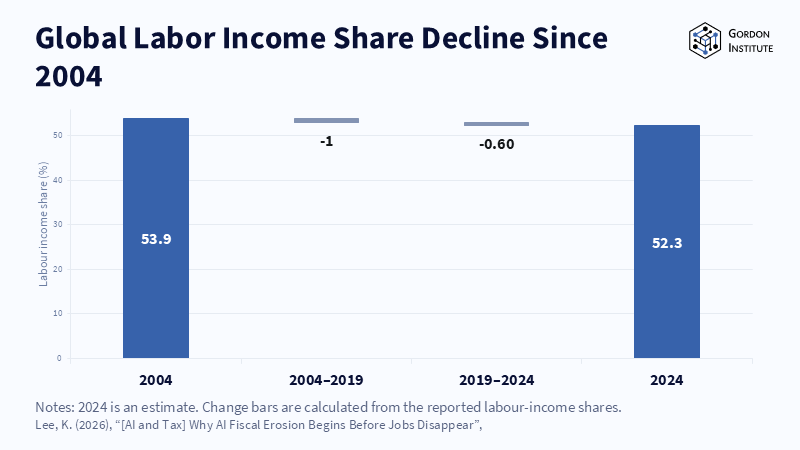
Professor Keith Lee’s SIAI working paper Labor Income, AI Rents and Fiscal Erosion separates productivity, distribution and fiscal transmission. Its argument is conditional: governments face pressure when gains move away from broadly taxed payroll toward concentrated, mobile or deferred income, not because AI necessarily destroys the tax base. A rise in domestic wages can produce different receipts from a rise in retained earnings, foreign supplier payments or unrealised capital gains. The budget must therefore examine the recipient and jurisdiction of income, alongside output. This makes the composition of growth financially important without predicting universal job displacement or assuming every profit escapes taxation.
Interest rates supply another uncertainty. Infrastructure investment in data centres, electricity systems and chips increases demand for financing; under some conditions that can raise the cost of capital. Higher expected growth may also influence yields, while changes in saving, policy and risk premia can push in other directions. The reported pressure in bond markets illustrates the relevance of rates, but does not identify a single cause or establish that AI necessarily raises government borrowing costs. Fiscal scenarios should nevertheless allow for a case in which part of the growth benefit is offset by more expensive debt service. The comparison must use consistent nominal growth and financing measures and distinguish temporary capital demand from the longer-run productive return. Growth forecasts that hold borrowing costs fixed can overstate the resulting improvement in debt dynamics.
Geography adds a further transmission issue. SIAI’s Data-Center Taxation and the Geography of AI Value treats the facility as one layer of a wider chain, rather than the location of all associated profit. A host region can incur energy and infrastructure demands while returns accrue through chips, cloud services, intellectual property or adopting firms elsewhere. SIAI’s Taxing AI Profits in Europe correspondingly argues against a narrow technology tax and examines instruments aimed at profits, rents and realised capital income. The financial issue is matching tax rights and collection to the income actually created, while preserving productive investment. A building, a model and an economic rent are not interchangeable tax bases.
Do Not Commit an Uncollected Dividend
The political risk arises when a forecast becomes permission to spend. An anticipated AI benefit may be invoked to justify tax reductions, expanded benefits, defence commitments or other programmes before receipts are observed. Some of those choices may be justified on independent grounds, but their affordability should be assessed independently too. If additional income eventually appears and is immediately absorbed by new commitments, higher productivity will not necessarily improve the debt position. The distinction between a growth opportunity and a fiscal saving must therefore survive the budget process. Governments should identify which decisions rely on the AI forecast, what happens if it is delayed and whether the expenditure can be adjusted without undermining essential services. A projected dividend is a scenario, not a revenue line already available for appropriation.
Practical safeguards include sensitivity analysis, transparent assumptions about the composition of taxable income and a clear separation between temporary receipts and recurrent expenditure. The tax response also requires choices about enforcement and allocation. The European SIAI paper distinguishes minimum-rate rules from assigning profit to markets: preventing a low effective tax rate does not by itself determine which jurisdiction receives the revenue. Those mechanisms can complement each other without producing an immediate or automatic solution. Domestic policy must likewise evaluate realised capital income, business profits and the burden on labour using coherent rules. This is financially more demanding than labelling a levy an AI tax, but it addresses the relevant bases. Preventive reform is possible; there is no need to assert that only a crisis can create political capacity, or to treat a debt crisis as inevitable.
AI can contribute to a sustainable budget where it expands taxable domestic income, supports efficient services and operates alongside credible tax and spending choices. It can also raise output while leaving public receipts relatively weak, depending on ownership, distribution, timing and jurisdiction. The Policy Forum’s conclusion is that financial planning should follow the realised income rather than the reputation of the technology. SIAI’s tax research helps identify the channels requiring measurement and reform, while the Science Forum’s discussion explains why generation of the surplus may itself be concentrated. Together they distinguish the creation of economic value from its public capture. Debt stabilisation remains a joint problem of growth, borrowing costs and fiscal institutions, and no productivity promise removes the need to specify how those elements will work.
This article presents analysis published by Gordon Institute’s Policy Forum. It does not constitute policy advice or an official policy position of Gordon Institute or any affiliated institution.
References
Lee, K. (2026a) ‘[AI and Tax] Labor Income, AI Rents and Fiscal Erosion’, SIAI Research Working Paper Series, 15 July.
Lee, K. (2026b) ‘[AI and Tax] Data-Center Taxation and the Geography of AI Value’, SIAI Research Working Paper Series, 15 July.
Lee, K. (2026c) ‘[AI and Tax] Taxing AI Profits in Europe’, SIAI Research Working Paper Series, 17 July.
Lee, K. (2026d) ‘[AI and Tax] Why AI Fiscal Erosion Begins Before Jobs Disappear’, The Economy, 1 August.
Lichtenberg, N. (2026) ‘A “Debt Spiral” Before a Fiscal Crisis: Interest on the National Debt Will Be Growing Faster than GDP in Just Five Years, Think Tank Warns’, Fortune, 9 March.
Rogoff, K.S. (2026) ‘The AI Growth Paradox’, Foreign Affairs, August.
Steil, B. and Harding, E. (2023) ‘For the First Time, the U.S. Is Spending More on Debt Interest than Defense’, Council on Foreign Relations.
The Chosun Ilbo (2026) ‘AI Boom Paradox: Rising Rates Pressure Tech Stocks’, The Chosun Ilbo, 19 August.
Similar Post
















