Europe’s Stablecoin Exposure - Cross-Border Tokens and Unequal Redemption Rights

Input
Modified
Stablecoin risk depends on redemption structure as well as market size
A globally fungible token can face different local exit rules
Cross-border safeguards must distinguish current rights from reform proposals

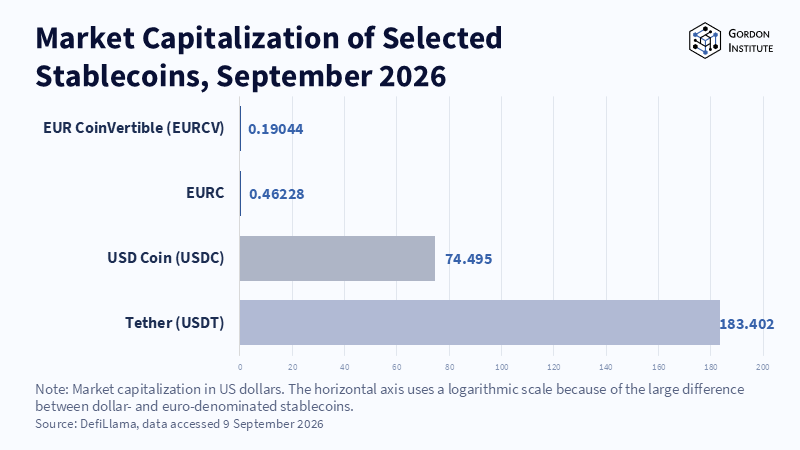
Europe’s stablecoin discussion is moving from market development to the allocation of risk. DefiLlama figures cited for late summer 2026 place euro-denominated stablecoins at roughly $912 million, compared with more than $316 billion in dollar-denominated products. Circle’s EURC accounted for around $462 million. These are dated market snapshots, not current quotations, but they establish the imbalance. At the same time, twenty-one financial institutions announced a stablecoin enterprise, targeting a first-half-2027 launch. That interest raises a policy question more important than the immediate size of the euro segment: who must redeem a token when several legally distinct issuers supply a globally interchangeable product? A local regulatory promise can become exposed to demand arising elsewhere. The issue is therefore the relationship between technological fungibility, legal rights and reserves, rather than whether a small European market is already systemically large.
Market Concentration Is Not the Same as New Demand
MiCA’s implementation changed the competitive setting. Tether discontinued EURT and did not pursue the licensing route described in the original account, objecting to the required reserve structure. Circle’s EURC subsequently increased its share, reported at approximately 41–50 percent of the euro-denominated market against 17 percent a year earlier. These developments are consistent with regulation influencing provider participation. They do not establish that every increase in market share occurred without growth in consumer demand. Share and absolute circulation are different quantities, and a provider can benefit from both competitor withdrawal and new adoption. Policy analysis should identify those contributions separately. Reserve and own-funds requirements also differ by token category and significance, so requirements discussed for particular issuers should not be treated as one undifferentiated rule for every stablecoin.
The dominance of dollar products remains striking. The dated figures discussed put USDT above $183 billion and USDC near $75 billion, each vastly larger than the euro segment. The cross-border question nevertheless concerns the issuance of dollar tokens in Europe as well as euro-denominated products. Circle’s USDC structure includes a US issuer and a French MiCA-authorised entity, with tokens circulating through the same smart-contract architecture. Units are technologically fungible even when legal obligations attach to different entities. A user inspecting an on-chain balance may therefore lack a simple marker identifying its original issuing jurisdiction. The policy challenge is how redemption responsibilities and reserve support apply to that fungible stock. Currency denomination, the customer’s location and the issuer’s regulatory home must remain distinct parts of the analysis.
Bank Participation Makes the Design Question More Urgent
The announced consortium includes institutions from North America, Europe, East Asia, the Middle East and Africa. European participants include Santander, BBVA, Deutsche Bank, Commerzbank, Crédit Agricole, Lloyds, UBS and Rabobank, alongside US firms including Bank of America, Citi and Goldman Sachs. Its proposed formation during the second half of 2026 and market launch in the first half of 2027 build on an exploratory announcement by ten banks in October 2025. Such participation demonstrates institutional interest, not a completed operating arrangement or a measured level of demand. The venture’s legal entities, reserve management and redemption procedures determine its eventual risk profile. Those details should be evaluated before the scale of its participants is converted into an assumption that the product will be safe, large or economically successful.
The stated initial focus is dollar-denominated issuance, with the euro a priority in a later expansion to other G7 currencies. The announcement refers to compliance with the US GENIUS framework and MiCA where applicable. This places coordination between regimes on the design agenda, but does not prove that the venture will reproduce Circle’s exact multi-issuer structure. A consortium can organise responsibility in several ways. Policymakers therefore need to examine the final arrangements rather than infer them from the list of member banks. The important question is whether a holder can choose among legally separate redemption channels for an otherwise interchangeable token, and how each channel is funded. Cross-border participation makes that question more likely to matter; it does not answer it.
Unequal Exit Rights Can Concentrate Pressure on One Issuer
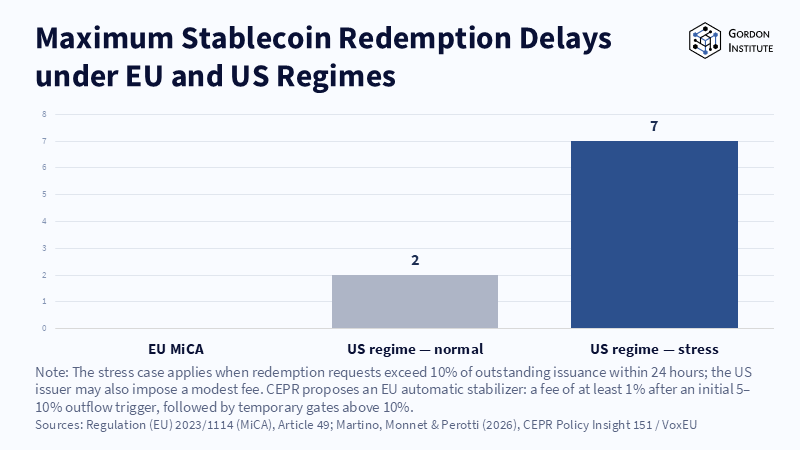
The risk discussed by Martino, Monnet and Perotti arises when holders can route redemptions toward the fastest, cheapest or most legally dependable jurisdiction. MiCA provides strong par-redemption protections for the relevant European products. The emerging US arrangements examined in their analysis allow more flexibility, including delays or charges under specified stress conditions. The particular two-business-day and potential seven-calendar-day periods described in the underlying article belong to the regime and proposed-rule comparison presented by that analysis; they should not be treated here as an unconditional rule applicable to every US token. What matters for the mechanism is an asymmetry in accessible exit terms. Technological equivalence can allow holders to seek the stronger promise even when the pressure originated in another market.
If such redirection is legally and operationally available, reserves sized for a local issuer may face claims arising from a much larger worldwide circulation. The token’s fungibility obscures the boundary that would otherwise separate the two balance sheets. Europe may then become an attractive redemption channel during stress in dollar funding or crypto markets outside its control. That is a risk scenario, not proof that every international holder presently has unrestricted access to every European redemption facility. Eligibility procedures, legal claims and reserve-transfer arrangements matter. The policy concern is that strong consumer protections can create an incentive for concentrated outflows when attached to one node of a shared global product. Improving the credibility of that node does not remove the mismatch if holders can still choose it as their preferred exit.
Automatic Safeguards Are a Reform Proposal, Not Existing Permission
The legal treatment of multinational issuance has been contested. ECRI’s 2025 analysis describes different emphases between the ECB’s prudential and sovereignty concerns and the Commission’s narrower interpretation of the framework. Legal research identifies parallel and consortium arrangements that may be compatible with MiCA, while the stress allocation of redemption obligations remains a separate issue. The automatic-stabiliser proposal seeks to address that allocation through rules set in advance. Its attraction is predictability: an issuer and its holders would know how exceptional outflows alter the redemption process. Its difficulty is that changing the promise can affect consumer protection and confidence. The existence of a proposed safeguard should never be presented as authority for an issuer to disregard the redemption rights currently required.
The proposal describes an initial fee, potentially at least 1 percent, when outflows cross a threshold of roughly 5–10 percent of the European issuer’s circulation, followed by a temporary suspension at more extreme levels. Those values are suggested calibration choices, not established legal limits or a validated optimum. Encoding triggers in contracts and operating systems would reduce discretion, reflecting the authors’ reading of money-market-fund experience in 2020. They also propose common supervision and an extraordinary ECB power when predetermined measures are insufficient. The design could reduce incentives to rush toward one redemption node, but thresholds can create their own incentives to exit before activation. A serious evaluation must test that possibility, the definition of the reference stock and how rules behave when reserves or obligations move between jurisdictions.
Coordination Must Follow the Token’s Global Structure
Alternative measures discussed in the Commission’s May 2026 consultation include eligibility restrictions, additional liquidity buffers and more frequent reserve reporting. Each addresses part of the problem. Eligibility can be difficult to preserve if an ineligible holder sells fungible units to an eligible intermediary. Buffers increase the ability to meet outflows but do not necessarily alter the incentive to choose the European channel. Reporting improves visibility without supplying liquidity. Cross-border reserve transfers can help if they remain available under stress; an agreement that depends on another authority releasing scarce liquidity may be least reliable when most needed. These are reasons to examine the operating details, not to dismiss every coordination instrument. A combination can be effective even where no single measure fully resolves the asymmetry.
Precommitted safeguards attempt to reduce reliance on emergency cooperation, but they also change the quality of the redemption promise. Aligning European terms with more flexible foreign arrangements may weaken a feature that regulation was intended to protect. Conversely, maintaining stronger local rights without matching global reserve support can expose those rights to pressure the issuer cannot absorb. The trade-off should be explicit. Supervisors need to determine which entity owes what, which holders can claim it, how reserves move and what happens when another jurisdiction intervenes. Reform may involve stronger coordination, clearer segregation, changed eligibility or carefully designed stress rules. It is premature to assume that every global token must adopt one particular fee-and-suspension scheme, just as it is unsafe to assume fungibility has no prudential consequence.
The small euro-denominated market offers an opportunity to address design questions before they become more expensive, but it is not the complete measure of European exposure. An EU issuer participating in a much larger dollar token can face risks disproportionate to euro-token circulation. The announced banking venture makes that distinction more timely without establishing its final structure. Gordon Institute’s Policy Forum therefore frames the issue as coherent cross-border responsibility: a token that operates as one product technologically cannot be evaluated only as separate local promises. The credibility of European protection depends on the resources and arrangements supporting it under stress. Regulators should make those arrangements clear, distinguish proposed reforms from current obligations and evaluate safeguards against the incentives they create for holders.
This article presents analysis published by Gordon Institute’s Policy Forum. It does not constitute legal, investment or policy advice, or an official position of any affiliated institution.
References
Arnal, J. (2025) Multi-Issuance Stablecoins and MiCA's First Real Credibility Test. ECRI In-Depth Analysis, Centre for European Policy Studies, Brussels.
Banco Santander (2026) Group of Leading International Financial Institutions to Establish Stablecoin Enterprise. Press release, 1 September.
DefiLlama (2026) Stablecoin Market Capitalisation Data.
Martino, E.D., Monnet, E. and Perotti, E. (2026a) 'Automatic stabilisers for multi-country issuance stablecoins', VoxEU Column, Centre for Economic Policy Research, 7 September.
Martino, E.D., Monnet, E. and Perotti, E. (2026b) Stablecoins Without Borders: Stablecoin Multi-Country Issuance and Dollar-Run Risks in Europe. CEPR Policy Insight No. 151, Centre for Economic Policy Research, London.
Portes, R. (2025) 'Multi-issuer stablecoins: a threat to financial stability', VoxEU Column, Centre for Economic Policy Research, 27 October.
Regulation (EU) 2023/1114 of the European Parliament and of the Council of 31 May 2023 on Markets in Crypto-Assets (MiCA). Official Journal of the European Union.
The Economy Editorial Board (2026) 'How dollar stablecoins are reshaping Asia's financial hubs', The Economy, 23 August.
Zetzsche, D.A. (2025) 'Third-country multi-issuer stablecoins', ERA Forum: Scripta Iuris Europaei.
Similar Post
















