AI’s Labor Market Shift Eludes Unemployment Figures, Emerges First in Denmark’s Youth Hiring

Input
Modified
Denmark’s AI adjustment is visible in recruitment before aggregate employment
Small adopters and younger graduates show the largest relative shortfalls
Monthly records reveal differences that broad exposure measures can conceal

Denmark offers an unusually detailed view of labour-market adjustment to AI because its employer and employee records can be examined monthly. The share of firms reporting AI use increased from 15 percent in 2023 to 59 percent in 2026, largely through generative tools for text and code, without a clear corresponding change in aggregate employment or unemployment attributable to the technology. Below those totals, however, adopters followed a different trajectory. Firms first reporting use in 2023 were around 9 percent below their earlier employment path by September 2025 relative to the comparison group. The distinction is between slower expansion and an absolute collapse in employment. A firm can continue growing while appointing fewer people than its previous pattern suggested, and a national total can remain stable while the route into particular occupations becomes narrower.
The pattern matters for education and employment policy because the missing appointments are not distributed evenly. Smaller firms, highly exposed occupations and young graduates account for much of the shortfall described in the analysis. Existing workers can retain their positions while employers reduce the intake through which a new cohort acquires income and experience. This is compatible with task-based frameworks that distinguish substitution from complementarity, but compatibility is not proof that a model explains every observed change. The Danish evidence is strongest as a detailed account of where adjustment appears and how it differs by firm size. Its policy value lies in making a recruitment problem observable before it becomes conspicuous in unemployment statistics, while retaining caution about adoption decisions that were not assigned randomly.
Monthly Administrative Records Reveal a Relative Shortfall
Danmarks Nationalbank’s researchers linked the official business IT-use survey to payroll-based employer and employee registers. The survey covers private non-financial firms with at least ten employees, which defines the population to which the results most directly apply. Denmark continued asking about AI in 2022 when the European survey omitted those questions, providing an additional observation before the 2023 adoption cohort. Researchers compared firms with non-users in the same three-digit industry and evaluated employment relative to each firm’s projected trend, estimated using 2020 and 2021. They reserved 2022 as an out-of-sample check rather than using it to construct that trend. Future adopters and comparison firms moved similarly in that check year. The design creates a more informative comparison than a simple before-and-after total, though it still depends on the suitability of the trend and comparison group.
For 2023 adopters, the relative shortfall widened from about 6 percent at the end of 2024 to 9 percent by September 2025. The source also reports a comparable path for firms first adopting in 2024, with a later estimate near 7.5 percent below trend. Those later-cutoff results should be distinguished from the September endpoint used for the initial comparison rather than treated as observations available over an identical window. Repetition across cohorts strengthens the interpretation that adoption timing is relevant, but does not eliminate selection. Firms can make technology and staffing decisions together, and a prior intention to slow hiring can influence adoption. Subsequent AI use among comparison firms may also narrow the contrast. The results therefore support a relative employment association with a plausible adjustment mechanism, rather than an unqualified estimate of jobs causally destroyed by AI.
Young Graduates and Smaller Employers Face Different Pressures
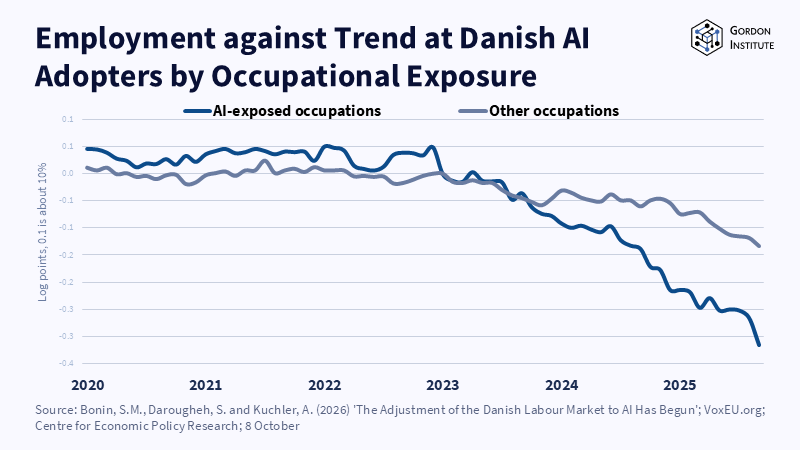
The occupational comparison places highly exposed work further below its prior trajectory. In the reported end-2025 estimates, top-quartile occupations in the Felten, Raj and Seamans measure were around 27 percent below trend, against approximately 12 percent for other occupations. These are relative differences within the study’s comparisons, not national unemployment rates or the fraction of every occupation eliminated. The concentration among workers under thirty and university graduates is particularly important because they often enter through activities that can now be supported or partly automated. The analysis identifies recruitment as a central channel: fewer recent hires coexist with longer retention among incumbents. A graduate can consequently encounter a reduced number of opportunities without an employer taking an explicit decision to dismiss younger workers already on its payroll.
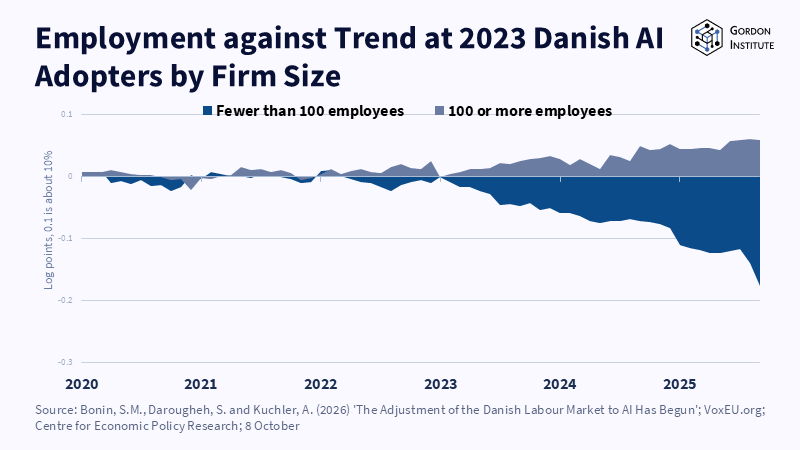
Firm size creates another division. Among adopters with fewer than one hundred full-time employees, the reported shortfall was around 16 percent by the later endpoint, whereas larger adopters showed a small, statistically insignificant increase. Rapidly expanding small adopters performed much like comparable non-users, placing the weaker outcomes nearer the middle and lower portions of the growth distribution rather than attributing them to a few extreme failures. The authors identify pre-existing leverage as a possible explanation: a small firm funding implementation has less room to add employees while returns are still uncertain. That mechanism is plausible, but the association does not establish that every missing appointment financed an AI investment. For policy, it suggests examining credit conditions and complementary investment alongside the technical characteristics of the work.
National Statistics and Exposure Scores Have Important Limits
Denmark’s flexicurity arrangements combine relatively flexible employment adjustment with income protection and active labour-market policies. A reduction in recruitment can therefore occur without the institutional obstacles associated with changing existing employment contracts, although that possibility is not unique to Denmark. International mobility further affects interpretation. The common Nordic labour market enables Danes to seek work in neighbouring countries; people who relocate may leave the relevant domestic register population. The study does not establish how much such movement explains the aggregate picture. Sector composition matters too. IT and other exposed industries were already experiencing broader changes, and many firms in those sectors reduced employment without belonging to the initial AI-adopter group. These considerations caution against assigning the whole sectoral slowdown to one technology.
The measures of technology use are also coarse. A positive survey response can cover occasional use of a drafting assistant or extensive redesign of production, while an occupation-level exposure score combines tasks that face very different pressures. SIAI’s discussion illustrates the problem through medical secretaries and secondary-school teachers: their AIOE scores are close, but the substitutable portions of their work differ substantially. Estimates generated by different models can also classify very different shares of occupations as highly exposed. Frequency of the outcome data is equally consequential. Using annual accounting information in the Danish exercise yields confidence intervals around minus 8 to plus 5 percent, too broad for the same conclusion. Monthly registers improve visibility without resolving every ambiguity about what adoption means or which tasks are affected.
Task-Based Frameworks Help Interpret the Pattern
SIAI’s discussion of Liminal Capital’s analysis separates the two employment margins that a single exposure score can obscure. In that framework, employment-weighted US work is classified as 32 percent substitutable, 15 percent complementary and 53 percent relatively unaffected by the language-model capabilities assessed. The reported employment gradients are 3.3 percentage points per year slower for substitutable work and 3.3 points faster for complementary work than the benchmark. These are study-specific classifications and associations, not fixed laws of the labour market. Their usefulness is that opposing pressures can coexist inside an occupation and disappear in a total. The accompanying decline in hiring among 22–25-year-olds in the most substitutable quartile provides a channel consistent with Denmark’s findings, without implying the US and Danish estimates share the same population or scale.
A second SIAI framework applies three filters: technical feasibility, the cost of integration and control, and demand for the resulting product. A task can be feasible to automate without being economical to delegate, and an economical process need not expand employment if demand does not grow. This helps reconcile the Danish studies examining different outcomes. Humlum and Vestergaard’s survey-linked analysis found no significant wage or hours effect in the exposed occupations studied, with reported time savings of only 2.8 percent. Stanford’s payroll work separately documents weaker employment among young entrants in highly exposed US occupations. Neither finding is contradicted by stable earnings among incumbent Danish workers. The relevant populations and margins differ: income conditional on having a job is not the same outcome as access to a new position.
Policy Must Protect the Route Through Which Expertise Develops
SIAI’s capability-building model offers one explanation for the small-firm result. Training, specialist recruitment and outsourcing all impose transition costs before their benefits arrive. In its hypothetical twenty-person service-centre comparison, no alternative exceeded the existing workflow over the first twelve months. This is a scenario result rather than a measured return from Danish firms, but it makes the financing constraint explicit. A highly leveraged employer may respond through postponed recruitment while it pays for implementation. Eurostat’s contrasting ICT figures reinforce the uneven capacity: only 6.23 percent of small firms recruited or attempted to recruit specialists, against 51.87 percent of large firms, while staff training was provided by 17.21 percent and 72.62 percent respectively. Those measures concern broader ICT activity, yet show why a uniform adoption policy may fit firms poorly.
The alternative explanation is that interest rates and the post-pandemic cycle account for weaker junior hiring. The 2022 rate environment must remain part of the analysis. Denmark’s pre-adoption check and the similar pattern in a subsequent adoption cohort make a single common shock an incomplete explanation, but do not rule out cohort-specific selection or other changes occurring with adoption. Earlier-period placebo tests in the task-based literature offer additional support, not conclusive identification. US resume and vacancy research similarly reports a 7.7 percent decline in junior employment at adopters over six quarters without a comparable senior change. Taken together, these studies justify monitoring the entry pipeline closely while avoiding the claim that each design proves an identical causal effect. Good policy needs evidence about mechanism and uncertainty as well as the direction of the association.
The narrow scale of the first Danish cohort explains why detailed records matter. Small 2023 adopters employ less than 2 percent of the country’s workers, so even a 16 percent relative shortfall amounts to only a few tenths of a percentage point of total employment spread over time. A broad national indicator may have little power to detect it. As adoption becomes common, the binary user/non-user distinction becomes less useful too. Gordon Institute’s Policy Forum therefore identifies a specific monitoring agenda: recruitment and departures by age, firm size, leverage, occupation and task, alongside intensity of use. The objective is to detect whether entry opportunities are disappearing, being redesigned or moving elsewhere. Stable totals should not obscure that question, because a smaller intake today can become a weaker stock of experienced judgment tomorrow.
The views expressed in this Policy Forum article are those of the author(s) and do not necessarily reflect the official position of Gordon Institute or its affiliates. This article does not constitute policy advice.
References
Bonin, Simone Maria, Darougheh, Saman and Kuchler, Andreas (2026) AI Adoption and Firm Size: Employment Effects in Monthly Administrative Data. Danmarks Nationalbank Working Paper No. 223. Copenhagen: Danmarks Nationalbank.
Brynjolfsson, Erik, Chandar, Bharat and Chen, Ruyu (2026) Canaries in the Coal Mine? Six Facts about the Recent Employment Effects of Artificial Intelligence. Revised August 2026. Stanford, CA: Stanford Digital Economy Lab.
Eurostat (2025) ICT Specialists: Statistics on Hard-to-Fill Vacancies in Enterprises. Statistics Explained. Luxembourg: Eurostat.
Felten, Edward, Raj, Manav and Seamans, Robert (2023) ‘Occupational Heterogeneity in Exposure to Generative AI’, AEA Papers and Proceedings, 113, pp. 282-287.
Hosseini Maasoum, Seyed Mahdi and Lichtinger, Guy (2025) Generative AI as Seniority-Biased Technological Change: Evidence from U.S. Résumé and Job Posting Data. SSRN Working Paper 5425555.
Humlum, Anders and Vestergaard, Emilie (2026) Still Waters, Rapid Currents: Early Labor Market Transformation under Generative AI. NBER Working Paper No. 33777, revised March 2026. Cambridge, MA: National Bureau of Economic Research.
Lee, Keith (2026a) AI Adoption and the Changing Value of Human Work. SIAI Working Paper. Schindellegi: Swiss Institute of Artificial Intelligence.
Lee, Keith (2026b) How Firms Build AI Workforce Capability. SIAI Working Paper. Schindellegi: Swiss Institute of Artificial Intelligence.
Swiss Institute of Artificial Intelligence (2026) ‘Artificial Intelligence and the Job Market: Jobs Created and Lost at Once’, Executive AI Brief, 7 October. Schindellegi: Swiss Institute of Artificial Intelligence.
Verschuere, Benjamin and Cameron, Angus (2026) Hiding in the Mean. SSRN Working Paper 7195359.
Similar Post
















