Europe’s Inflation Shock Began Before the Gas Ran Short

Input
Modified
Uncertainty about future gas supply can raise prices before deliveries fall
Energy costs propagate broadly through production and household expectations
Reliable supply arrangements complement rather than replace monetary policy

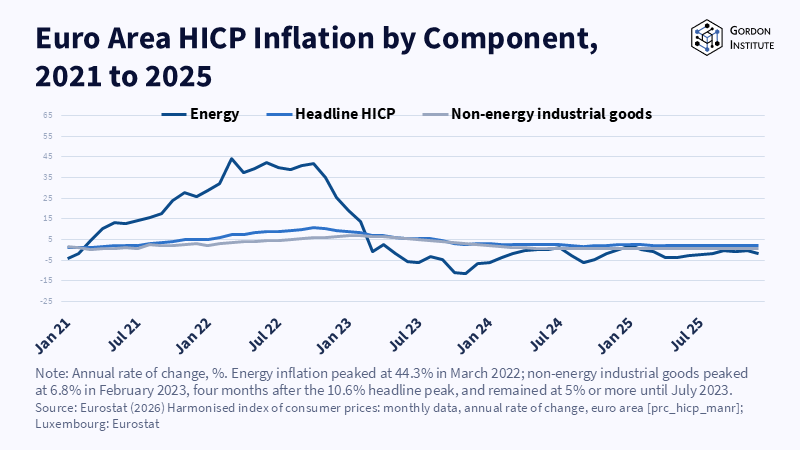
Europe’s 2022 energy crisis demonstrates why the inflationary effect of a supply disruption cannot be inferred from the missing quantity alone. Euro-area annual inflation reached 10.6 percent in October, with energy contributing 4.44 percentage points and its prices 41.5 percent above the previous year. Output proved more resilient than the most adverse early scenarios, helped by replacement gas, storage and adjustment. That resilience does not mean the disruption was inexpensive. Buyers faced uncertainty about subsequent deliveries and competed for resources to protect themselves against future scarcity. The resulting prices affected household budgets and production costs even when current supply remained available. For policy, the distinction is between restoring today’s flow and establishing confidence in tomorrow’s supply. The latter can shape precautionary demand, contracts and inflation well before an actual shortage appears.
Separate Current Disruption from Future-Supply News
A higher gas price can reflect several different disturbances. A cold spell raises heating demand; a pipeline failure reduces current supply; an announcement can change expectations about later deliveries without changing the volume arriving that day. Those cases require different interpretations even if the immediate price increase is identical. The research by Colombo and Toni uses temperature deviations and event-linked movements in futures to distinguish demand from supply-related developments, selecting events not attributed to broader macroeconomic news. Identification through such events rests on assumptions about what information changed and how prices reflect it. Its contribution is to move beyond reading the price alone. Energy policy needs to know whether the constraint is physical availability, expected reliability or demand pressure before deciding what intervention is likely to help.
The distinction within supply is especially useful. Pipeline shutdowns and failures identify current-flow disruptions, while security-of-supply news changes the expected availability of future gas. Near-term prices and longer-dated contracts help differentiate their timing. The analysis finds demand relatively less responsive to price than supply in the markets examined. That makes substantial price movement possible with a comparatively limited change in traded quantities: users cannot immediately stop heating buildings or substitute an industrial process. Stable volumes therefore do not imply an absent supply concern. Nor does every futures movement establish a future physical shortage. It can reflect precautionary behaviour, financing and changing expectations. The policy task is to connect price and quantity evidence with the event that generated the uncertainty.
Fear of Later Scarcity Can Have a More Persistent Price Effect
The study normalises the two supply shocks to an initial 10 percent increase in the real gas price, allowing their subsequent effects to be compared. A realised flow disruption briefly reduces industrial production and has relatively limited estimated consumer-price pass-through, around a 0.1 percent increase in the price level. Security-of-supply news produces a more persistent response: the pass-through coefficient rises toward 5 percent after a year, corresponding to approximately a 0.5 percent price-level effect for that normalisation. These coefficients should not be confused with a 5 percent rise in overall inflation. Increased inventories and volatility alongside limited immediate quantity change are consistent with precautionary behaviour. Kilian and Murphy’s earlier oil research provides a related mechanism in which expectations of future scarcity increase current inventory demand and prices.
The US comparison highlights the role of exposure. Domestic gas production reduces dependence on imported supply, although it does not make the economy immune to price movements or regional constraints. The analysis finds limited consumer-price effects from current-flow shocks in both markets, but a stronger and more persistent European response to news about future availability. Replacing Russian pipeline gas with LNG also changed Europe’s relationship with the international market. Access became tied more closely to competition for cargoes and infrastructure used to receive them. That shift helps explain why current deliveries could be maintained while uncertainty remained costly. The result is not a universal European multiplier; it is evidence that import dependence and market structure affect how a supply concern reaches domestic prices.
Production networks transmit the cost beyond the fuel itself. A manufacturer paying more for process heat may increase the price of an intermediate product, passing pressure to businesses further along the chain. New York Fed research discussed in the source links supply factors more strongly to producer prices and then to consumer-goods prices than to services. Limited short-run substitution amplifies the effect because a factory cannot immediately redesign its energy requirement. The timing also matters: purchasing contracts, inventories and firms’ pricing decisions can delay the response. A headline energy increase can consequently fade before all indirect goods-price effects have worked through. This is why core inflation is not insulated simply because it excludes direct fuel prices, and why a policy diagnosis needs the structure of production as well as the consumer basket.
Aggregate Resilience Can Conceal Expensive Industrial Adjustment
Germany’s experience shows how a modest expenditure share can coexist with substantial dependence. Before the crisis, gas-import spending was about 0.8 percent of gross national expenditure, against 0.5 percent for the euro area. Those ratios describe the purchase value, not the economic importance of gas to processes unable to substitute quickly. Reduced use can indicate efficiency or fuel switching, but can also indicate lost production and investment. Evaluating an adjustment by the volume saved alone risks treating industrial contraction as a success. The relevant comparison includes output, expenditure, productive investment and the distribution of costs across households and firms. A successful emergency response can prevent a more severe disruption while still impose a meaningful burden that aggregate resilience does not capture.
The research’s combined supply measure associates German adjustment with lower gas use, weaker expenditure and investment, and industrial production persistently below its baseline. Euro-area effects are generally milder or shorter-lived, illustrating uneven exposure. The environmental consequences are also conditional. A current-flow interruption can encourage switching toward coal or oil, increasing short-run emissions, whereas persistent supply-security concerns can support longer-run investment or reductions in fossil-fuel use. Lower emissions may also reflect reduced activity rather than improved technology. The observed responses therefore cannot establish that an inflationary shock is inherently a clean-energy transition. Policy needs to distinguish productive substitution, involuntary contraction and durable investment, because each has different implications for competitiveness, welfare and future resilience.
Different Inputs Produce Different Inflation Footprints
Edelberg’s review of 88 papers organises eight types of supply shock, six transmission channels and several amplifying conditions. Supply-chain disruption, productivity shocks and pandemic effects appear frequently, but the number of studies is not a ranking of future economic importance. The framework’s value lies in connecting an initial constraint with the mechanisms that spread it. Production costs recur widely; inventory, network dependence, limited substitution and expectations can alter scale and persistence. A shock reaching several channels at once may have a different outcome from one confined to a narrow input. This provides a way to compare energy with critical materials without assuming every shortage operates like the gas crisis. The classification is an analytical guide, not a set of fixed coefficients.
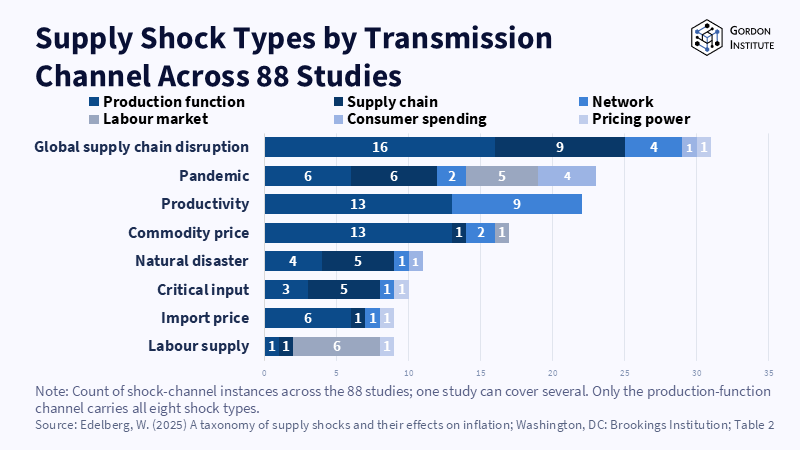
Gas combines broad industrial use with household price visibility. Fuel and heating bills can influence expectations directly, while the input cost spreads through manufacturing. Rare earths are different: small quantities can be indispensable to magnets and specialised equipment, producing severe effects in specific industries when substitutes are unavailable. The April 2025 Chinese controls discussed in the source illustrate that vulnerability. Yet those materials do not have a widely observed retail price comparable to gasoline or electricity. Their direct contribution to a broad consumer index may consequently be less visible. That does not make them economically less important in every scenario. A critical-input blockage can halt production, and its network effects can expand. The relevant distinction is between an input’s strategic importance and the breadth of its measured inflation footprint.
Table 1: Supply-Shock Types, Transmission Mechanisms and Inflation Effects
| Type of disruption | Typical example | Main transmission channels | Key amplifiers | Extent and duration of impact on inflation |
|---|---|---|---|---|
| Prices of commodities, in particular energy | Natural gas in Europe in 2022 | Cost of production, network of inputs and outputs, labour market | Low substitution, wage rigidity, price visibility that moves expectations | Very broad, in almost all industries, persistent when expectations become unanchored |
| Critical inputs | Semiconductors in 2021, rare earths in 2025 | Production costs, supply chain, pricing power | Zero short-term substitution, lean inventory, switching costs | Narrow but deep, with production interruptions in specific industries |
| Global supply chain | Freight rates and delivery delays 2020 to 2022 | Production costs, supply chain, network | Diffusion on the network, low stocks, expectations | Wide on goods through producer prices, less on services |
| Productivity | A sharp drop in input efficiency | Production costs, network | Capacity limits, market power, monetary policy that tolerates higher inflation | Wide, proportional to the size and duration of the drop |
| Import prices | U.S. tariffs on Chinese products | Production costs, chain reorganization, pricing power | Lack of domestic substitutes, higher margins for domestic competitors | Moderate and unequal between import and domestic companies |
| Labour supply | Reduced willingness to work during the pandemic | Labour market | Skills specialization, wage rigidity, expectations | Concentrated across industries, persistent through wages |
| Natural disasters | Tohoku earthquake in 2011 | Supply chain, production costs | Specialized suppliers, low inventory, hoarding | Initially local, then diffuse, often as shortages instead of price increases |
| Pandemic | COVID-19 | All channels at once | Limited factor mobility, little economic slack, expectations | Very broad, although precautionary savings can soften it |
The table retains that comparison at the level of mechanisms. Energy can simultaneously affect production costs, consumer budgets and expectations, while a critical-material disruption may be narrow in origin but deep within the affected production network. Other categories combine channels differently. None should be interpreted as a guarantee about duration or a universal ordering of damage. In Europe’s gas case, uncertainty adds precautionary demand to the direct input-cost mechanism. A threatened future shortage can therefore matter before the present flow fails. A rare-earth shortage may appear first as an inability to complete output rather than a large household price rise. Policy should address each form of harm directly instead of using the inflation index as the sole test of importance.
Credible Supply Is Part of Inflation Resilience
The case for looking through an energy-price rise depends on persistence and wider transmission. The comparatively limited estimated effect of a current-flow shock supports caution about responding mechanically to a temporary headline movement. The longer effect of supply-security news argues against assuming all energy pressure reverses quickly. Europe’s October 2022 core rate of 5 percent illustrates the broader inflation context, without proving that gas alone caused it. Bernanke and Blanchard emphasise the restraining role of anchored expectations, while Guerrieri and colleagues show how some supply shocks can lead to a larger demand contraction when households cannot smooth spending. These findings reinforce a conditional response. Central banks must assess expectations, indirect costs and demand together; the distinction between flows and news informs that assessment but does not determine the interest-rate decision by itself.
Energy policy can reduce uncertainty by making future supply more credible. Diversified sources, suitable storage, dependable infrastructure and clear information about contingency arrangements affect the perceived risk of later scarcity. Private precautionary storage is a rational response and should not simply be suppressed; policy should examine whether its incentives and access arrangements support resilience or intensify a bottleneck. The new energy shock discussed in the 2026 account makes the issue relevant beyond the Russian pipeline episode. Europe has changed its supply mix but remains exposed to global energy markets. A smaller dependence on one supplier does not remove dependence on shipping routes, cargo availability or receiving capacity. The objective is a credible system that functions under stress, rather than reassurance unsupported by operational arrangements.
The 2022 inflation figures reflect a combination of disrupted flows, expectations, precautionary behaviour and pass-through, not proof that fear alone caused the price surge. Replacement supply helped keep the economy operating without restoring the earlier cost structure. Whether the response to the later shock is less expensive depends on the infrastructure, alternatives and confidence built in the meantime. Germany’s adjustment warns that small gas-import expenditure shares can conceal much larger productive constraints. Gordon Institute’s Policy Forum therefore treats future-supply credibility as a complement to monetary policy and industrial adjustment. It can reduce a source of precautionary pressure, but cannot guarantee stable prices or substitute for actual capacity. Reliable supply, transparent plans and careful distinction between price and quantity effects provide a stronger policy foundation than assuming every shortage has the same inflationary consequence.
The views expressed in this Policy Forum article are those of the author(s) and do not necessarily reflect the official position of Gordon Institute or its affiliates. This article does not constitute policy advice.
References
Alessandri, P. and Gazzani, A. (2023) ‘The impact of gas supply shocks in Europe’, VoxEU.org, 25 July.
Beaudry, P., Hou, C. and Portier, F. (2025) ‘The dominant role of expectations and broad-based supply shocks in driving inflation’, NBER Macroeconomics Annual, 39(1), pp. 235-276.
Bernanke, B. and Blanchard, O. (2025) ‘What caused the US pandemic-era inflation?’, American Economic Journal: Macroeconomics, 17(3), pp. 1-35.
Colombo, D. and Toni, F. (2025) ‘Gas prices and the macroeconomy’, SSRN Working Paper 5237587.
Edelberg, W. (2025) A taxonomy of supply shocks and their effects on inflation. Washington, DC: Brookings Institution.
Emiliozzi, S., Ferriani, F. and Gazzani, A. (2024) ‘The European energy crisis and the consequences for the global natural gas market’, VoxEU.org, 11 January.
European Commission (2026) Spring 2026 Economic Forecast: slowdown in growth as energy shock drives up inflation. Brussels: European Commission.
Eurostat (2022) ‘Annual inflation up to 10.6% in the euro area’, Euro indicators 130/2022, 17 November. Luxembourg: Eurostat.
Eurostat (2026) Harmonised index of consumer prices: monthly data, annual rate of change [prc_hicp_manr]. Luxembourg: Eurostat.
Kilian, L. and Murphy, D.P. (2014) ‘The role of inventories and speculative trading in the global market for crude oil’, Journal of Applied Econometrics, 29(3), pp. 454-478.
Ministry of Commerce of the People’s Republic of China and General Administration of Customs (2025) Announcement No. 18 of 2025 on the implementation of export control on certain medium and heavy rare earth related items. Beijing: Ministry of Commerce.
Similar Post
















