The Institutional Cost of Fiscal Dominance

Input
Modified
Fiscal dominance undermines monetary authority well beyond initial fiscal shocks.
Fiscal policy decisions create persistent credibility challenges for central banks.
Long-term sovereign debt yields reflect institutional trust deficits, not only economic fundamentals.

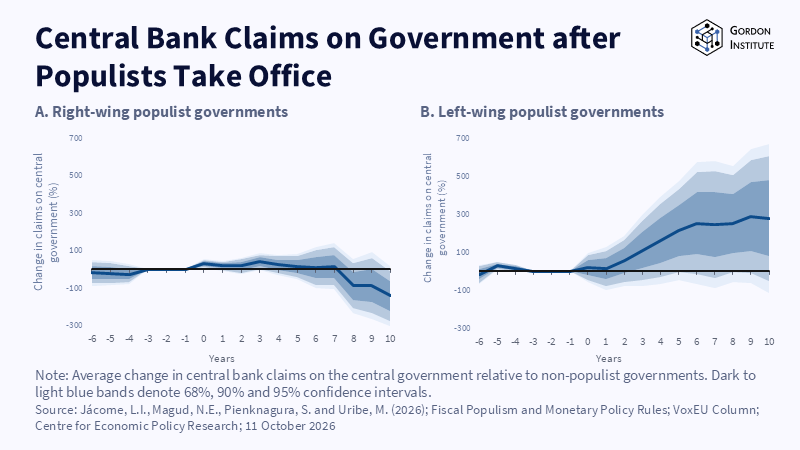
Empirical analyses reveal that a decade following the tenure of left-wing populist administrations, central banks maintain significantly elevated credit exposure to their governments. This credit exposure is approximately 300 percent higher than in economies that experienced governance by non-populist administrations, indicating a durable institutional effect beyond political cycles.This evidence stems from a comprehensive study published in September 2026 as a National Bureau of Economic Research working paper by economists affiliated with the International Monetary Fund, Georgetown University, and Columbia University. The research encompasses data from both advanced and emerging market economies spanning 1960 to 2008. While the concept that monetary financing of deficits fuels inflation is well-established in monetary economics, the study’s rigorous, data-driven documentation confirms that fiscal expansion under populist regimes leads to enduring impairment of monetary credibility. Crucially, the findings underscore that central banks operate under persistent market skepticism long after these governments exit power, illustrating institutional hysteresis. This enduring distrust helps explain market dynamics observed since spring 2025, wherein investors price U.S. Treasury securities and the dollar itself with diminished safe-haven appeal, reflecting a lasting institutional legacy rather than solely contemporaneous fiscal or monetary developments.
I. Institutional Persistence of Fiscal Dominance
In their study, Jácome, Magud, Pienknagura, and Uribe integrate the populist government dataset created by Funke, Schularick, and Trebesch with detailed IMF statistics on central bank lending to governments. Notably, the classification of populism is based strictly on leaders’ rhetoric rather than on the actual policy outcomes, intentionally imposing a rigorous test given that populist discourse does not inevitably translate into fiscal expansions. When aggregating all populist administrations without ideological distinction, the data show a 150 percent increase in central bank credit to governments over a decade, albeit lacking statistical significance. However, disaggregating by ideology reveals a stark contrast: right-wing populist governments demonstrate only a modest, statistically insignificant rise in such credit, whereas left-wing populist administrations exhibit a substantial and statistically robust cumulative increase near 300 percent. This aligns with left-wing populists’ historical preference for expansive fiscal policies focused on domestic demand stimulation and redistribution efforts, which exert substantial and lasting pressure on monetary authorities to accommodate deficit financing. These findings emphasize that the institutional consequences of fiscal dominance are profoundly shaped by the specific fiscal behaviors associated with ideological orientations.
Building on the observed surge in central bank lending to governments under fiscal populist regimes, the analysis demonstrates a clear and lasting inflationary impact. Specifically, a one standard deviation increase in central bank credit correlates with a peak inflation increase of roughly one percentage point within a two-year horizon. Moreover, the resulting elevation in the general price level persists, registering about 4 percent higher a decade later compared to countries without such fiscal dominance episodes. These empirical results substantiate the theoretical insights of Sargent and Wallace's (1981) “unpleasant monetarist arithmetic,” which argues that when fiscal authorities maintain unsustainable spending without adjustment, central banks ultimately face pressure to monetize deficits, thereby compromising inflation control regardless of their initial intentions or policy stances.
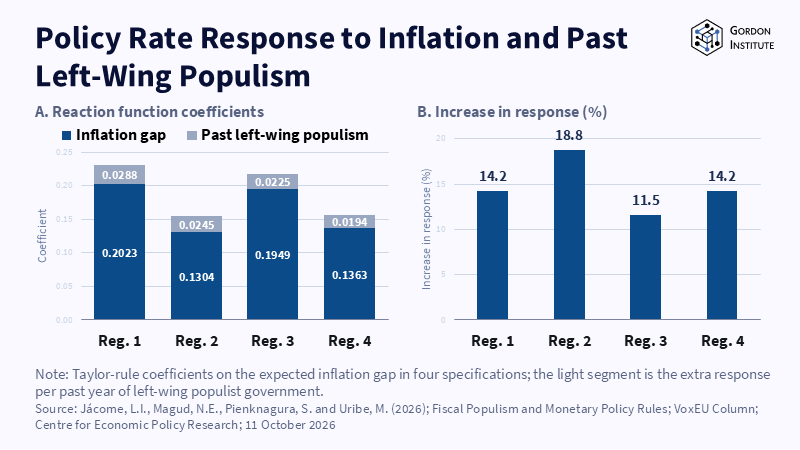
Analysis of 32 inflation-targeting countries through 2023 indicates that those with prior left-wing populist regimes continue to face a structurally higher monetary policy response to inflation deviations. Central banks in these countries tighten policy more aggressively as inflation expectations diverge from targets, and this heightened responsiveness does not diminish simply with time or changes in political leadership. This persistence reflects institutional hysteresis: markets factor in the ongoing risk that fiscal dominance—a scenario where fiscal policy constraints compromise monetary independence—may reemerge. Such perceptions endure beyond the tenure of the original fiscal expansionists and shape expectation formation, imposing continuous costs on economic agents. Consequently, households and firms bear higher borrowing costs due to this long-lasting credibility damage, even if they were not directly exposed to the initial fiscal shocks.
II. Fiscal and Monetary Policy Interactions: Institutional Challenges
In early 2025, financial markets initially interpreted the new administration's fiscal policy announcements with cautious optimism. The Department of Government Efficiency, led by Elon Musk, outlined ambitious plans aiming for up to $2 trillion in federal spending cuts—later revised to $1 trillion—which bond investors viewed as a tentative signal of fiscal responsibility. This anticipation of improved fiscal discipline nurtured expectations that monetary policy independence might be preserved through sustainable public finances. However, confidence quickly eroded following the imposition of the so-called "Liberation Day" tariffs in April, which sparked a rare simultaneous decline in equities, U.S. Treasury securities, and the U.S. dollar—disconcerting developments given the dollar's traditional role as a global safe haven. Concurrently, public pressure mounted against Federal Reserve Chair Jerome Powell for not lowering interest rates, intensifying institutional strains on monetary autonomy. By late May 2025, Musk publicly resigned, criticizing the "One Big Beautiful Bill Act" for enlarging fiscal deficits and undermining austerity efforts. The Congressional Budget Office’s preliminary assessments projected that the bill’s tax provisions alone would add approximately $3.8 trillion to deficits over the ensuing decade. These episodes highlight how initial commitments to fiscal consolidation can unravel, exacerbating institutional vulnerabilities through rising fiscal dominance risks that challenge central bank credibility and long-term monetary policy effectiveness.
The impact of these policy dynamics is evident in financial markets. For example, the U.S. dollar index dropped significantly in the first half of 2025—the worst performance since the 1970s—while bond yields rose despite tightening monetary policy. Commentary from experts highlights these developments as indicative of a hidden fiscal tax on purchasing power, resulting from devaluation and monetary accommodation driven by fiscal imperatives rather than standard cyclical factors. The politicization of monetary policy further amplifies these institutional risks by eroding central bank credibility in the eyes of market participants. Scholarly critique has further questioned policy initiatives aimed at deliberately weakening currency values, underscoring misconceptions about the relationship between the dollar's international role and domestic economic structure. Notably, dissenters argue that such strategies distract from underlying institutional fiscal-monetary challenges that ultimately threaten long-term monetary stability and investor trust. Moreover, attempts to influence Federal Reserve composition and decisions have raised concerns about legal and operational independence. The appointment of officials favoring rate cuts despite inflationary pressures exemplifies the tensions between elected authorities and monetary institutions, revealing gaps in the institutional safeguard framework against fiscal dominance emerging from political interference.
From an institutional perspective, the fiscal trajectory involving a $2 trillion deficit presents two distinct policy pathways to mitigate the escalating debt servicing burden. The first entails politically challenging measures—reducing public expenditure and increasing tax revenues—that credibly signal fiscal discipline by imposing genuine economic costs. Such adjustment mechanisms tend to restore market confidence by demonstrating commitment to sustainable public finances. Alternatively, fiscal relief can be sought via monetary accommodation, whereby the central bank maintains nominal interest rates artificially below prevailing inflation, effectively reducing real debt service by eroding the currency's value. This latter approach compromises monetary credibility and blurs the demarcation between fiscal and monetary responsibilities. In the case examined, explicit calls from the executive branch to lower the federal funds rate from approximately 3.6 percent to 1 percent—levels inconsistent with contemporaneous inflation rates—were interpreted by markets as signaling a return to predictable fiscal dominance dynamics. These developments represent an implicit institutional breach of the unwritten social contract between debtor and creditor, undermining trust in independent monetary governance and fiscal sustainability. This dynamic acts as an implicit fiscal burden or 'hidden tax' embedded within the economy's institutional framework, imposed on economic agents through depreciated currency values and elevated financing costs. Consequently, households face diminished real purchasing power, while firms encounter increased borrowing costs, reflecting an intergenerational transfer of economic burdens stemming from institutional erosion rather than immediate policy decisions.
III. The Long-Term Economic Cost of Fiscal Dominance
Fiscal pressures have intensified considerably since early 2026, exacerbated by military expenditures linked to the unapproved war initiated against Iran on February 28, 2026. This conflict has imposed significant strain on public finances, complicating fiscal sustainability and extending fiscal dominance risks that constrain monetary policy autonomy. By August 2026, official estimates from the Congressional Budget Office indicated that war-related spending had surpassed $38 billion. Further, in June, the executive branch sought an additional $87.6 billion in appropriations to sustain ongoing operations, underscoring the accumulation of discretionary fiscal pressures that compound systemic budget imbalances. Simultaneously, the defense budget proposal for fiscal year 2027 reached approximately $1.5 trillion—nearly a 50 percent increase relative to prior allocations. The fiscal year concluding September 30, 2026, closed with a deficit nearing $2 trillion, $218 billion above the prior year. This was driven primarily by a $386 billion rise in expenditures against only a $169 billion increment in revenues. Notably, interest payments on public debt grew by $115 billion (11 percent), a reflection of the rising costs associated with a gross debt exceeding $40 trillion. These mounting interest obligations now surpass defense spending levels, illustrating the enduring institutional and economic costs imposed by fiscal dominance and the consequential erosion of monetary policy effectiveness.
The bond market's response offered a definitive signal of persistent institutional concerns. During the U.S. Treasury auction on August 13, 2026, $25 billion worth of thirty-year bonds were issued at a yield of 5.216 percent, marking the highest yield for this maturity since 2001. By September 29, the thirty-year yield further climbed to 5.62 percent, levels unseen since mid-2002, indicating heightened investor demands amid long-term monetary and fiscal credibility uncertainties. On October 7, during intraday trading, these thirty-year yields surged further to 5.70 percent,while ten-year Treasury yields broke above 5.3 percent. Notably, this considerable increase in long-term yields unfolded even as the Federal Reserve actively tightened monetary policy. Under Chair Kevin Warsh—appointed in May 2026 by the prior administration—the Fed implemented a 25 basis point rate hike on September 16, raising the policy range to 3.75–4.00 percent in a unanimous vote. Importantly, the Fed anticipated Personal Consumption Expenditures (PCE) inflation to remain elevated at 3.7 percent by year-end. The market’s upward repricing of long-term yields thus reflects enduring skepticism about the Fed’s institutional ability to sustain credibility amidst fiscal pressures. In contrast to these tightening moves, the president publicly urged a reduction of interest rates to 1 percent “and fast,” amplifying the institutional tension between fiscal objectives and monetary policy independence.
In financial markets characterized by robust central bank credibility, an increase in policy interest rates typically dampens long-term bond yields by signaling a credible commitment to reanchoring inflation expectations around the central bank's target. However, contrary to this conventional dynamic, recent observations indicate that at the close of September, the yield on two-year Treasury securities stood near 4.92 percent, while the thirty-year bond yield was nearly 70 basis points higher, illustrating an unexpected steepening of the yield curve. This divergence reflects investor skepticism regarding the durability of current monetary tightening efforts and doubts about the institution's capacity to sustain disciplined policy over extended horizons beyond the immediate tightening cycle. Consequently, market participants demand an increasing term premium to compensate for the heightened risk of fiscal pressures undermining monetary policy independence over the long term. Inflation has persistently exceeded the 2 percent target for more than half a decade, a point explicitly acknowledged by Chair Warsh during his September 16 press conference. The institutional signal sent to holders of bonds maturing in 2056 is that Federal Reserve independence is perceived as contingent on transient leadership figures rather than stable institutional frameworks. Furthermore, ongoing executive pressures advocating for low interest rates despite elevated inflation reinforce market concerns that fiscal dominance could reemerge, imposing enduring constraints on monetary policy and intergenerational economic stability.
IV. Institutional Hysteresis: Why Credibility Damage Outlasts Political Terms
A common counterargument is that institutional safeguards demonstrated resilience: the Federal Reserve, under Chair Kevin Warsh, proceeded with interest rate hikes amidst political pressures, and with the president’s term concluding in January 2029, one might anticipate the associated risk premia to subside thereafter. However, recent market data challenges this expectation. Following the September 16 rate increase, long-term Treasury yields continued to climb sharply—from 5.29 percent on September 22 to 5.70 percent two weeks later—highlighting that investor concerns target not the current leadership’s policy intentions but the structural robustness of the Federal Reserve as an institution against executive interference. This observation aligns with Jácome et al. (2026), who find that central banks with histories of fiscal dominance exhibit persistent elevated responsiveness to inflation deviations. Importantly, this enduring tightening reflects market skepticism that fiscal dominance may reoccur in the future, independent of current political cycles or length of inflation-targeting experience. In effect, institutional memory of compromised monetary credibility creates a hysteresis dynamic, whereby the cost of prior fiscal expansion persists and constrains monetary policy, extending economic burdens across administrations and generations.
A common critique of the empirical findings is their emphasis on left-wing populist governments, which at face value differ ideologically from recent U.S. administrations. However, the study’s classification hinges on the rhetoric of populism rather than strict political labels, underscoring that the key mechanism underlying institutional damage is behavioral fiscal expansion rather than partisan identity. Specifically, expansive fiscal policy characterized by substantial deficits compels monetary authorities to accommodate lower borrowing costs for the government, effectively transferring financing pressures onto the central bank. This dynamic creates institutional strains on monetary policy independence, irrespective of the political orientation of the ruling administration. Currently, the U.S. fiscal environment — marked by an approximately $2 trillion deficit at near-full employment, significant tax reductions estimated in the trillions by the Congressional Budget Office, unfunded military engagement, and explicit executive demands for federal funds rates near 1 percent amid inflation close to 3.7 percent — aligns with the fiscal dominance profile linked to protracted institutional costs. Alternative narratives suggesting that the dollar's decline reflects mere cyclical correction, an argument partially endorsed by Kenneth Rogoff, fail to reconcile why currency depreciation coincides with rising Treasury yields. This confluence indicates a persistent erosion of monetary credibility embedded in institutional frameworks rather than simple market volatility or short-term adjustments.
From an institutional standpoint, the sustained elevation of the term premium on U.S. Treasury securities should be understood as a persistent structural characteristic reflecting enduring fiscal-monetary credibility challenges rather than a transient anomaly expected to resolve with upcoming electoral cycles. This institutional risk profile necessitates that investors incorporate currency risk hedging as a fundamental element in managing dollar-denominated portfolios. Meanwhile, the Federal Reserve faces an ongoing obligation to respond more stringently to any deviations in inflation expectations to uphold credibility, a policy stance that inevitably raises borrowing costs for households through mortgages, constrains business investment, and exerts upward pressure on unemployment. Importantly, these economic burdens are not confined to the incumbents responsible for past fiscal actions but extend to subsequent administrations and the broader economy. Treasury operations involving repurchases of longer-dated debt—such as buybacks of bonds maturing in 20 to 30 years—may alleviate immediate market pressures but ultimately delay addressing the root institutional deficit: a structurally unbalanced fiscal budget that impedes the restoration of durable monetary independence and market trust.
V. Policy Frameworks to Prevent and Repair Institutional Fiscal Dominance
The study’s most compelling institutional insight extends beyond the headline 300 percent surge in central bank credit to left-wing populist administrations: it is the persistent erosion of monetary credibility that transcends political cycles and leadership changes. Central banks in these economies continue to bear the economic burden of lost trust well after fiscal populist governments have departed. Although the United States has yet to resort to explicit deficit monetization, the Federal Reserve under Chair Warsh has demonstrated that institutional resistance is still possible. However, market pricing reflects more than current policymakers’ intentions, incorporating skepticism about future fiscal-monetary dynamics. For example, the $25 billion issuance of thirty-year Treasury bonds in August 2026, priced at a yield of 5.216 percent, implies an annual interest cost to the Treasury of approximately $1.3 billion through 2056, totaling around $39 billion. This sum is comparable to the Congressional Budget Office’s estimated costs of the Iran war through August. Crucially, this represents just a single auction among many scheduled through early 2029, underscoring how past fiscal choices impose substantial and durable economic constraints on successor governments through increased debt servicing costs that reflect institutional credibility deficits.
The views expressed in this article are those of the author(s) and do not necessarily reflect the official position of Gordon Institute or its affiliates.
References
Associated Press (2026) ‘Iran war has cost the US more than $38 billion, budget office says’, Associated Press, 15 September.
Board of Governors of the Federal Reserve System (2026) Federal Reserve issues FOMC statement and Summary of Economic Projections. Press release, 16 September. Washington, DC: Board of Governors of the Federal Reserve System.
Business Insider (2025) ‘The dollar posted its worst first-half performance since Nixon was president’, Business Insider, 1 July.
Committee for a Responsible Federal Budget (2026) CBO Estimates $2.0 Trillion Deficit for First 11 Months of FY 2026. Press release, September. Washington, DC: Committee for a Responsible Federal Budget.
Congressional Budget Office (2026) Monthly Budget Review: September 2026. Washington, DC: Congressional Budget Office.
Funke, Manuel, Schularick, Moritz and Trebesch, Christoph (2023) ‘Populist leaders and the economy’, American Economic Review, 113(12), pp. 3249-3288.
Global News (2025) ‘Musk says Trump’s “big, beautiful” tax bill undermines his DOGE cuts’, Global News, 28 May.
Jácome, Luis I., Magud, Nicolas E., Pienknagura, Samuel and Uribe, Martín (2026a) Fiscal Populism and Monetary Policy Rules. NBER Working Paper No. 35758. Cambridge, MA: National Bureau of Economic Research.
Jácome, Luis I., Magud, Nicolas E., Pienknagura, Samuel and Uribe, Martín (2026b) ‘Fiscal populism and monetary policy rules’, VoxEU Column, Centre for Economic Policy Research, 11 October.
Rogoff, Kenneth (2025) ‘Trump’s misguided plan to weaken the dollar’, Project Syndicate, 6 May.
Sargent, Thomas J. and Wallace, Neil (1981) ‘Some unpleasant monetarist arithmetic’, Federal Reserve Bank of Minneapolis Quarterly Review, 5(3), pp. 1-17.
Sedensky, Matt (2026) ‘The value of the U.S. dollar has weakened since Trump took office. Experts say that can be a “hidden tax”’, PBS News, 4 May.
U.S. Department of the Treasury (2026a) Treasury Auction Results: 30-Year Bond, 13 August. Washington, DC: U.S. Department of the Treasury.
U.S. Department of the Treasury (2026b) Daily Treasury Par Yield Curve Rates. Washington, DC: U.S. Department of the Treasury.
Adapted from Fiscal Populism and the Long Bill for U.S. Treasuries.
Similar Post
















