China Cannot Rebalance Toward Consumption Without Protecting Precarious Workers

Input
Modified
Flexible and migrant labour helped subsidise China’s production-led growth
Household consumption cannot deepen while income and social protection remain insecure
Labour reform, hukou reform and local fiscal capacity must be treated as one policy problem

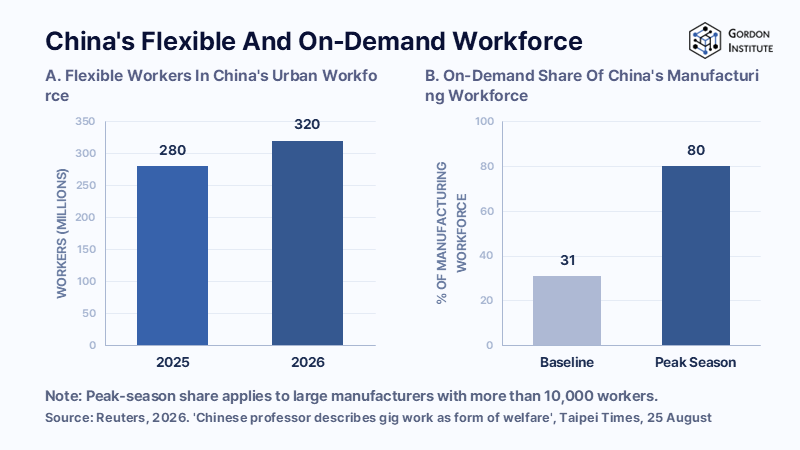
China’s effort to shift from investment and exports toward domestic consumption confronts a problem embedded in the success of its previous growth model. An estimated 320 million urban workers may lack permanent full-time employment in 2026, equivalent to roughly 44 per cent of the urban workforce. More than 300 million migrant workers have also supported manufacturing, construction and urban services while remaining only partially integrated into the welfare systems of the cities in which they work. These are not marginal groups waiting to be incorporated into an otherwise consumer-led economy. They are the households whose income security, access to services and expectations will determine whether such an economy can emerge.
The Labour Subsidy Behind Export-Led Growth
China’s industrial development rested partly on an institutional separation between the place where labour was used and the place where its social costs were recognised. The household registration, or hukou, system enabled workers registered in rural areas to spend years in cities without receiving the same access to education, housing, health care and social insurance as registered urban residents. Employers and urban economies benefited from their labour, while families and places of origin absorbed a substantial share of the cost of reproducing that workforce. The resulting transfer did not appear in export prices, but it functioned as a durable subsidy to manufacturing and construction.
Central authorities have gradually acknowledged this imbalance. Social insurance coverage began to expand during the 2000s, the 2010 Social Insurance Law created a broader framework and the July 2024 Party Plenum promised that basic public services would increasingly follow actual residence. In May 2026, the State Council directed local governments to extend education, housing support and social security to residents without urban hukou who had stable employment. The direction is consequential, but implementation depends on local governments whose land-related revenues and balance sheets are already under pressure. A central promise financed through uneven local capacity may therefore reproduce the very geographic inequality it is intended to reduce.
The political economy has also changed across generations. Younger migrant workers are generally better educated and less willing to accept the conditions their parents regarded as a temporary stage toward urban security. They seek predictable hours, access to schools for their children and employment that is not governed entirely by a platform algorithm or a “996” schedule of 9 a.m. to 9 p.m., six days a week. Earlier insecurity was sustained by the expectation of upward mobility. As that expectation weakens, precarious employment becomes not merely a labour-market category but a challenge to the implicit social bargain that accompanied rapid growth.
A Consumption Strategy Built on Insecure Income
The 15th Five-Year Plan is accompanied by a dedicated effort to expand consumption, reflecting recognition that the investment- and export-intensive model has reached important limits. Yet household consumption depends on more than the current wage. It reflects expectations about future employment, medical expenses, housing, education and retirement. Workers who cannot rely on continuous earnings or portable benefits have strong reasons to save defensively, even when policy offers temporary consumption incentives. In this setting, weak consumption is not primarily a failure of confidence that can be repaired through official messaging. It is a rational response to incomplete insurance.
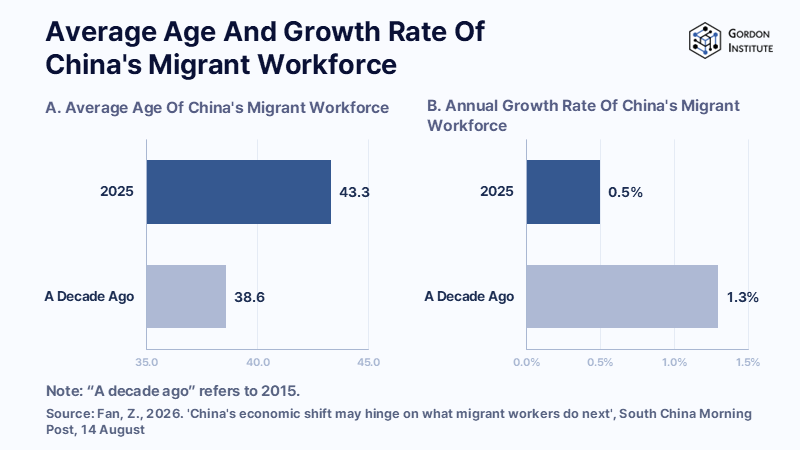
Demographic and sectoral shifts reinforce the constraint. The migrant workforce grew by only 0.5 per cent in 2025, compared with 1.3 per cent a decade earlier, while its average age rose from 38.6 to 43.3 years between 2015 and 2025. Construction lost millions of workers, manufacturing employed fewer migrant workers than a decade earlier and labour-intensive services absorbed people without necessarily delivering comparable productivity or wage growth. Automation may improve industrial output, but it also weakens the old mechanism through which export industries absorbed large numbers of workers. A strategy that raises production without strengthening household income can widen rather than resolve the gap between industrial capacity and domestic demand.
Platform Work Extends an Older Institutional Divide
Platform employment is often presented as a new consequence of digital technology, but in China it overlaps with the older structure of migrant labour. Delivery riders, ride-hailing drivers and online content workers frequently come from rural backgrounds and enter platform work because their access to protected urban occupations is limited. The algorithm did not create the hukou divide; it made that divide more measurable and more intensive by allocating tasks, setting prices and monitoring performance at a scale that conventional employers could not achieve. Flexibility can offer genuine value to some workers, but it should not be inferred from participation that workers prefer insecurity to stable employment.
Regulation has begun to respond. An April 2026 central policy document addressed services and management for workers in new forms of employment, and nationwide work-injury insurance followed a pilot that had already covered tens of millions. Major companies have also announced subsidies or broader benefits. These measures establish a foundation, but they do not yet provide standard contracts, transparent rules for algorithmic management, effective limits on working time or fully portable social insurance. Voluntary coverage can improve conditions at leading platforms while leaving the competitive baseline largely unchanged, particularly where smaller firms can undercut employers that internalise more of their labour costs.
The central policy tension is therefore between employment quantity and employment quality. Authorities may fear that stronger protections will raise labour costs and reduce the number of available jobs during a period of weak demand. That concern is real, especially for new graduates and workers leaving construction. But suppressing labour costs also suppresses the household income and security required for consumption-led growth. What appears to be a trade-off at the level of an individual employer may be a complementarity at the level of the national economy: social protection raises costs for firms while supporting the demand on which those firms increasingly depend.
Graduate Insecurity Broadens the Coalition for Reform
A record 12.7 million university students were expected to graduate in 2026, while measured unemployment among 16- to 24-year-olds outside education reached 17.9 per cent in July. This has extended precarious employment beyond the migrant workforce into an educated urban generation whose expectations were formed during decades of expansion. Graduates accepting delivery or ride-hailing work are not necessarily making an entrepreneurial choice; many are using platforms to bridge a labour market that does not produce enough positions matching their qualifications. The increase in the retirement age and external trade barriers add to the congestion by slowing turnover and limiting the capacity of export industries to absorb new entrants.
The popular language of tang ping, or “lying flat”, and bai lan, roughly allowing a situation to deteriorate, should be interpreted cautiously. These expressions do not constitute a uniform political movement, and they can easily be exaggerated when read from outside China. They nevertheless reveal a shift in expectations: the willingness to endure extreme competition declines when education, long hours and delayed consumption no longer appear to lead reliably to security. That shift matters for economic policy because consumption depends not only on resources but on confidence that participation in the system will be rewarded.
From Labour Regulation to Fiscal Redistribution
The debate over whether flexible work itself constitutes a form of welfare illustrates the risk of treating freedom of schedule as a substitute for social protection. Some genuinely value control over when and where they work, but flexibility has a different meaning when an algorithm determines access to income and when declining a task threatens future assignments. Policy should distinguish voluntary flexibility, supported by portable benefits and bargaining power, from insecurity imposed on workers with few alternatives. Without that distinction, the language of choice can legitimize a transfer of risk from firms and the state to households.
Durable reform requires coordination across labour law, hukou status and public finance. Municipalities cannot be expected to extend expensive services to mobile residents while central-local revenue arrangements remain unchanged. Nor can portable social insurance succeed if contributions are tied to conventional employment relationships that platform work routinely fragments. A credible rebalancing strategy would establish nationally portable minimum protection, increase central fiscal support for cities receiving migrant workers and gradually require platforms and labour intermediaries to contribute on comparable terms. Such reform should be phased to avoid abrupt employment losses, but gradualism needs enforceable milestones rather than indefinite voluntary commitments.
| Structural constraint | Consumption channel | Policy implication |
|---|---|---|
| Non-portable hukou-linked services | Households save for education, health and housing risks | Make core benefits follow residence and fund receiving cities |
| Irregular platform income | Uncertain cash flow discourages durable spending | Set contribution, contract and algorithmic-transparency standards |
| Weak local-government finances | Uneven implementation preserves geographic inequality | Increase central fiscal participation in nationally mandated benefits |
| Graduate underemployment | Education no longer produces expected income progression | Support labour mobility and demand for higher-productivity services |
| Automation in manufacturing | Output rises without equivalent household wage growth | Link industrial policy to worker transition and income protection |
The Household Balance Sheet Is the Test
China’s consumption transition will not be secured by asking households to spend more while leaving the distribution of risk substantially unchanged. The earlier model succeeded in part because families absorbed costs that employers and urban governments did not. Rebalancing requires some of those costs to move back onto firms and the public balance sheet, even if doing so narrows margins or requires new central transfers. This is not a concession peripheral to growth policy. It is the institutional price of changing the source of growth.
The 320 million people in flexible employment are often discussed as evidence of a changing labour market. They should instead be understood as the central constituency of China’s macroeconomic transition. If their incomes remain volatile, their benefits incomplete and their expectations weak, domestic consumption will struggle to replace external demand at the scale policymakers envisage. The decisive indicator will not be the number of consumption initiatives announced, but whether precarious workers become secure enough to spend without fearing that the next interruption of work will expose their family to costs they cannot meet.
References
Fan, Z. (2026) ‘China’s economic shift may hinge on what migrant workers do next’, South China Morning Post, 14 August.
Maulana, I. (2026) ‘China’s precarious underclass teeter on the edge’, East Asia Forum, 30 August.
Reuters (2026) ‘Chinese professor describes gig work as form of “welfare”’, Taipei Times, 25 August.
South China Morning Post (2025) ‘China braces for record 12.7 million graduates entering tight job market in 2026’, 21 November.
Similar Post
















