Japan's Outbound Travel Slump Is an Economic Policy Problem

Input
Modified
Japan’s inbound tourism boom conceals a persistent decline in outward mobility
The historical record points to purchasing power rather than cultural reluctance
Restoring mobility requires income, education and exchange-rate policy—not cheaper passports alone

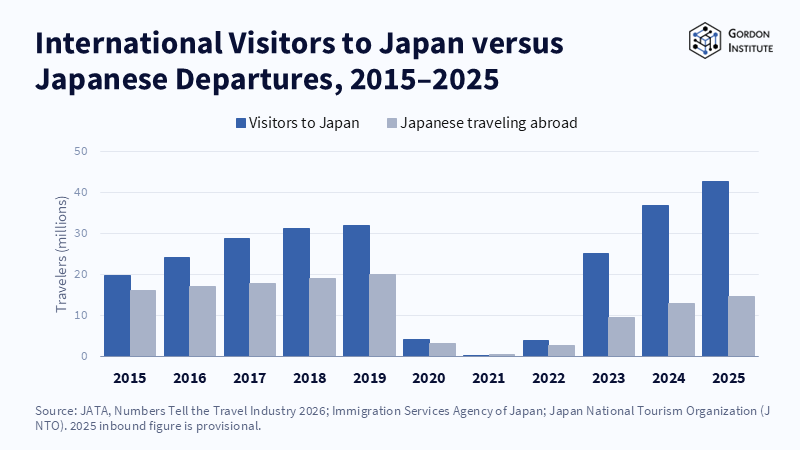
Japan’s tourism figures present an image of openness moving in only one direction. The country received a record 42.7 million visitors in 2025, 33.9 per cent more than in 2019, while only 14.7 million Japanese citizens travelled abroad. At the end of the year, 18.5 per cent of the population held a valid passport, still well below the pre-pandemic share. This divergence is often explained through culture: Japan is safe, varied and geographically distant from other destinations, while younger citizens are said to be less interested in the outside world. Such explanations overlook a simpler mechanism. Outbound travel rose dramatically when Japanese wages and the yen made it affordable, and it weakened as purchasing power stagnated.
One-Way Internationalisation
The imbalance extends beyond holidays. Japan hosted a record 408,069 international students by May 2025, exceeding a national target of 400,000, while 91,054 students from Japanese higher-education institutions studied abroad in fiscal year 2024. Roughly two-thirds of those outward experiences lasted less than one month. The government aims to raise the number of outgoing pupils and students to 500,000 by 2033, but current patterns suggest that Japanese institutions are internationalising more rapidly through the arrival of foreigners than through sustained overseas experience among their own students.
This asymmetry matters because mobility is a form of capability as well as consumption. Time abroad can build language proficiency, professional networks and familiarity with institutions that cannot be reproduced fully through short visits or classroom instruction. When fewer citizens travel, companies recruit from a narrower pool of people able to work across markets, while public debate about immigration and international competition is conducted by a population with less direct exposure to other societies. The result can become self-reinforcing: reduced mobility weakens the personal and institutional networks that would make future mobility easier.
The Strong-Yen Precedent
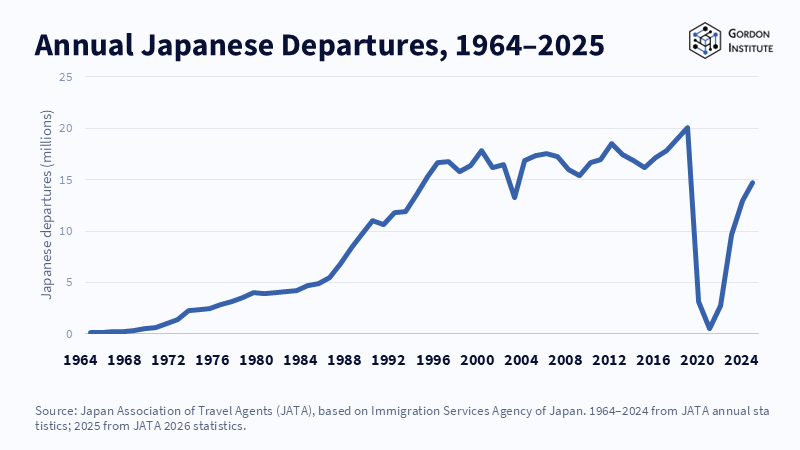
Japan’s own history challenges the claim that citizens are inherently reluctant to travel. After overseas travel was liberalised in 1964, only 128,000 citizens went abroad. Departures exceeded five million in 1986, reached ten million in 1990 and rose to 18.49 million in 2012 before peaking at 20.08 million in 2019. The acceleration after the mid-1980s coincided with the sharp appreciation that followed the Plaza Accord, when the yen moved from roughly 240 to 120 per US dollar within two years. Foreign accommodation, food and transport became dramatically cheaper in yen terms, converting overseas travel from an elite purchase into an attainable household activity.
The relationship does not establish that exchange rates alone determine travel, but it sets a demanding test for cultural explanations. Preferences did not need to change abruptly for departures to grow; the budget constraint changed. Comparable episodes in other Asian economies also show that rising income and stronger purchasing power generate outward tourism as households enter the middle class. Geography, language and risk perceptions influence destination choices, yet they operate within an affordability constraint. When that constraint tightens sufficiently, surveys may register lower intention even though the underlying interest remains.
Weak Purchasing Power, Not Weak Curiosity
The yen’s recent position is the reverse of the post-Plaza period. Its real effective exchange rate has remained near levels last seen in the early 1970s, magnifying the foreign-currency cost of travel for households whose earnings have shown little long-term growth. Japan’s hourly labour productivity was reported at US$60.10 in purchasing-power-parity terms in 2024, ranking 28th among 38 OECD members, while output per worker remained the lowest in the Group of Seven. Average wages measured on a purchasing-power basis were scarcely higher in 2022 than in 1991, even as the OECD average rose substantially.
Travel prices have moved in the other direction. A JTB survey estimated the average cost of an overseas trip at US$2,098, 6.2 per cent higher than a year earlier, as airfares, accommodation and currency conversion all became more expensive. Among respondents not planning to travel abroad, 33.6 per cent cited high costs, 26.4 per cent inadequate household finances and 24.4 per cent the weak yen. These categories are analytically distinct, but they describe a common constraint: foreign travel is absorbing a larger share of disposable income. A household may express the result as price anxiety, insufficient savings or exchange-rate concern without revealing three separate causes.
Younger travellers offer further evidence against a simple decline in curiosity. Women aged 20 to 29 recorded an outbound travel rate well above the national average in 2024, and surveys of 18- to 29-year-olds found strong interest alongside concerns about price, language, safety and the absence of prior experience. Those anxieties are important because mobility skills are cumulative. People who travelled with their families, studied abroad or learned how to manage unfamiliar transport and accommodation face a lower psychological and practical cost on later trips. A prolonged affordability shock can therefore become a behavioural shock in the next generation, even if it began with income rather than preference.
Why Lower Passport Fees Are Insufficient
Japan reduced the adult passport fee from 15,900 yen to 8,900 yen in July 2026 in an effort to revive outward mobility. The measure lowers an obvious administrative barrier and may be useful for first-time applicants, but the saving represents only a small fraction of the cost of an average trip. It cannot offset stagnant earnings, expensive flights or the accumulated uncertainty associated with a weak currency. A policy that subsidises entry into the travel market while leaving the recurring price unchanged is likely to increase passport ownership more than actual departures.
The same limitation applies to short educational exchanges. Institutions may increase participation counts through programmes lasting several days or weeks, but such visits do not necessarily deliver the language acquisition, institutional familiarity and independent living experience associated with a semester or year abroad. Students also face rigid academic calendars, credit-transfer uncertainty and graduate recruitment practices that penalise absence from the standard timetable. Financial support must therefore be paired with reforms that reduce the academic and career cost of prolonged mobility.
Outbound Mobility as Economic Infrastructure
Japan’s demand for internationally experienced workers is rising as its domestic population contracts and the foreign-resident population grows. Companies operating across supply chains need employees able to interpret different regulatory, commercial and professional cultures, not only communicate in English. Universities seeking international relevance need two-way exchange rather than an inbound model in which foreign students adapt to Japan while most domestic students remain inside the national system. Public policy should consequently treat outward mobility as an investment in human capital and institutional capacity, rather than a discretionary tourism objective.
Macroeconomic policy sets the outer boundary. A durable recovery in purchasing power ultimately depends on productivity and real-wage growth, while fiscal and monetary choices influence the currency through interest-rate expectations and debt sustainability. Japan’s high public debt makes rapid rate adjustment costly, and large investment programmes may support productivity only after long delays. Mobility policy cannot solve those macroeconomic constraints. It can, however, protect access during the adjustment through targeted grants for longer study abroad, support for lower-income first-time travellers, portable academic credit and recruitment practices that recognise rather than penalise international experience.
| Observed barrier | What it indicates | Policy response |
|---|---|---|
| Weak yen and higher foreign prices | Travel consumes more household income | Target support where mobility produces education or workforce benefits |
| Stagnant real wages | The constraint extends beyond tourism | Place productivity and wage growth at the centre of the diagnosis |
| Low passport ownership | An administrative and experiential barrier, not the full cost | Combine lower fees with first-trip and information support |
| Very short study-abroad periods | Participation targets may overstate substantive exposure | Fund longer stays and improve credit transfer |
| Rigid recruitment calendars | Students bear a career penalty for absence | Encourage flexible hiring and recognition of overseas experience |
Restoring the Capacity to Leave
The contrast between record inbound tourism and subdued Japanese departures is sometimes celebrated as proof of the country’s attractiveness. It should also be read as evidence of unequal purchasing power. Foreign visitors experience Japan as comparatively affordable, while Japanese households experience the same exchange rate as a tax on exposure to the world. The two outcomes are not contradictory; they are produced by the same relative-price movement.
Japan does not need to persuade an incurious population to become international. It needs to restore the practical capacity to travel, study and work abroad. The expansion that followed the mid-1980s shows how quickly behaviour can change when economic conditions permit it. Passport discounts may help at the margin, but a durable response must address income, institutional barriers and the long-term erosion of mobility experience. The relevant question is not why Japanese citizens have ceased to want the world. It is how public policy can prevent temporary weakness in purchasing power from becoming a permanent narrowing of national experience.
References
Benoza, K. (2023) ‘Why Japan has so many “never travelers”’, CNN, 19 February.
Chai, P. (2026) ‘Japan’s global exposure has a one-way ticket’, East Asia Forum, 31 August.
International Monetary Fund (2026) Japan: 2026 Article IV Consultation. IMF Country Report No. 26/075.
Japan Association of Travel Agents (2024) Trends in the Number of Overseas Travellers.
Japan National Tourism Organization (2026) Visitor Arrivals for December 2025.
Japan Productivity Center (2025) International Comparison of Labor Productivity 2025.
Japan Student Services Organization (2026) Results of the 2024 Survey of Japanese Students Studying Abroad and the 2025 International Student Survey.
JTB Corp. (2025) 2025 Travel Trend Outlook.
Ministry of Foreign Affairs of Japan (2026) Passport Statistics for 2025.
Organisation for Economic Co-operation and Development (2026) Average Annual Wages.
Similar Post
















