Meta's Teen Time Limit Is an Identity-Control Problem

Input
Modified
Meta’s settlement changes product design but still measures accounts rather than people
Early evidence shows restrictions displace usage into borrowed and fabricated identities
Platform risk will depend on enforceable controls, privacy costs and behavioural outcomes

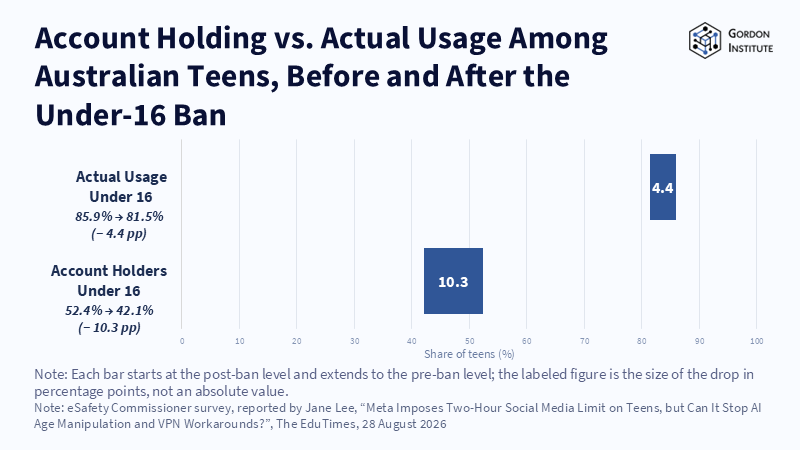
Meta’s agreement to limit teenage users to two hours a day appears, at first glance, to convert a disputed social problem into an operational rule. Yet the rule controls an account, while the underlying legal and reputational exposure concerns a person. Early evidence from Australia illustrates the difference. After restrictions on accounts held by children under 16 took effect, the proportion reporting an active account fell from 52.4 per cent to 42.1 per cent, but actual social-media use declined only from 85.9 per cent to 81.5 per cent. The EduTimes reporting on Meta’s settlement and its technological loopholes shows why product redesign alone cannot settle the liability question. If prohibited activity continues through another identity, device or platform, a company may demonstrate formal compliance without producing the behavioural outcome on which the settlement’s credibility depends.
The Settlement Converts Litigation Into Product Requirements
Under the reported settlement with 48 US states and other jurisdictions, Meta must limit users under 18 to two hours of daily access, block overnight access from midnight to 6 a.m. and suppress most notifications during school hours. Teen accounts remain private by default, reaction counts are hidden, unfamiliar adult contact is restricted and users may select a chronological rather than algorithmically personalised feed. Parents can approve the removal of restrictions. These measures address several design features cited in litigation concerning addictive engagement, and they give the company observable implementation tasks that can be audited more readily than a general obligation to make a platform safer.
The commercial structure is unusual because Meta’s payment and operating obligations are partly connected to the behaviour of competing platforms. If YouTube, TikTok and Snap accept comparable restrictions, Meta’s limit may fall to one hour and the overnight block may expand. The threshold therefore reflects negotiation and competitive alignment as much as clinical evidence. From a corporate-risk perspective, that matters: the company is not implementing a stable scientific standard but a contingent settlement architecture whose economics, user experience and enforcement burden can change when third parties act.
Account-Level Controls Invite Identity Substitution
A daily time limit is effective only if the platform can connect every relevant account to the same individual. A teenager can create multiple profiles, use an account registered to an older relative, move between Meta services and competing platforms or conceal location through a virtual private network. Australian research found that 15 per cent of 12- and 13-year-olds and 19 per cent of 14- and 15-year-olds were already using false accounts to bypass restrictions, while about 3 per cent used VPNs. These are predictable responses to a control that reduces access without reducing demand.
Age-estimation technology does not remove the problem cleanly. Tests of eight models using digitally modified faces found that images initially classified as minors could be reclassified as adults in as many as 83 per cent of cases. The SIAI analysis of recognition systems is relevant because generative tools lower the cost of adversarial modification at the same time that regulators expect platforms to improve verification. Stronger checks can also require more biometric or documentary data, increasing privacy, retention and breach risks. The platform is therefore balancing two liabilities: failing to identify minors and collecting excessive information from every user in order to do so.
Two Hours Is a Negotiated Metric, Not a Risk Model
The rule treats time as a proxy for harm, although two hours of passive algorithmic consumption is not equivalent to two hours of messaging, creative work, accessibility support or supervised research. The National Academies of Sciences, Engineering, and Medicine found insufficient evidence to conclude that social media causes population-wide changes in adolescent health, while recognising both risks for some users and benefits for others. A uniform time ceiling can be operationally simple, but simplicity should not be mistaken for precision. It records duration while ignoring content, purpose, vulnerability, time of day and the design features most plausibly associated with compulsive use.
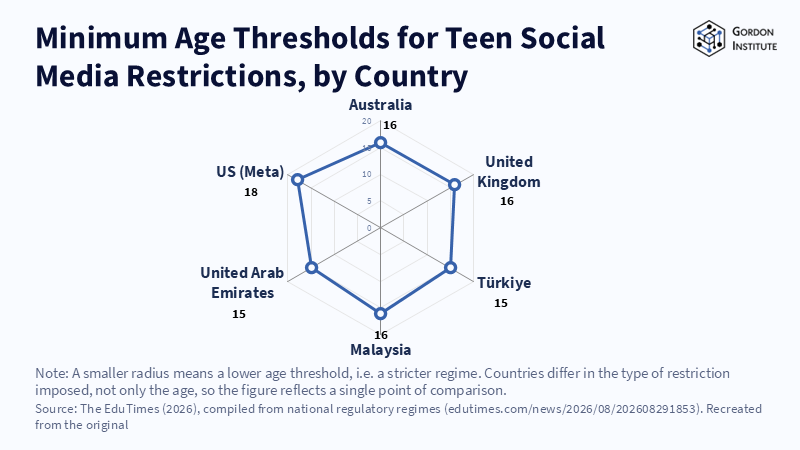
International variation reinforces this point. Australia prohibits accounts under 16, Türkiye uses a threshold of 15, Malaysia blocks new registrations under 16, the United Arab Emirates sets a minimum of 15, and the United Kingdom has considered a combination of age restrictions, overnight controls and design requirements. The differences do not prove that all restrictions are arbitrary, but they show that no common scientific boundary has yet translated into policy. Meta must therefore operate a global identity and product-control system across jurisdictions that define childhood, parental authority, privacy and acceptable platform design differently.
Displaced Usage Can Preserve or Increase Exposure
Formal reductions in teen accounts may improve reported compliance metrics while making behaviour less visible. A child using a parent’s account is now misclassified as an adult, weakening age-appropriate recommendations and parental reporting. A user driven to a smaller service may encounter weaker moderation. A teenager who relies on VPNs or fabricated images becomes practised in concealing activity from both the platform and the family. The control can therefore reduce the measured population while concentrating the remaining risk among identities the system no longer recognises correctly.
This distinction affects litigation reserves, regulatory dialogue and investor interpretation. A platform that reports millions of restricted or deleted accounts should also report changes in unique-person usage, attempted circumvention, migration between products and the error rates of age controls. Otherwise stakeholders may infer behavioural improvement from an administrative measure. The gap resembles familiar problems in financial compliance: a rule can reduce recorded transactions in one channel while moving the same activity to a less transparent channel. Control effectiveness depends on the residual behaviour, not the number of flags generated.
The economic consequences extend beyond lost engagement. Identity verification creates infrastructure and vendor costs, additional data attract cybersecurity obligations, false positives generate appeals and customer-service demand, and uneven enforcement can expose the company to discrimination or consumer-protection claims. Meanwhile, lower teen engagement affects advertising inventory and the long-term formation of user habits. Management therefore needs a unified view of legal settlement cost, revenue impact, verification expense, data risk and competitive migration rather than treating the limit as a narrow trust-and-safety feature.
A Better Control Architecture Measures Outcomes
A stronger operating model would combine proportionate identity assurance with behaviour-based safeguards. Low-risk activity could require minimal verification, while attempts to change age, open repeated accounts or evade device-level controls would trigger stepped-up review. Platforms could distinguish passive recommendation loops from direct communication and active creation, apply stronger friction to overnight use and repeated harmful-content exposure, and give families intelligible controls without forcing a new application for every feature. Independent testing should examine both false acceptance and false rejection across age, gender and demographic groups.
Governance should also separate model performance from policy effectiveness. A verification model can achieve a high classification score while the overall control fails because users borrow accounts, abandon appeals or migrate to another service. Product, legal, privacy and finance teams need a common control owner with authority to reconcile those measures and disclose trade-offs to the board. External evaluation should include the equity concerns identified in Brookings’ analysis of screen-time policies, because uniform restrictions can impose different burdens on users who rely on assistive tools, shared devices or online support. Red-team exercises should test the same technical loopholes that teenagers can obtain cheaply, rather than assuming misuse will resemble the company’s standard test data.
| Control layer | Management metric | Failure signal |
|---|---|---|
| Identity assurance | Unique-person coverage and age-error rates | Account closures rise while usage barely changes |
| Circumvention | Repeat profiles, borrowed identities and VPN indicators | Restricted users migrate beyond recognised teen accounts |
| Product design | Passive recommendation, overnight use and harmful-content exposure | Time falls without improvement in the targeted risk |
| Privacy | Data collected, retained and shared for verification | Safety controls create disproportionate biometric exposure |
| Competition | Cross-platform migration and equivalent safeguards | Activity moves to less supervised services |
The central board-level question is whether the company can demonstrate that the control changes teenage experience rather than the classification of teenage accounts. That requires baselines, independent evaluation and disclosure of unintended effects. It also requires the company to resist using a single headline metric as proof of safety when the settlement itself recognises multiple mechanisms: notification design, algorithmic feeds, overnight access, account privacy and adult contact.
Compliance Must Follow the User Across the System
Meta’s two-hour limit may still reduce harmful exposure for users who remain correctly identified and accept the restriction. The weakness lies in treating that population as the whole system. Australian evidence indicates that account ownership can fall much faster than actual use, while AI-enabled manipulation makes the boundary between a minor and an adult account increasingly contestable. A defensible control framework must recognise substitution and measure what happens after the apparent intervention succeeds.
For platform executives, investors and regulators, the lesson is straightforward: account compliance is an intermediate output, not the desired outcome. If users can multiply identities, borrow credentials or move elsewhere, the risk migrates rather than disappears. The organisations that manage this well will be those that combine privacy-preserving identity assurance with differentiated product controls and transparent behavioural evaluation. Those that rely on the visible decline in teen accounts may discover that they have improved the dashboard while losing sight of the user.
References
eSafety Commissioner (2026) Survey Evidence on Under-16 Social-Media Accounts and Usage in Australia.
Lee, J. (2026) ‘Meta Imposes Two-Hour Social Media Limit on Teens, but Can It Stop AI Age Manipulation and VPN Workarounds?’, The EduTimes, 28 August.
National Academies of Sciences, Engineering, and Medicine (2023) Social Media and Adolescent Health. Washington, DC: National Academies Press.
Parshall, A. (2026) ‘The Backlash Against Screens in Schools Is Escalating’, Scientific American, 31 August.
Stewart, A. (2026) ‘The Equity Blind Spot in School Screen-Time Policies’, Brookings, 3 September.
This article is provided for general informational purposes and does not constitute legal, investment or business advice.
Similar Post
















