Scaling AI Tutoring Without Weakening the Public Purpose of Education

Input
Modified
Adaptive systems can widen access to consistent instructional support
Evidence of higher test performance does not yet establish transferable understanding
Public adoption requires independent evaluation, qualified teachers and safeguards against unequal experimentation

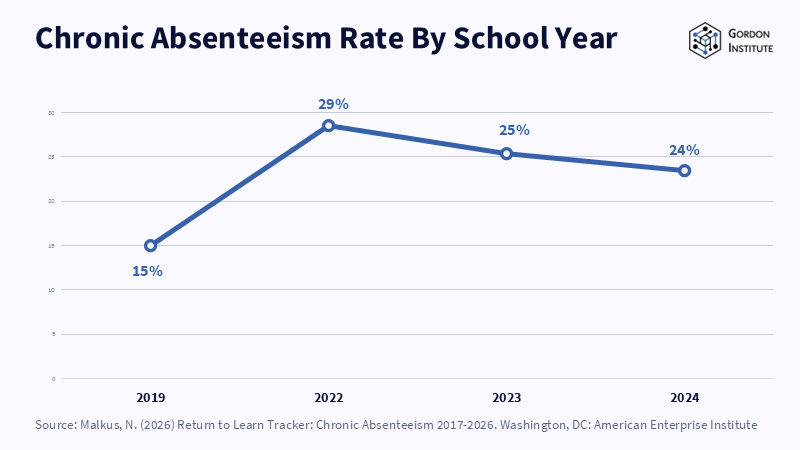
The rapid expansion of AI-assisted schooling has turned a technical question about educational software into a public-policy question about what societies expect schools to provide. Alpha School, a United States network that assigns much of its morning instruction to adaptive learning systems, has announced an ambition to reach as many as one billion children. Its growth comes at a moment when chronic absenteeism remains elevated and achievement in reading and mathematics has weakened across many American schools. Under those conditions, a system that promises individualized instruction, rapid feedback and consistent delivery is understandably attractive. Yet the relevant policy test is not whether students can produce better answers within the system that taught them. It is whether they acquire knowledge that remains usable when the question, setting or social context changes.
From a Private-School Model to a Public Experiment
Alpha School describes its learning process through an analogy with autonomous vehicles: a system improves by observing many cases and learning to respond to unusual events. In education, the unusual events are the misconceptions, gaps and different rates of progress that distinguish one child from another. The analogy captures a real advantage of adaptive systems. A classroom teacher responsible for many pupils cannot continuously recalibrate the pace and sequence of every exercise, whereas software can record each response and adjust the next task immediately. This capacity could be particularly valuable where schools struggle to recruit experienced teachers or where pupils have accumulated large learning gaps.
The analogy also reveals why scale should not be confused with validation. Traffic environments contain difficult edge cases, but educational understanding is not simply a larger catalogue of recognizable situations. A learner must be able to explain an idea in unfamiliar language, connect it to other knowledge and recognize when a familiar rule no longer applies. Alpha School has not released the underlying data required for independent assessment of its broad claims, and observers have noted that its core mathematics tools resemble established adaptive-learning products whose effects are already studied. Moving such a model into public schools therefore changes the burden of proof. The issue is no longer whether affluent families may choose an experimental service, but under what evidence and governance standards a public institution may reorganize teaching around it.
What the Evidence Measures—and What It Does Not
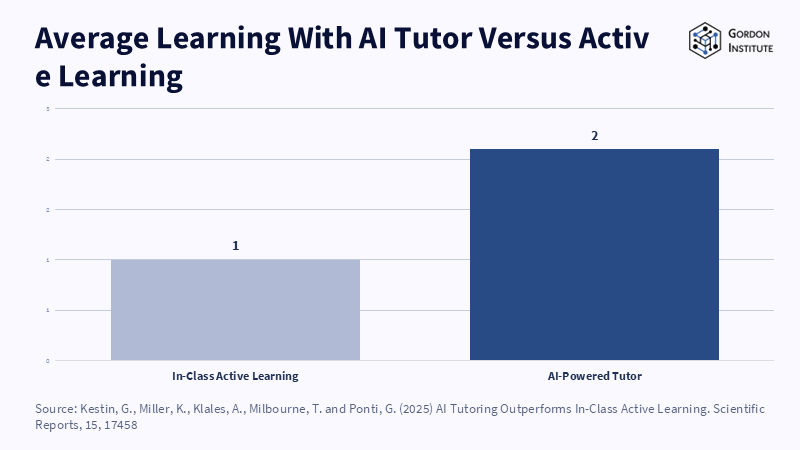
A randomized study conducted in an introductory physics course at Harvard University found that students using an adaptive digital assistant achieved more than twice the average improvement of students receiving in-class active instruction. That result deserves serious attention, especially because it emerged from an experimental design rather than a promotional comparison. It does not, however, settle the wider question. When instruction and assessment occur under closely matched conditions, a system may become highly effective at preparing learners for the form of performance it subsequently measures. The study’s authors themselves raised the possibility of “fragile knowledge”: an apparent mastery that weakens when students encounter a differently framed problem or must reconstruct the reasoning without the same prompts.
A 2025 systematic review of 28 studies involving nearly 5,000 primary and lower-secondary pupils similarly found generally positive effects from AI-driven intelligent tutoring systems. The important comparison was not between AI support and no support, but between AI systems and well-designed active learning without artificial intelligence. Against that more demanding benchmark, the additional advantage became negligible. This distinction matters for public procurement because the relevant alternative to an AI platform should not be an unchanged, under-resourced classroom. It should include lower-cost pedagogical reforms, structured practice and teacher-led active learning that may deliver similar gains without transferring as much instructional authority to a proprietary system.
Selection effects require equal scrutiny. Private-school outcomes can reflect family resources, prior attainment, small cohorts and the capacity to withdraw pupils who do not adapt to the model. Public systems serve a wider distribution of language backgrounds, disabilities, household conditions and behavioral needs. Trials in Houston and Springfield, Massachusetts, may therefore be more informative than results from high-fee campuses, but only if their evaluation separates the effects of software, staffing, time allocation and student selection. A credible evidence programme should publish protocols in advance, include comparison groups, measure outcomes after meaningful delays and test transfer to tasks that were not presented in the original interface.
Education Is More Than the Delivery of Correct Answers
The distinction between tutoring and teaching is central. Tutoring can diagnose a missed step, select another exercise and provide an explanation at the learner’s pace. Teaching also establishes intellectual norms: asking why an answer follows, deciding when an error reveals a deeper misconception, connecting a problem to an unexpected context and demonstrating how disagreement can be resolved through evidence. These functions are partly cognitive and partly social. Their value is difficult to capture through short-term attainment measures because they influence how learners approach unfamiliar problems, cooperate with others and revise their own judgments over time.
Socratic questioning is one way to describe this second layer, but the principle extends beyond any single philosophical tradition. A capable teacher does not merely supply another prompt after a wrong response. The teacher changes the representation of the problem, notices hesitation that the formal answer does not reveal and asks the learner to defend a conclusion before an audience with a different perspective. Current AI systems can imitate some of these exchanges, yet imitation is not evidence that they reliably identify when a learner’s mental model has changed. If a system optimizes progress through a sequence of questions, it may reward smooth advancement even when productive confusion and extended discussion would produce more durable understanding.
This does not imply that human instruction is uniformly superior. Teaching quality varies substantially within schools, and many pupils already receive neither consistent feedback nor sustained intellectual engagement. The strongest case for AI tutoring is therefore comparative rather than idealized: a dependable system may improve on weak provision and free teachers to concentrate on discussion, diagnosis and pastoral responsibility. That possibility makes the design of the surrounding institution more important, not less. If automation is used principally to reduce professional staffing, it may remove the human functions that make its instructional gains transferable. If it is used to strengthen the work of qualified teachers, the same technology can become part of a more credible educational settlement.
A Governance Framework for Responsible Adoption
Public authorities should treat AI-led instruction as a high-impact institutional intervention rather than an ordinary software purchase. Contracts should preserve access to outcome data for independent researchers, define responsibility when automated guidance is inaccurate and prevent vendors from using children’s interactions for unrelated model development. Schools also need a clear minimum for qualified adult supervision. Describing classroom adults as guides does not resolve whether they possess the subject knowledge, safeguarding training and professional authority required to challenge the system or suspend its use. Accountability becomes especially diffuse when curriculum design, assessment and student profiling are bundled into a platform that a school cannot independently inspect.
Equity is the second governance test. Well-resourced families may combine adaptive software with teachers, tutors and extensive extracurricular discussion, while public systems may be tempted to offer the software as a substitute for those relationships. The same product could consequently operate as an enhancement for affluent pupils and as a thinner form of schooling for disadvantaged pupils. Trials should report distributional effects rather than only average gains, including whether the model works for pupils with special educational needs, limited English proficiency or unstable attendance. They should also examine whether students become more or less capable of working without the platform after prolonged use.
| Policy question | Minimum evidence or safeguard | Risk if omitted |
|---|---|---|
| Does learning transfer? | Delayed assessment using unfamiliar questions and settings | High scores may represent fragile knowledge |
| What caused the gain? | Comparisons that separate software, staffing, selection and active learning | Institutions may pay for AI when simpler reforms produced the result |
| Who remains accountable? | Qualified teacher oversight and auditable vendor responsibilities | Errors and safeguarding failures fall between school and provider |
| Who benefits? | Outcome reporting across income, language and learning-needs groups | Automation becomes enrichment for some and substitution for others |
| Does dependence grow? | Periodic unaided work and measures of learner autonomy | Performance improves inside the platform while independent capability weakens |
Scaling Support Without Scaling Weakness
The policy choice is not between rejecting artificial intelligence and surrendering the classroom to it. Adaptive systems can extend practice, identify gaps and offer a consistency that many schools currently cannot provide. The public purpose of education, however, includes the formation of judgment and the capacity to act when familiar instructions no longer apply. Those outcomes require evaluation methods that deliberately move beyond the conditions in which the system taught the learner. They also require institutions willing to preserve professional teaching even when a more automated model appears cheaper.
Alpha School’s expansion makes this question urgent because ambition can outrun evidence long before a technology visibly fails. A billion-child model would not merely scale an instructional tool; it would scale its assumptions about knowledge, authority and the role of adults in learning. Governments and school systems should demand evidence proportionate to that ambition. The measure of success is not whether AI can help more children reach the correct answer today, but whether those children can still reason well when the system, the prompt and the familiar path are no longer present.
References
Coyle, T. (2025) The AI Knowledge Crisis: Why Artificial Intelligence Is Struggling to Learn from Science. Auckland: HERA.
Kestin, G., Miller, K., Klales, A., Milbourne, T. and Ponti, G. (2025) ‘AI Tutoring Outperforms In-Class Active Learning’, Scientific Reports, 15, 17458.
Létourneau, A., Deslandes Martineau, M., Charland, P., Karran, J.A., Boasen, J. and Léger, P.M. (2025) ‘A Systematic Review of AI-Driven Intelligent Tutoring Systems in K–12 Education’, npj Science of Learning, 10(1), 29.
Malkus, N. (2026) Return to Learn Tracker: Chronic Absenteeism 2017–2026. Washington, DC: American Enterprise Institute.
Mineo, L. (2025) ‘Is AI Dulling Our Minds?’, Harvard Gazette.
Randolph, M. (2026) ‘Alpha School Wants AI to Teach a Billion Kids. Should It?’, Scientific American.
Similar Post
















