Beyond ‘Buy European’: A Security-of-Supply Test for Defence Procurement

Input
Modified
European defence procurement must reconcile industrial sovereignty with military readiness
Trusted-partner access requires enforceable commitments, not assumptions about political alignment
Security of supply depends on technology, production and crisis-time delivery
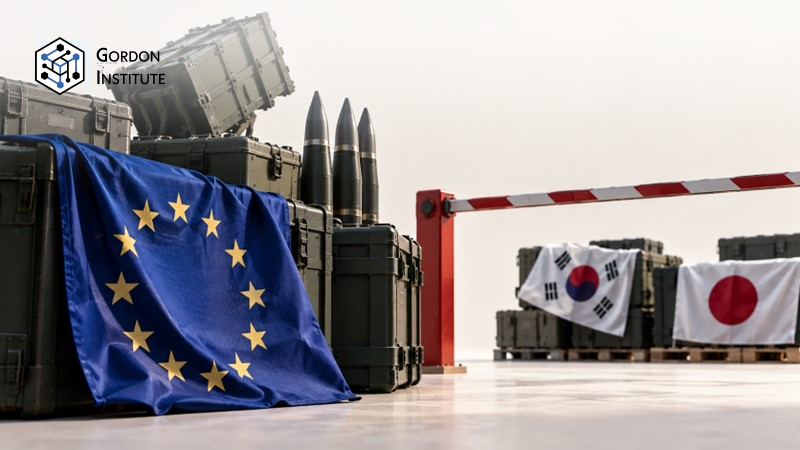
European rearmament presents an institutional problem: how can governments purchase immediate military capability while building an industrial base dependable during war? The supplied SIPRI evidence places European states at roughly one-third of global arms imports in 2021–2025. SAFE, established by Council Regulation (EU) 2025/1106, offers EUR 150 billion in loans while restricting the origin of components in supported procurement. These resources can support productive investment, but eligibility rules also determine competition, fiscal exposure and dependence on particular suppliers. The relevant question is not simply whether to buy European. It is whether procurement arrangements reduce security-of-supply risk without sacrificing essential capability or creating unnecessarily expensive duplication. This analysis develops an institutional alternative to the market-access emphasis of The Economy Review’s original article, “How ‘Buy European’ Arms Rules Shut Out South Korea and Japan” (https://economy.ac/review/2026/10/202610295883). South Korea and Japan illustrate different cooperation models, not a presumption that foreign participation is always beneficial. Domestic preference, negotiated access and conditional industrial integration each require an assessment of operational and institutional outcomes.
SAFE: Industrial Preference Through Distinct Legal Tests
SAFE combines several eligibility tests that procurement authorities must assess separately. Under Article 16(11) design autonomy and restrictions imposed by third countries matter for designated category-two products, including specified air-defence and naval capabilities; this is not a universal requirement for every supported purchase. Separate provisions address contractor establishment, control and permissible guarantees. The component-origin ceiling limits components originating outside the EU, EEA-EFTA states and Ukraine to 35% of the estimated cost of an end product’s components. It is neither a foreign-manufacturer market-share quota nor a rule satisfied automatically by European assembly. SAFE also encourages joint procurement, although its transitional provision permitted qualifying national contracts signed by 30 May 2026. Common financing can aggregate demand and support scale, but it does not itself integrate specifications, production or purchasing decisions. The source reports substantial intended allocations to domestic companies in Poland and Germany. Those allocations are not intrinsically inefficient, but procurement concentration should be tested against readiness and industrial additionality rather than treated as evidence of integration. Otherwise, common borrowing may subsidise existing national industrial preferences.
Article 17 provides a negotiated route for eligible third countries to participate on agreed terms, potentially covering industrial, security and financial conditions. An EU Security and Defence Partnership can establish a gateway to negotiations; it does not itself confer broader SAFE eligibility, NATO membership or a mutual-defence guarantee. The EU–Canada SAFE participation agreement is a precedent for structuring access through negotiated commitments rather than treating nationality as the sole criterion. Its operative provisions, not general diplomatic assurances, must determine any conclusions about reciprocal obligations. The source’s October 2026 account reports a Korean application in September 2025, Japanese interest confirmed that December, and no Korean agreement at the June 2026 summit. Those reports do not independently establish either country’s participation status at publication; the latest official agreement and implementing notices must be checked before eligibility is assumed. SAFE financing must also be distinguished from national procurement, EDIP’s separate framework and multinational development programmes such as GCAP. Exclusion from one financing instrument is not exclusion from the entire European defence market.
What Industrial Autonomy Must Actually Deliver
Defence procurement differs from ordinary public purchasing because failure can threaten national survival, while governments cannot readily replace complex weapons suppliers during conflict. A domestic industrial base can preserve specialised skills, emergency output and strategic options that market prices do not fully capture. However, autonomy has four distinct dimensions: domestic manufacturing; independent design and adaptation; reliable crisis-time delivery and maintenance; and freedom from foreign political restrictions on exports or use. Domestic assembly may improve manufacturing capacity without delivering source code, modification rights or authority over critical subsystems. Conversely, foreign ownership does not establish that a supplier will fail to deliver: facilities, contractual rights, inventories and intergovernmental commitments all matter. IISS’s Defending Europe Without the United States highlights the substantial cost and difficulty of replacing American capabilities. Its significance is not that every foreign supplier should be displaced, but that dependence must be assessed capability by capability, including functions that European production cannot quickly reproduce.
The source’s reporting on calls to put European defence production on a wartime footing reflects a genuine capacity concern. However, its Russian ammunition estimate combines several munition categories, whereas its European comparison concerns artillery shells; these are not directly comparable measures of output. EDA procurement and expenditure reporting and EPRS analysis of defence-market fragmentation provide more appropriate starting points for assessing collaboration and industrial constraints, supplemented by verified delivery records. Economic policy must distinguish productive redundancy from wasteful duplication. Geographical concentration may lower unit costs and sustain specialised expertise, yet expose production to common disruption. International diversification can add capacity while introducing licensing and transport risks. Domestic preferences are strongest where critical capabilities would otherwise disappear or remain externally constrained. They are weaker where protected production duplicates available capacity, delivers too late or diverts scarce fiscal resources from more urgent operational needs. Employment benefits matter distributionally, but should be reported separately from military performance.
Procurement Contracts as Investments in Resilience
South Korea’s Polish contracts illustrate why industrial arrangements matter more than a simple domestic–foreign distinction. The source cites an August 2025 agreement worth USD 6.5 billion for 180 K2 tanks and 81 support vehicles, including 61 K2PL tanks assembled at Bumar-Łabędy. Such arrangements can create European manufacturing and sustainment capabilities, but their strategic value depends on the rights and responsibilities transferred. Direct imports principally purchase delivered capability; licensed production adds manufacturing knowledge subject to licence limits; joint ventures allocate investment and governance between partners. Multinational research programmes distribute development risk and intellectual property, while domestic production using foreign intellectual property may retain important external dependencies. None guarantees independent design authority. Transaction-cost economics suggests examining who controls specialised assets, who bears disruption costs and whether either party can exploit the other’s sunk investment. Localisation should therefore be assessed for additional resilience, not merely domestic expenditure.
A security-of-supply schedule should translate these distinctions into auditable obligations: dated deliveries, tested surge capacity, emergency prioritisation, local maintenance capability, spare-parts and ammunition availability, interoperability, component traceability and defined modification rights. Authorities should establish baselines before contract award and monitor delivery, repair turnaround and inventory availability afterwards. The source’s reporting on requests for PAC-3 interceptors from Korean stockpiles also illustrates why purchases, stockpile transfers and donations require separate analysis. A government’s policy that it does not supply lethal weaponsto a belligerent is not equivalent to evidence that manufacturers cannot honour contracts with European customers. Nevertheless, contracts cannot eliminate sovereign export controls. Supplier-level obligations can govern inventories, maintenance, reporting, remedies and licensed technical access; export permissions, emergency exemptions and competing national priorities generally require government-to-government arrangements. The EU–Canada agreement offers a negotiating precedent, but any claimed guarantee must be grounded in its actual text. Even binding international commitments may leave emergency exceptions or enforcement difficulties. Procurement authorities should therefore stress-test supply under geopolitical disruption, not merely assess normal commercial performance. An assurance that a transfer remains subject to government approval.
Trusted Partnerships Are Not Unconditional Supply Guarantees
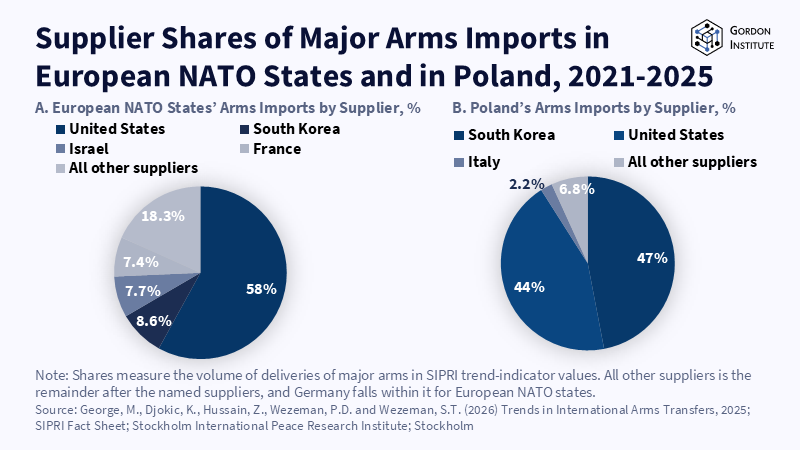
South Korea combines established export capacity with an immediate security constraint: its armed forces must deter North Korea. SIPRI figures cited in the source attribute 3% of global arms exports in 2021–2025 to South Korea, with Poland receiving 58% of Korean exports. These flows demonstrate an existing commercial relationship, not a legally binding commitment to prioritise European demand during simultaneous crises. The source also describes Russia–North Korea military cooperation and Russian warnings against Korean weapons transfers to Ukraine. Such circumstances make it inappropriate to predict that improved SAFE access would automatically change Seoul’s assistance policy. European authorities should instead examine the consequences of competing mobilisation requirements, export licensing and ammunition demand. Licensed production, European repair facilities and diversified component stocks could reduce particular dependencies, while leaving others intact. The relevant risk is not an assumed diplomatic bargain but competing claims on scarce capacity during a crisis. Negotiated access could support investment and interoperability if paired with credible production commitments. It cannot purchase an automatic alignment of national security decisions or remove the peninsula’s defence requirements.
Japan presents a different institutional model, with greater emphasis here on joint technology development, intellectual property and export permissions rather than established high-volume European arms sales. GCAP demonstrates that multinational development can allocate design and manufacturing responsibilities through a dedicated programme; it does not establish SAFE eligibility. Japanese export-control rules and partner approvals remain material to transfers, adaptation and onward exports. Energy security also affects the wider diplomatic environment: the source describes continuing Japanese interests in Sakhalin-2 and sanctions exemptions, although those commercial ties should not be treated as proof of a particular procurement response. European cooperation agreements should distinguish research access, ownership of resulting technology, manufacturing licences and export rights. Predictable procurement opportunities may encourage investment in engineering, workforce development and European facilities, but foreign suppliers have less incentive to make relationship-specific investments when future eligibility remains uncertain. Conversely, building a European factory need not transfer independent technological control. Commercial incentives can deepen cooperation without becoming a defence guarantee or determining assistance to Ukraine.
Three Approaches, Evaluated Against Five Outcomes
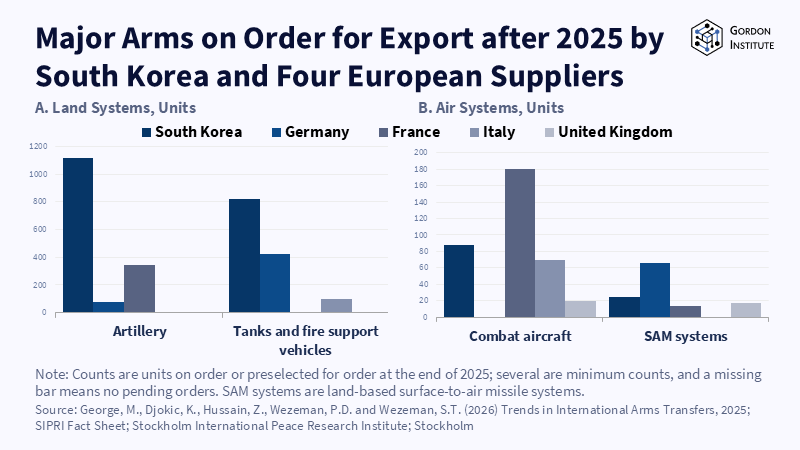
Approach A, strict European industrial preference, prioritises domestic production and independent design authority. It can sustain sovereign capabilities and concentrate procurement commitments sufficiently to support investment, but may reduce competition, raise transition costs or delay access to external capacity. Approach B, negotiated trusted-partner participation, uses Article 17 agreements to exchange access for defined industrial, financial and security-of-supply commitments. Reciprocity can strengthen incentives, although differentiated country arrangements impose negotiating, monitoring and political costs. Approach C, conditional industrial integration, admits qualifying European facilities, joint ventures and technology-sharing arrangements within applicable law. It can combine external expertise with European capacity, but requires credible audits of origin, control, intellectual property and emergency delivery. It is not a licence to disregard SAFE requirements. The accompanying source figure concerns industrial order books, not a test of these alternatives: order volume alone cannot establish readiness, affordability, technological independence or reliability under wartime stress.
A proposed evaluation framework would assess five dimensions: operational readiness, industrial capacity, technological control, security of supply and international cooperation. Readiness indicators include delivery schedules, acceptance testing and interoperability certification. Capacity indicators include functioning production lines, workforce plans and demonstrated surge output. Technological control requires examination of design documentation, software access, modification rights and third-party restrictions. Supply security requires traceable critical inputs, repair capability, inventories and legally assessed licensing arrangements. Cooperation should be measured through implemented joint programmes, reciprocal access and enforceable commitments rather than declarations of friendship. Before procurement, authorities can inspect facilities, licences, ownership and contractual rights; after award, they must monitor actual deliveries, repair performance, investment milestones and exercises testing emergency procedures. Payment schedules and remedies can reinforce compliance, but penalties cannot instantly replace missing missiles. Long-term commitments may unlock private investment in tooling and research, while poorly designed local-content rules can create costly parallel plants without eliminating upstream dependencies. Evaluation should therefore publish the intended resilience benefit, identify who bears its cost and test whether the investment supplies additional capability. No single fixed weighting can reconcile urgent shortages with every long-term industrial objective.
The choice among these approaches should follow capability-specific risk assessment. Strict preference may be justified where sovereign design or assured domestic output is indispensable and achievable. Negotiated partner participation may be preferable where complementary capacity exists and governments can establish credible reciprocal commitments. Conditional integration may work where European production and sustainment can be combined with external technology without leaving unacceptable licensing or component dependencies. Each arrangement must be evaluated for military readiness, fiscal efficiency, competition, resilience and international cooperation, including adverse geopolitical scenarios. Procurement authorities should also identify distributional effects: which regions receive investment, which taxpayers finance additional resilience and which military requirements face delay. The central challenge is therefore not choosing categorically between domestic industry and foreign suppliers. It is designing institutions that convert public spending into usable capability, productive capacity, technological options and dependable crisis-time supply. Nationality and component origin remain relevant legal and strategic indicators, but neither is a sufficient measure of policy success.
The views expressed in this article are those of the author(s) and do not necessarily reflect the official position of Gordon Institute or its affiliates.
References
Adamowski, J. (2025) ‘Poland doubles down on South Korean tanks with $6.5 billion deal’, Defense News, 1 August.
Barry, B., Barrie, D., Boyd, H., Childs, N., Gjerstad, M., Hackett, J., McGerty, F., Schreer, B. and Waldwyn, T. (2025) Defending Europe Without the United States: Costs and Consequences. London: International Institute for Strategic Studies.
Chosun Ilbo (2026) ‘Exclusive: Ukraine requests South Korea’s latest Patriots, government hesitant’, The Chosun Ilbo, 24 August.
Council of the European Union (2025) Council Regulation (EU) 2025/1106 establishing SAFE, 27 May. EUR-Lex.
Diakonov, I. (2026) ‘South Korea rules out supplying Ukraine with weapons and air defence systems’, Ukrainska Pravda, 11 August.
Fiorenza, N. (2026) ‘Poland receives first K2 MBTs under second executive contract’, Janes, August.
George, M., Djokic, K., Hussain, Z., Wezeman, P.D. and Wezeman, S.T. (2026) Trends in International Arms Transfers, 2025. SIPRI Fact Sheet. Stockholm: Stockholm International Peace Research Institute.
Griffin, O. (2026) ‘Stop Russian airstrikes: Europe moves to send more Patriot missiles to Ukraine, but depleted U.S. stockpiles and Ukraine’s defense-budget waste hobble effort’, The Economy, 9 September.
Jiji Press (2026) ‘Japan lifts weapon export ban in principle’, Jiji Press, 21 April.
Khan, S. (2026) ‘Europe is rearming. It is not integrating’, Modern Diplomacy, 11 October.
Konrad-Adenauer-Stiftung (2026) Deepening the Partnership at the 11th EU-Korea Summit. Country Report. Berlin: Konrad-Adenauer-Stiftung.
Lawrence, T. (2026) Europeanising NATO: Immediate Response. ICDS Brief. Tallinn: International Centre for Defence and Security.
Politico Europe (2024) ‘Putin warns South Korea: Sending killer weapons to Ukraine would be a big mistake’, Politico Europe, 20 June.
S&P Global Commodity Insights (2026) ‘UK allows some continued Russian LNG trade into Japan, South Korea under sanctions’, S&P Global, 1 October.
Skujins, A. (2026) ‘Europe must switch to war-mode defence production, Polish defence minister says’, Euronews, 13 October.
Adapted from How ‘Buy European’ Arms Rules Shut Out South Korea and Japan.
Similar Post