Monetary Policy Under Geopolitical Shocks: When Inflation and Recession Risks Collide

Input
Modified
Geopolitical shocks transmitted through energy markets typically raise prices, while those driven by demand contractions tend to lower them.
Only sufficiently large geopolitical shocks activate nonlinear uncertainty and expectation dynamics affecting inflation and output.
The Iran conflict-induced inflation remains concentrated in energy prices without broad core inflation increases.

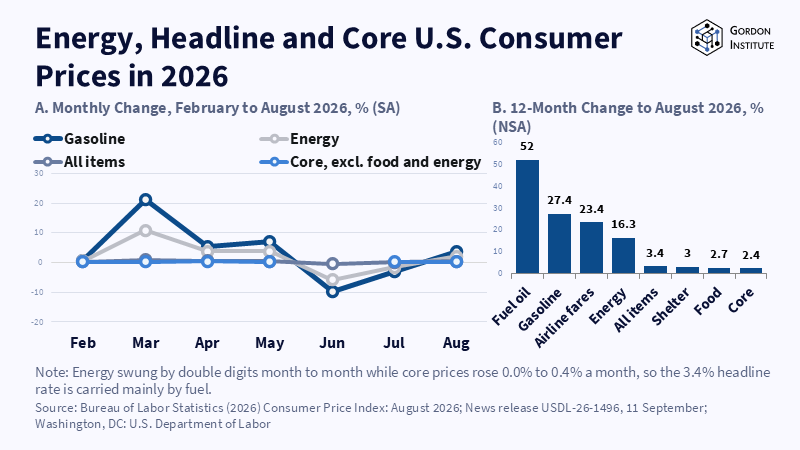
In March 2026, US gasoline prices surged by over 20% in just one month, contributing to a 10.9% rise in the overall energy index according to the Bureau of Labor Statistics. Despite this, six months later, annual inflation in the US settled at 3.4%, while Eurostat’s preliminary data for the eurozone indicated 3.8%, alongside energy costs nearly 19% higher than the previous year. This surge is widely attributed to the war with Iran, similar to the prior inflation shocks linked with the Russian invasion of Ukraine, prompting public narratives to equate geopolitical conflict directly with inflationary pressures. However, recent central bank research cautions against this simplistic equation. Some geopolitical events elevate prices markedly, while others suppress them. Crucially, the inflationary outcome depends on the transmission channel of the shock—whether it disrupts energy supply or affects aggregate demand—and the magnitude of the shock, factors often overlooked in public discourse.
The Breakdown of Traditional Central Bank Inflation Models Since 2022
Since the late 1970s, following Paul Volcker’s decisive shift toward tight money supply control, central banks in advanced economies have predominantly conceptualized inflation as driven by demand pressures. During the 1980s, explicit quantitative monetary targeting was phased out in favor of adjusting policy interest rates, a paradigm that dominated through the Great Moderation under Alan Greenspan. The prevailing framework presumed that inflation could be stabilized by modulating aggregate demand: raising interest rates when the economy overheats to restrain spending, thereby anchoring inflation expectations near the 2% target and restoring price stability. This approach operated effectively for roughly three decades, reinforcing a demand-centric model of inflation dynamics.
This well-established framework was disrupted in 2022, when inflation rates soared—reaching 9.1% annualized in the US and peaking at 10.6% in the eurozone—driven not by excessive demand but by a significant supply shock. The massive spike in natural gas prices following Russian supply curtailments, coupled with disruptions in grain shipments from Ukraine, triggered cost pressures unseen since the 1970s oil crises. Conventional monetary tightening, through interest rate hikes, cannot directly alleviate constrained energy supplies or open blockaded ports. Instead, it aims to reduce demand sufficiently to prevent pass-through from energy costs to wages and core prices. This scenario explains the tendency to view each new geopolitical conflict as heralding a new inflation wave, though the underlying economic mechanisms differ fundamentally from past demand-driven episodes. new inflationary surge.
Divergent Types of Geopolitical Shocks and Their Contrasting Price Dynamics
Monetary policy formulation is complicated by the heterogeneous nature of geopolitical shocks. For example, following the September 11, 2001 attacks, the Federal Reserve’s geopolitical risk index—developed by Caldara and Iacoviello based on global news coverage—soared sharply, yet oil prices declined, illustrating that heightened geopolitical risk does not uniformly translate into higher energy prices or inflation. This insight underpins a recent Banque de France study published in the Journal of International Economics, which analyzed 31 significant geopolitical events from 1986 onwards by examining movements in the geopolitical risk index alongside crude oil prices over a three-day window encasing each event. The study distinguishes episodes where rising geopolitical risk coincides with increasing oil prices—indicating expected disruptions to energy supply—as "geopolitical energy shocks." Notable examples include the Gulf War and Russia’s invasion of Ukraine, where supply concerns drove up energy prices and subsequently exerted upward pressure on inflation through cost-push mechanisms affecting both production and consumer prices. Monetary policymakers must recognize these supply-side shocks, as their inflationary transmission differs fundamentally from demand-driven shocks, necessitating calibrated responses to avoid unnecessary economic contraction.Conversely, the study identifies episodes in which heightened geopolitical risk is accompanied by falling oil prices, signaling an anticipated deterioration in the global economic outlook that suppresses aggregate demand and reduces fuel consumption. In such demand-driven shocks, the inflationary impulse may be negative, or deflationary, requiring monetary authorities to balance inflation control with supporting activity. This bifurcation in shock transmission channels emphasizes the necessity for central banks to discern the underlying nature of geopolitical disturbances rather than reacting mechanically to aggregate risk indices or headline inflation figures.
Both energy-supply disruptions and demand-related geopolitical shocks share the consequence of dampening industrial production, yet their inflationary effects diverge sharply. Energy shocks act as standard negative supply disturbances, pushing consumer price indices up by approximately 0.2% at their peak. In contrast, shocks transmitted via deteriorating economic conditions resemble aggregate demand contractions, leading to a price decline ranging from 0.1% to 0.4%, varying with the time horizon. Supporting this dichotomy, sectoral analyses reveal that energy-intensive manufacturing sectors, such as basic metals and refined petroleum products, experience output declines of up to 3% and increases in producer prices exceeding 1% following energy shocks. These differential sectoral responses largely vanish in demand-driven shocks. This heterogeneity underscores that the inflationary impact of identical geopolitical events may differ substantially across economies, contingent upon their energy dependency, import reliance, and industrial composition, highlighting the importance for policymakers of country-specific assessments rather than one-size-fits-all conclusions.
Shock Magnitude Alters the Inflationary Transmission of Geopolitical Events
While categorizing geopolitical shocks by their primary channels—energy supply disruption or aggregate demand contraction—provides early guidance for monetary policy, a crucial dimension remains: the magnitude of these shocks and their nonlinear effects. A recent comprehensive ECB working paper, coauthored by researchers from the ECB, Bank of England, and Autonomous University of Barcelona using monthly US data from 1970 through 2023, offers vital insights. Their analysis reveals that the macroeconomic impact of geopolitical shocks does not scale linearly with their size. Smaller shocks—roughly one standard deviation, or a 20% rise in the geopolitical risk index—have minimal discernible effects on inflation and output, well captured by conventional linear models. Shocks up to two standard deviations remain largely proportional, but beyond this threshold, nonlinearities emerge sharply. Over the past five decades, the geopolitical risk index surpassed two standard deviations only eighteen times, and just four episodes—namely the 1973 Yom Kippur War, the Gulf War, the September 11 attacks (an extreme event measured at eight standard deviations), and the 2003 Iraq conflict—exemplify very large shocks. Recognizing these nonlinear patterns is critical for monetary policymakers, as traditional linear policy frameworks and rule-based interest rate adjustments may inadequately address the complex economic dynamics induced by major geopolitical crises, including amplified uncertainty and shifts in inflation expectations.
In large-scale geopolitical shock episodes, an economic transmission channel that remains subdued in smaller shocks becomes prominent: heightened uncertainty. For shocks measuring around four standard deviations, stock markets drop approximately 3% immediately, significantly exceeding the 0.8% decline forecasted by linear models, while the VIX volatility index rises about three points rather than less than one. In extreme cases, such as shocks reaching eight standard deviations (e.g., the 2001 September 11 attacks), volatility surges by fourteen points, stocks plunge by 10%, real consumption contracts nearly 2%, and industrial production shrinks around 3%. Concurrently, monetary authorities respond to the severe downturn by lowering policy interest rates by around one and a half percentage points to support collapsing economic activity. The precautionary behavior of households and firms—postponing purchases and delaying investments—means that while localized or smaller shocks have limited effects on energy supply and consumer demand, major geopolitical conflicts can simultaneously disrupt supply chains and suppress aggregate demand, producing nonlinear, compounded economic consequences that complicate monetary policy responses.
A nuanced challenge for monetary policy under geopolitical shocks lies in understanding the dual components embedded within geopolitical risk indices that influence inflation differently. Actual military actions—such as attacks or invasions that have already transpired—tend to suppress oil prices and dampen inflation expectations, effectively manifesting as demand shocks and exerting downward pressure on the overall price level. In contrast, the anticipation or threat of forthcoming geopolitical events escalates speculative demand for oil and raises inflation expectations for future periods. This anticipatory effect intensifies nonlinearly with the magnitude of the perceived threat, progressively permeating core inflation measures that exclude volatile energy and food prices. For central banks, discerning this divergent influence is crucial to avoid conflating transient inflation spikes driven by speculative forward-looking behavior with sustained inflationary trends rooted in realized supply disruptions, thereby enabling more calibrated and credible monetary policy responses.
Interpretation Challenges: Lessons from Ukraine and Iran Conflicts
Notably, the Federal Reserve team responsible for developing the geopolitical risk index analyzes an extensive dataset comprising nearly 5,000 observations across over 40 countries dating back to 1900. Their comprehensive analysis reveals that typical spikes in geopolitical risk are statistically associated with increases in inflation paired with declines in GDP. Specifically, these episodes tend to exhibit a pattern of rising inflation and contracting economic output, illustrating the dual challenges monetary authorities face in balancing price stability with supporting growth during geopolitical disruptions. However, while robust on average, these aggregate findings mask substantial heterogeneity across events. By averaging energy-driven supply shocks, demand-driven downturns, localized incidents, and large-scale wars, the measure provides limited granularity for informing policy responses to specific crises. Moreover, the Federal Reserve’s counterfactual modeling suggests that a portion of post-crisis inflation arises not directly from the geopolitical shock but from policy reactions—such as increased military expenditures, rising fiscal deficits, and monetary expansion—highlighting the complexity of disentangling shock effects from policy-induced inflationary pressures.
The ECB’s decomposition of 2022 US data paints a similar picture: the direct contribution of the geopolitical shock to price increases was limited, with broader supply disruptions playing a dominant role in inflation dynamics. This is consistent with the US being less dependent on Russian energy compared to Europe while simultaneously recovering from the pandemic. Conversely, the Iran conflict, which directly threatened critical energy transit routes like the Strait of Hormuz, exerted its influence predominantly via the energy channel from the outset.
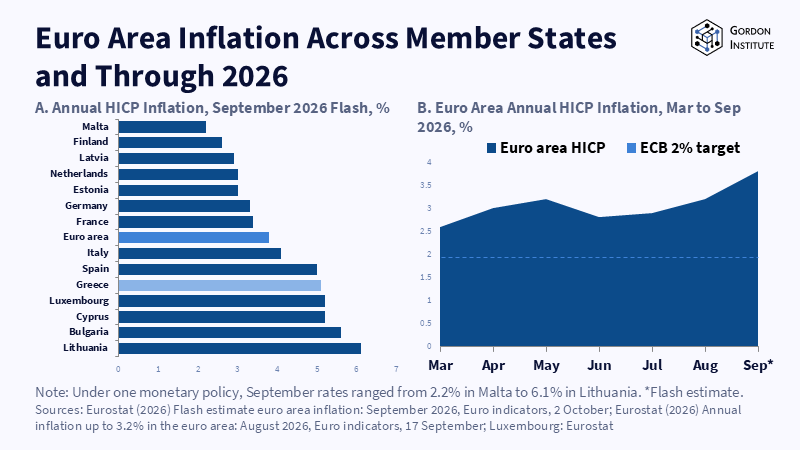
Recent 2026 data reinforce this pattern. In the US, the energy price index increased 10.9% in March, dropped 5.7% in June, then rose again by 2.1% in August. Meanwhile, core inflation excluding energy and food declined to 2.4% year-on-year despite gasoline prices being 27.4% higher. The eurozone showed an 18.8% rise in energy prices alongside a 2.5% core inflation figure in September, illustrating a large-scale energy shock scenario not yet accompanied by a generalized increase in underlying inflation. Whether this containment endures depends critically on inflation expectations—the very locus where the ECB identifies significant nonlinear policy challenges.
Policy Implications for the Federal Reserve, ECB, and Energy-Intensive Sectors
In response to the ongoing geopolitical uncertainties, the European Central Bank raised its key policy rates by 25 basis points in September 2026, lifting the deposit facility rate to 2.50%. Concurrently, ECB projections forecast average inflation moderating to 3.0% in 2026, declining further to 2.5% in 2027 and 2.1% by 2028, accompanied by subdued economic growth near 0.9% for the year. This cautious tightening reflects a policy stance aligned with prevailing research indicating that monetary tightening is appropriate when inflationary pressures transmit predominantly via energy-supply disruptions, while easing may be warranted if shocks are driven by demand contractions. Policymakers face an increasingly complex trade-off as the magnitude of geopolitical shocks amplifies, intensifying the balance between curbing inflation and supporting output. Notably, empirical models show that in exceptionally large shocks, central banks have historically prioritized stabilizing economic activity—even accepting higher inflation—manifested by policy rate reductions despite rising prices. This underscores the necessity for nuanced policy judgments informed by the specific shock characteristics rather than mechanical adherence to inflation targeting.
Effective policy formulation during geopolitical crises hinges on accurately interpreting early market signals, particularly fluctuations in crude oil and natural gas prices that emerge shortly after conflict escalations. These price movements help distinguish whether market participants anticipate supply shortages or demand contractions. Furthermore, differentiating between imminent threats and events already realized provides crucial insight into which transmission channels—supply or demand—will dominate as the shock unfolds. National exposure profiles significantly influence inflation and output outcomes, exemplified by September’s inflation estimates within the eurozone where, despite a uniform monetary policy, Greece and Spain saw substantially higher inflation around 5.0–5.1%, compared to Malta and Finland, which experienced much lower figures near 2.2–2.6%. This heterogeneity underscores the importance of country-specific risk assessments. Additionally, for energy-intensive sectors like basic metals and petroleum refining, where concentrated rises in production costs notably impact prices, strategic measures such as hedging energy expenses and securing long-term supply contracts gain heightened relevance. These risk management tools become especially critical when conflicts directly affect pivotal supply routes in the Gulf of Hormuz or the Black Sea, generating pronounced disruptions distinct from geopolitical events that only elevate risk indices without causing physical supply constraints.
The sharp 21.2% surge in U.S. gasoline prices in March 2026 marked a definitive onset of a significant energy-supply shock emanating from critical nodes in the global oil distribution network. This event’s magnitude aligns with thresholds identified in ECB research that provoke nonlinear inflation expectation dynamics, complicating monetary policy responses. The Iran conflict exemplifies a geopolitical disturbance exhibiting both a dominant energy-channel transmission and sufficient scale to activate these complex effects. By contrast, geopolitical events of comparable scale occurring outside major energy transit corridors tend to manifest predominantly through demand contraction, eliciting price declines rather than inflationary pressures—as witnessed following the 2001 crisis. Effective policy response thus requires identifying both the transmission mechanism and shock intensity to calibrate monetary actions appropriately, avoiding mistimed tightening or easing measures.
A pressing question remains: will inflation remain primarily confined to energy prices? ECB projections hint at an easing of energy prices before the broader basket, with core inflation excluding energy and food forecasted to be 2.6% in 2027—slightly above the headline inflation projection of 2.5%. The upcoming US Bureau of Labor Statistics report will be closely watched to gauge whether spillover to core inflation has commenced, informing policy decisions on the persistence of the shock.
The views expressed in this article are those of the author(s) and do not necessarily reflect the official position of Gordon Institute or its affiliates.
References
Board of Governors of the Federal Reserve System (2026) Federal Reserve issues FOMC statement. Press release, 16 September. Washington, DC: Board of Governors of the Federal Reserve System.
Brignone, Davide, Gambetti, Luca and Ricci, Martino (2025) Geopolitical risk shocks: when size matters. ECB Working Paper Series No. 2972. Frankfurt am Main: European Central Bank.
Bureau of Labor Statistics (2026) Consumer Price Index: August 2026. News release USDL-26-1496, 11 September. Washington, DC: U.S. Department of Labor.
Caldara, Dario, Conlisk, Sarah, Iacoviello, Matteo and Penn, Maddie (2026) 'Do geopolitical risks raise or lower inflation?', Journal of International Economics, 159.
European Central Bank (2026) Monetary policy decisions. Press release, 10 September. Frankfurt am Main: European Central Bank.
Eurostat (2026) Flash estimate euro area inflation: September 2026. Euro indicators, 2 October. Luxembourg: Eurostat.
Pinchetti, Marco (2026) 'Geopolitical risk and inflation: the role of energy markets', Journal of International Economics.
Adapted from Geopolitical Shocks and Inflation: The Magnitude of the Crisis Determines the Price Path.
Similar Post