From Industrial Robotics to Physical AI: Rethinking Japan’s Technology Policy

Input
Modified
Manufacturing strength needs new institutions to become physical AI capability
Shared data, research talent and international partnerships are complementary investments
Public support should reward verified deployment and productivity, not announcements
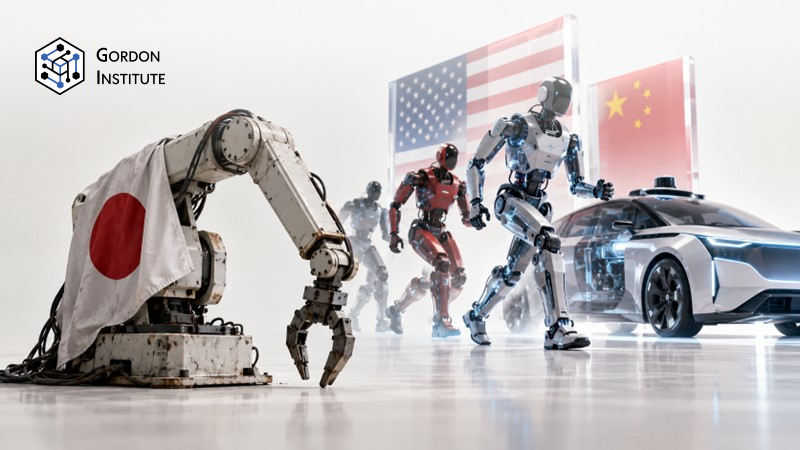
The source article reports that private AI investment during 2013–2025 totalled about USD 757 billion in the United States and USD 132 billion in China, while Japan attracted USD 7 billion over the same period. These disparities raise an institutional question: how should governments adapt industrial policy when established manufacturing strengths no longer guarantee leadership in emerging technologies? Physical AI connects learned models with machines acting in real environments, making robotics a useful case. This analysis develops that question from The Economy Review’s original article, https://economy.ac/review/2026/10/202610295890, without treating technological self-sufficiency as the objective. Its 2026 investment, programme and corporate claims have not been independently verified here and should be checked against primary releases before informing expenditure decisions. The policy challenge is nevertheless clear: convert existing capabilities into accessible data, research capacity and deployable technologies, rather than assume that manufacturing success automatically transfers across technological generations.
Manufacturing Capabilities Need New Data Institutions
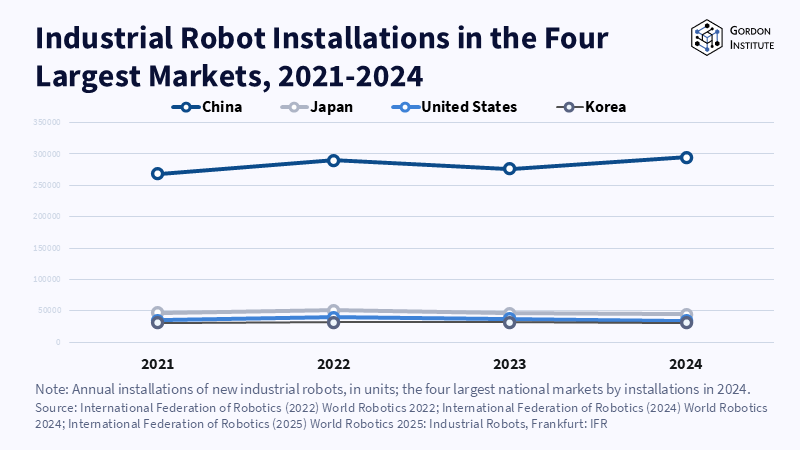
Industrial robots traditionally execute tightly specified tasks; physical AI seeks more adaptable perception, reasoning and action. Precision engineering, reliable actuators and production expertise remain valuable complementary assets, but do not themselves supply foundation models, multimodal training or deployment software. The IFR figures cited in the source put Japan’s share of global robot production at about 46 percent in 2022, with 44,500 domestic installations and 450,500 operating robots in 2024. China accounted for 54 percent of worldwide installations and had more than two million operating units. These measure different activities: manufacturing, annual adoption and installed stock. None measures accessible training data. The 2024 observations must not be relabelled as 2025 installation data; updating them requires verification against World Robotics 2026. Technological discontinuity changes the sources of advantage, while organizational routines and legacy investments can make adaptation difficult.
Japan’s challenge is therefore partly one of converting knowledge into reusable information. METI’s 2018 digital transformation report warned of potential annual economic losses reaching JPY 12 trillion after 2025 without legacy-system renewal—a forecast, not a measured outcome. The Digital Agency’s subsequent removal of 1,034 floppy-disk requirements illustrates administrative modernization, not proof of industrial AI readiness. Factory expertise may constitute a valuable complementary asset, but training requires synchronized sensor readings, equipment histories, expert demonstrations and machine-vision observations, supplemented by simulation and synthetic environments. Quantity is insufficient without quality, coverage, provenance and interoperability. Competing firms also face confidentiality, intellectual-property, cybersecurity and liability risks. Sector-specific platforms, trusted intermediaries, secure access agreements and federated learning could support cooperation. None eliminates the need for common standards, clear rights and incentives for firms—including smaller suppliers—to contribute useful data.
Choose Capabilities Rather Than Assume Self-Sufficiency
Capital-market comparisons indicate differences in financing capacity, not the optimal public budget. The source reports that US private AI investment in 2025 reached USD 285.9 billion, against USD 12.4 billion in China, while noting that Chinese government guidance funds are incompletely captured. It also reports 56 newly funded Japanese AI companies against 1,953 American companies, and Japan’s recent AIRankings position between tenth and twelfth. Such indicators cover different dimensions and cannot establish physical AI productivity. A proposed comparative figure should show Japan, China and the United States in separate panels for robot installations, private AI investment and research capacity, using matched years, consistent country attribution and explicit denominators. Public appropriations, corporate commitments and actual expenditure must remain distinct. Any unavailable observation should be marked missing, not inferred from neighbouring years or incomparable indicators.
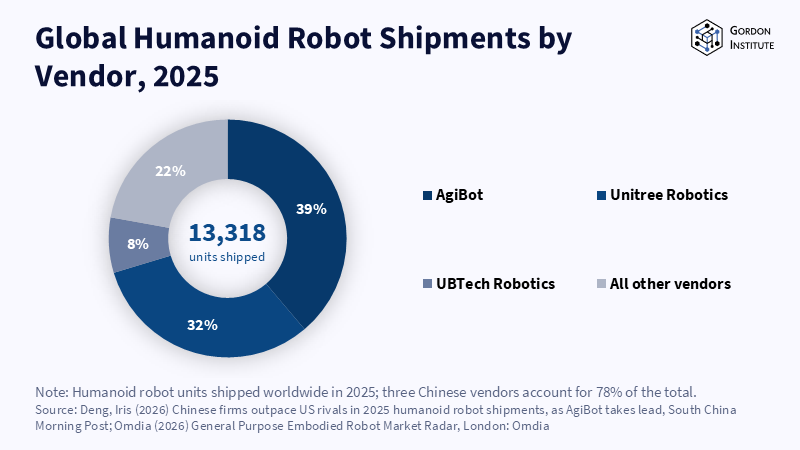
Hardware production and model development likewise require separate assessment. Omdia’s figures cited in the source record 13,318 humanoid shipments in 2025, including 5,168 from AgiBot, 4,200 from Unitree and 1,000 from UBTech. Shipments do not demonstrate sustained industrial deployment or productivity. Models such as NVIDIA’s GR00T, Google DeepMind’s Gemini Robotics and Physical Intelligence’s π0.5 illustrate another layer of the technology stack. Under Approach A, national development supports control, specialized intellectual property and security, but requires substantial continuing expenditure and scarce researchers. Approach B integrates international models while concentrating domestic investment on applications, operational expertise and deployment; this can accelerate adoption but creates licensing, continuity and switching risks. The source also describes DeepSeek’s proposed investment of approximately CNY 140 million in Unitree. Such partnerships illustrate complementary capabilities, not proven outcomes. Approach C combines selected domestic research with international models and shared data infrastructure, preserving options but requiring disciplined coordination rather than indiscriminate support.
Partnerships and Consortia Require Explicit Governance
International integration need not mean abandoning domestic capability. The source describes Nissan’s October 2026 agreement with Applied Intuition to use its Vehicle OS as a common software platform across vehicle models, building on cooperation since 2020. A demonstration reportedly updated a LEAF-based test vehicle within minutes rather than months; that company-reported example is not an independently measured productivity gain. Honda’s reported partnership with the same supplier shows why procurement can be a capability-building instrument. Contracts should address interfaces, data access, engineering participation, security and credible exit options, rather than assume ownership of every underlying model is necessary. Nissan’s fiscal 2024 net loss of JPY 670.9 billion and restructuring plans involving the closure of seven factories and 20,000 job cuts underscore adjustment pressures, not proof that foreign software caused industrial weakness.
The source presents Noetra as a domestic research response, reportedly launched on July 1, 2026 with 44 corporate participants, including SoftBank, NEC, Honda and Sony. It describes selection for a five-year NEDO multimodal robotics programme, citing approximately JPY 387.3 billion for fiscal 2026 and up to JPY 1 trillion over five years. These figures require checking against official award documents: programme envelopes are not necessarily Noetra’s allocation, corporate cash contributions or realized spending. The reported research network, centred on AIST, brings together 14 institutions and about 200 researchers across Japan, North America and Europe. Such breadth can combine manufacturing, electronics and AI expertise; international participation can strengthen rather than contradict technological control. It also creates coordination costs and conflicting commercial incentives. Governance should specify competitive funding allocation, participation and access conditions, ownership and licensing, confidentiality, publication, technology transfer and procurement pathways. Independent reviews should permit redesign or termination without treating every unsuccessful experiment as misconduct. Assessment of METI’s 2026 AI Robotics Strategy, GENIAC and the relevant NEDO awards requires their official rules and disbursement records, not announcement totals alone. National model development is most defensible where security, specialized industrial requirements or durable research spillovers exceed the costs of duplication and the benefits available through licensing or adapting open-weight models.
Research Capacity Cannot Be Created by Appropriation Alone
Human capital constrains all three approaches. MEXT figures cited in the source show doctoral entrants declining from 18,200 in 2003 to 14,380 in 2022, a reduction of 21 percent. For 2020, the source reports 123 new doctorates per million inhabitants in Japan, compared with 313 in the United Kingdom and 315 in Germany. It also cites NISTEP comparisons in which Japan’s annual doctoral output fell from 17,860 to 15,128 between 2006 and 2019 while China and South Korea approximately doubled theirs. These are economy-wide education indicators, not counts of available robotics researchers, and entry and graduation measures should not be conflated. They nevertheless suggest a constrained recruitment pipeline. Population ageing intensifies competition for skilled labour, but demographic totals alone cannot determine whether a country can assemble internationally competitive teams. Research quality, specialization, mobility and institutional conditions matter alongside cohort size.
The source reports a July 2026 fellowship expansion targeting 20,000 doctoral researchers annually; its coverage and implementation require verification. Scholarships can reduce the private cost of training, but enrolment is not equivalent to competitive research capacity. Compensation, stable careers, strong supervision, computational access and opportunities to publish and collaborate determine whether researchers stay and develop. University–industry laboratories can connect doctoral work with industrial problems, provided publication and intellectual-property arrangements remain attractive. International recruitment and researcher mobility can ease immediate shortages while domestic education reforms mature. A student entering doctoral study in 2026 might finish around 2029 or 2030, but graduation does not automatically produce an experienced research leader. Increasing public R&D budgets faster than the workforce can expand may raise costs or redistribute existing teams rather than increase output. Fellowship policy, recruitment, infrastructure and long-term institutional support therefore need coordinated timelines, not only matching announcement dates.
Evaluate the Conversion from Capabilities to Productivity
An integration strategy can be economically attractive even without leadership in general-purpose foundation models. Manufacturers may retain advantages in process design, safety validation, customer relationships and specialized operational knowledge. Wider availability of vision-language-action systems, including models released with open weights, can lower some entry barriers. However, open weights do not remove licensing conditions, integration costs or dependence on training tools and computing infrastructure. Equally, China’s larger installed robot fleet does not establish that its operational data are consistently recorded, accessible or suitable for generalization. Data value depends on task diversity, annotations, rights and applicability to deployment conditions. Policy should test where domestic specialization creates durable value and where global integration offers better performance at lower public cost. Sovereignty can mean the ability to audit, adapt, switch suppliers and sustain essential functions, rather than complete domestic ownership of every technological layer.
A second proposed figure should be explicitly conceptual: existing industrial capabilities → AI-ready data infrastructure → research and technological capacity → commercial deployment → measurable industrial productivity. The first transition needs instrumentation, standards and enforceable data rights; the second needs secure access, talent and computing; the third needs validation, procurement and integration partners; the fourth requires baseline measurement and independent evaluation. This framework is distinct from the existing source-preview charts and should not be presented as quantitative evidence. Proposed indicators include operational deployments, verified model performance in real production, cross-company interoperability, reliability and productivity improvements, researcher recruitment and retention, licensing and adoption. Strategically relevant reductions in external dependence should be demonstrated against specific vulnerabilities. These are evaluation proposals, not currently established Noetra outcomes. Near-term workforce policy should also attract and retain international researchers through competitive conditions while developing domestic teams; recruitment alone cannot substitute for durable research institutions.
No approach is universally optimal. National development offers control and research spillovers but exposes public finances to continuing costs and architectural obsolescence. International integration can speed deployment and conserve resources, while requiring safeguards against dependence and weak domestic learning. A hybrid can preserve adaptability, but only if support is selective and projects face credible review. The balance depends on security needs, market size, industrial capabilities, research talent and fiscal capacity. Evaluations should examine adoption beyond consortium members and whether smaller firms and workers share the benefits rather than bear disproportionate adjustment costs. Japan’s case illustrates why industrial leadership cannot be preserved simply by protecting yesterday’s successful organizations. The institutional test is whether public investment converts manufacturing resources into useful data, knowledge and commercially deployable technology—without unnecessarily duplicating global innovation or mistaking funding announcements for productive capability.
The views expressed in this article are those of the author(s) and do not necessarily reflect the official position of Gordon Institute or its affiliates.
References
Applied Intuition (2026) Applied Intuition and Nissan drive the future of AI-defined vehicle development. Mountain View, CA: Applied Intuition.
Deng, I. (2026) ‘Chinese firms outpace US rivals in 2025 humanoid robot shipments, as AgiBot takes lead’, South China Morning Post, 9 January.
International Federation of Robotics (2025) World Robotics 2025: Industrial Robots. Frankfurt: IFR.
Ministry of Education, Culture, Sports, Science and Technology (2024) Get a PhD: Doctoral Human Resources Action Plan. Tokyo: MEXT.
Nissan Motor Co., Ltd. (2025) Fiscal Year 2024 Financial Results and Re:Nissan Recovery Plan. Yokohama: Nissan Motor Co., Ltd.
SoftBank Corp. (2026) Noetra Launches Full-Scale R&D to Support Japan’s Leadership in Physical AI. Tokyo: SoftBank Corp.
Stanford Institute for Human-Centered Artificial Intelligence (2026) Artificial Intelligence Index Report 2026. Stanford, CA: Stanford University.
Statistics Bureau of Japan (2026) 2025 Population Census: Final Results. Tokyo: Ministry of Internal Affairs and Communications.
Adapted from Japan’s Advantage in Physical AI Is a Thing of the Past.
Similar Post