The Division of Labour in Inflation Policy: Tariffs, Energy, and the Limits of Central Banks

Input
Modified
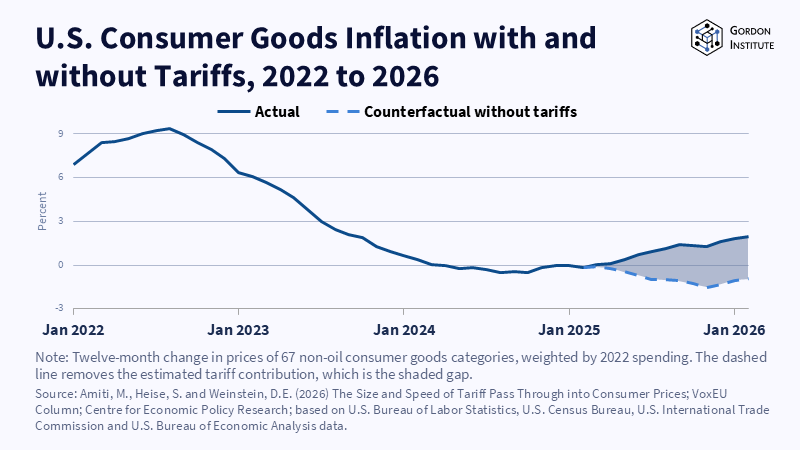
Tariffs contributed modestly to inflation, less than widely feared.
Distribution and retail margins significantly diluted tariff impacts on consumer prices.
Energy price increases propagated into services, unlike tariff effects limited to goods.

In early 2026, tariffs imposed by the U.S. administration raised prices notably in selected consumer goods categories, contributing an estimated 0.5 percentage-point to overall inflation as reported by Federal Reserve researchers. In contrast, the energy index surged sharply, with year-on-year gasoline and crude supply disruptions exerting a much larger impact on headline inflation figures. This divergence reflects the distinct channels by which tariffs and energy costs influence the consumer price index (CPI). Recognizing these differences is crucial for designing appropriate government responses, rather than treating headline CPI changes as homogenous inflationary shifts. Tariff effects on consumer prices remained below initial high-impact predictions from 2025 modeling exercises. Meanwhile, energy price increases fuelled a broader rise in inflation. Energy contributed to pushing headline inflation above core levels in 2026. The contrast in inflation dynamics stems from how each shock infiltrates the economic value chain, a complexity often overlooked by simple CPI headline interpretations.
The Tariffs Paid Fell Well Short of Those Announced
In spring 2025, initial forecasts anticipated that the peak tariff rates—reaching as high as 145% on certain Chinese imports—would impose significant inflationary pressures. The US Treasury characterized these peak tariffs effectively as an embargo, and analyses by the Yale University Budget Lab estimated the average effective tariff rate at 21.9%, marking the highest level since 1909. Early assessments projected a short-term price level increase of 2.2%, with household income losses of approximately USD 3,600. Financial institutions, such as Citigroup, projected that as inventories accumulated ahead of tariff expirations, consumer cost burdens would rise from an estimated 30–40% to near 60% over the subsequent months. These expectations reflected the assumption that firms initially absorbing tariff costs would pass them on gradually to consumers, illustrating the delayed transmission dynamics inherent in tariff-related inflation.
Trade policies ultimately adopted a more measured trajectory than initially projected, underscoring the importance of adaptive policy design and institutional coordination. The Geneva agreement of May 2025 markedly reduced targeted tariffs on Chinese imports from an extreme 145% to 30%, with successive extensions sustaining this moderated approach through early 2027. Judicial decisions in early 2026 further curtailed tariffs imposed under emergency mandates, prompting the administration to substitute these with a uniform 10% surcharge. Reflecting these developments, the Yale Budget Lab's November 2025 assessment recalibrated the effective tariff rate downward to 16.8%, with an associated price level increase of 1.2 percentage points—significantly less than preliminary estimates had suggested. Crucially, this reduction in trade restrictions provided firms ample time to implement mitigation strategies, including diversification of supply sources and phased pricing adjustments, limiting abrupt retail price spikes. Empirical monitoring by the New York Fed confirmed the absence of widespread supply chain bottlenecks, stable wage growth rates aligned with subdued inflation, and well-anchored inflation expectations. These conditions collectively indicate that tariff-related cost pressures did not cascade into a broad-based or sustained inflationary surge. Nonetheless, a clear understanding of the precise mechanisms and pace by which tariff shocks feed through to consumer prices remains essential for policymaking, highlighting the need for ongoing empirical analysis and institutional dialogue to guide coordinated fiscal, trade, and monetary responses.
How Tariff Pass-Through Reaches the Shelf
The initial mechanism of tariff transmission occurs primarily at the customs border and operates in a largely predictable manner. Empirical studies conducted by the Federal Reserve Bank of New York reveal that foreign exporters generally do not significantly reduce their prices to offset tariffs, resulting in approximately 90% of the tariffs imposed in 2025 being directly reflected in import prices almost immediately—even when accounting for dollar depreciation. This near-complete pass-through at the import price level replicates patterns observed during prior U.S. trade disputes in 2018 and 2019. However, as prices move along the supply chain toward retail, the initial tariff impact becomes increasingly diluted. Transportation, wholesale, and retail activities together constitute around half of the final consumer price and are exempt from customs duties, effectively softening tariff-induced price increases at the point of sale. For instance, on a product with a $100 retail price composed equally of $50 import value and $50 distribution costs, a 10% tariff raising import costs by 10% translates to approximately a 5% increase in the retail price. This example aligns closely with the New York Fed’s estimated 5.6% retail price increase for every 10% rise in import and producer prices, highlighting the significant mitigating role played by distribution margins in the tariff pass-through process.
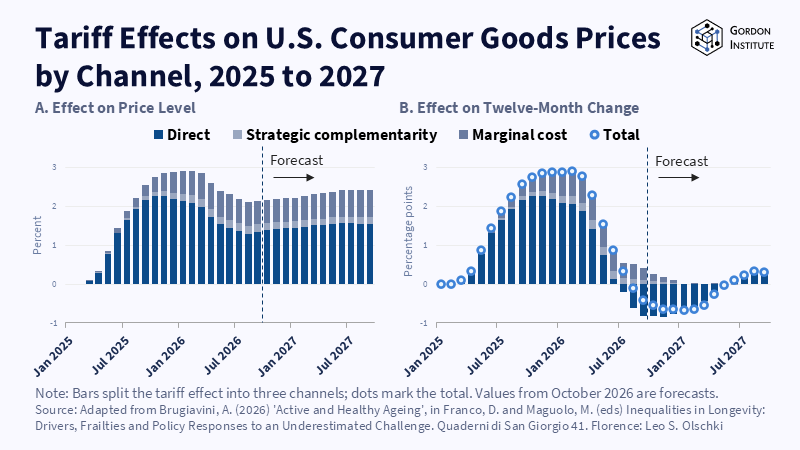
Beyond the direct impact on imported finished goods, tariffs also influence domestic production costs through intermediate inputs such as steel and aluminum. When tariffs raise the cost of these inputs, domestic producers face higher expenses and may find it economically rational to increase their own profit margins. Empirical data confirms these dual transmission channels, with the indirect cost effect exerting a more substantial influence overall. However, the pass-through to producer prices unfolds gradually: price increases are modest within the initial six months post-tariff imposition but approximately double their magnitude over the subsequent six months. In contrast, about half of the direct tariff effect on imported goods is incorporated within three months, fully materializing by six months. roughly equivalent to one-quarter of the initial tariff rateTaking these mechanisms together, an across-the-board 10% tariff on imports is estimated to raise consumer goods prices by approximately 2.6% after twelve months. Of this increase, around two-thirds derive from higher import prices directly, while one-third result from the upward adjustments in domestically produced goods affected via input costs and profit margin changes. By February 2026, the indirect channel accounted for about 30% of the total tariff-induced price level increase, and this share is expected to grow further as domestic producers progressively pass higher costs through to retail prices.
Energy Costs Run Through Every Link of the Value Chain
Unlike tariffs, which apply to specific goods defined by customs codes, energy costs permeate all facets of production and distribution without distinction. From factories processing raw materials like aluminum, to the trucks transporting goods, warehouses requiring cooling, retail outlets needing lighting and heating, and administrative offices, every stage incurs substantial energy expenses. Each of these economic actors consistently faces electricity and fuel bills, constituting a pervasive input cost that can be incrementally passed along throughout the supply chain. This cascading transmission is evidenced in recent data from August 2026, where gasoline prices jumped 27.4%, heating oil surged 52%, and consequentially, sectors such as commercial aviation saw ticket prices—classified within the core inflation index—increase significantly due to elevated fuel costs. Notably, these sectors, including airline travel, which counts toward the core CPI measure, illustrate how energy price rises extend beyond volatile commodities to impact broader service categories,while electricity prices, despite a more modest 3.8% annual rise, remain ubiquitous across commercial and industrial activity, underscoring energy's foundational role in shaping overall inflation trends.
Empirical research quantifies the so-called second-round effects that deepen energy price shocks into broader inflation. Analyses by economists affiliated with the Federal Reserve Board, covering 27 advanced economies, estimate that a 10% rise in Brent crude oil prices increases the energy component of the consumer price index by approximately 2.3% within two quarters. Simultaneously, food prices rise by 0.3%, the core inflation rate by 0.1%, and the cumulative impact on the headline inflation rate nears 0.4%, with these indirect effects accumulating gradually over an estimated eight quarters. Post-2022 data from Canada, the UK, and eurozone countries show second-round energy price effects contributing, on average, an additional half a percentage point to annual inflation. Complementary findings from the London School of Economics’ Centre for Macroeconomics, analyzing 38 OECD countries, reveal that core inflation progressively rises for approximately 14 months post energy shocks, with service sector prices responding nearly as strongly as goods prices. This pattern aligns with data from the UK Office for National Statistics, which indicate the energy intensity in services (about 2%) exceeds that of non-energy goods (approximately 1.4%), illustrating how sectors traditionally considered insulated from oil prices can have proportionally higher energy consumption, thereby challenging simplistic assumptions about sectoral exposure to energy inflation.
Tariffs Stay in Goods While Energy Reaches Services
The critical distinction between tariff-induced inflation and energy price inflation rests on their scope and persistence within the economy. Tariffs primarily affect tradable goods and, to a limited extent, domestic manufacturing inputs, leaving the service sector—which constitutes about two-thirds of consumer expenditures—largely unaffected. Moreover, tariff-driven price increases occur discretely and generally elevate the overall price level without sustaining higher inflation rates over time. Empirical estimates indicate that by August 2026, tariffs' contribution to goods inflation had declined from an initial 2.9 percentage points to near zero, with prices settling roughly 2% above what would have prevailed without tariffs. During this period, core goods prices (excluding food and energy) rose by only 0.7% year-on-year, while non-energy services recorded a 3.0% increase. In contrast, energy-related inflation plays a more persistent and diffuse role. It emanates indirectly through rising production costs, affecting each service sector variably depending on their energy intensity, and also influences inflation expectations. Unlike tariffs, which have a clear enactment date and immediate effect, energy price shocks lack a formal initiation point and trigger ongoing, broader inflationary pressures that evolve over time.
A common critique posits that tariff impacts extend widely due to their embedding in intermediate inputs like steel, aluminum, and components that feed into a vast array of domestic products, suggesting the actual inflationary burden could be larger than estimated. However, empirical findings do not substantiate this broader spillover effect in its stronger interpretations. The indirect tariff transmission channel constitutes roughly one-third of the total price impact and predominantly remains confined within tradable goods sectors, without significant evidence of pervasive wage or inflation expectation pressures according to Federal Reserve analyses. In contrast, energy price shocks have already manifested more visibly in service sectors, such as air travel. Nonetheless, the energy inflation transmission is also nuanced: Dallas Fed research indicates gasoline price shocks exert only moderate influence on headline CPI and minimal effect on core inflation in the U.S., while stronger pass-through effects occur in the eurozone. Concurrently, dollar depreciation during this period has contributed to higher import prices, influencing inflation dynamics through channels not fully captured by either tariff or energy price transmission frameworks. This complexity underscores the need for policymakers to carefully discern the distinct origins and propagation mechanisms of inflation when designing coordinated interventions.
The Fed Faces Two Clocks and Importers Lose Their Cushion
Monetary policy faces distinct challenges when addressing inflation stemming from tariffs versus energy supply disruptions, particularly due to their divergent timelines and economic pathways. Tariff increases are discrete policy decisions occurring at identifiable moments, enabling central banks to anticipate their inflationary impact and plan accordingly. For instance, tariffs scheduled on Canadian imports starting August 2026 and on vehicles and parts from January 2027 imply a calculable—and relatively contained—influence on goods inflation, expected to slightly rise by mid-2027 before dissipating. Conversely, energy price shocks permeate broader sectors and have delayed effects; their inflationary imprint on the core price index unfolds gradually over at least a year after the initial price surge. This necessitates extended monitoring to distinguish between inflation pressures originating from transient energy cost pass-through and those from underlying demand overheating. Importantly, the distribution margins that previously halved tariff-related price increases encompass significant energy-related expenses, including costs for transportation fuel, climate control in warehouses, and electricity consumption in retail environments.Thus, when tariff-induced price pressures coincide with rising energy costs, the protective buffer that had cushioned consumers against rapid price increases is progressively diminishing. This convergence complicates retailers’ ability to absorb or postpone cost pass-through, underscoring the need for coordinated policy actions among monetary, trade, fiscal, and energy authorities to mitigate inflationary pressures without amplifying economic distortions.
Although tariffs increased goods prices by about 2% relative to a scenario without tariffs, their overall impact on headline inflation amounted to roughly a 0.5 percentage-point rise, following a predictable trajectory aligned with scheduled trade policy changes. In contrast, energy price shocks lack such a defined timetable and continue to exert significant inflationary pressures across the economy. Notably, in August 2026—the month when tariff contributions to goods inflation effectively diminished to near zero—gasoline alone accounted for over one-third of the monthly increase in the overall consumer price index, while airline ticket prices rose by 2.7% within that single month. Upcoming data releases, including the September 2026 figures scheduled for October 14 by the Bureau of Labor Statistics, will provide clearer insight into the extent to which energy price effects have penetrated service sectors, further informing targeted and coordinated policy responses across monetary, trade, fiscal, and energy institutions.
The views expressed in this article are those of the author(s) and do not necessarily reflect the official position of Gordon Institute or its affiliates.
References
Alp, H., Klepacz, M. and Saxena, A. (2023) ‘Second-round effects of oil prices on inflation in the advanced foreign economies’, FEDS Notes. Washington, DC: Board of Governors of the Federal Reserve System, 15 December.
Amiti, M., Flanagan, C., Heise, S. and Weinstein, D.E. (2026) ‘Who is paying for the 2025 U.S. tariffs?’, Liberty Street Economics. New York: Federal Reserve Bank of New York, 12 February.
Amiti, M., Heise, S. and Weinstein, D.E. (2026a) The anatomy of tariff pass-through into consumer prices. Federal Reserve Bank of New York Staff Report No. 1201. New York: Federal Reserve Bank of New York.
Amiti, M., Heise, S. and Weinstein, D.E. (2026b) ‘The size and speed of tariff pass through into consumer prices’, VoxEU. London: Centre for Economic Policy Research, 12 October.
Bureau of Labor Statistics (2026) Consumer Price Index: August 2026. News Release USDL-26-1496. Washington, DC: U.S. Department of Labor, 11 September.
Cavallo, A., Gopinath, G., Neiman, B. and Tang, J. (2021) ‘Tariff pass-through at the border and at the store: evidence from US trade policy’, American Economic Review: Insights, 3(1), pp. 19-34.
Delaney, S. (2026) ‘Trump’s tariff inflation shock proves limited as energy and semiconductor costs increase the burden on U.S. households’, The Economy, 12 October.
Kilian, L. and Zhou, X. (2023) ‘A broader perspective on the inflationary effects of energy price shocks’, Energy Economics, 125, 106893.
The Budget Lab at Yale (2025a) State of U.S. tariffs: May 23, 2025. New Haven, CT: Yale University.
The Budget Lab at Yale (2025b) State of U.S. tariffs: November 17, 2025. New Haven, CT: Yale University.
Vlieghe, G. (2024) Core strength: international evidence on the impact of energy prices on core inflation. CFM Discussion Paper 2024-07. London: Centre for Macroeconomics, London School of Economics.
Williams, J.C. (2026) ‘A few words for the New Year’, speech delivered at the Federal Reserve Bank of New York, 12 January.
Adapted from Tariff Pass-Through and the Energy Shock: Why the Pump Has Weighed on Inflation More Than Customs.
Similar Post