AI in Education - SIAI’s Experience of Building Institutional Capability

Input
Modified
AI capability develops through problem definition and supervised use
SIAI’s experience connects educational adoption with everyday operations
Governance and accumulated evidence determine when a tool can be trusted

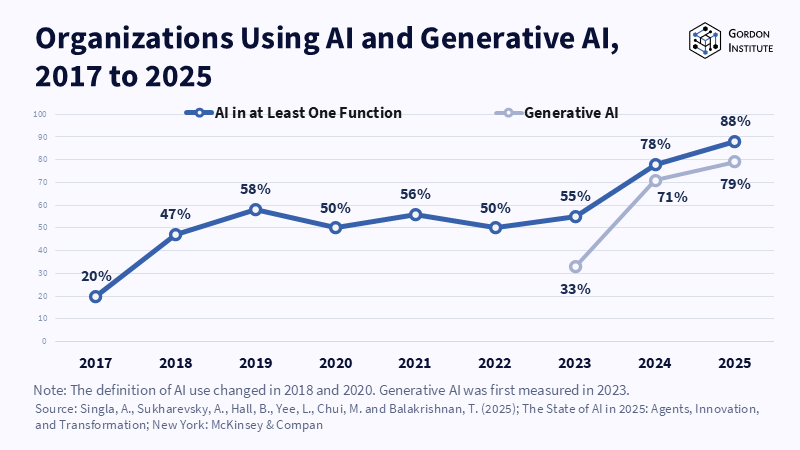
Access to an AI system and the capacity to use it productively are different institutional achievements. McKinsey’s 2025 survey of 1,993 respondents in 105 countries found regular use in at least one organisational function among 88 percent, up from 78 percent a year earlier. Only 39 percent attributed any operating-profit effect to AI, usually below 5 percent, and roughly one-third had begun organisation-wide expansion. The figures do not demonstrate that access has no value; they show that access is a weak measure of successful implementation. SIAI’s experience supplies a concrete illustration. The institute uses available AI products and develops tools of its own, yet those systems become useful only after someone identifies the work they should support, the conditions under which they will operate and the checks their outputs require. The gap between access and organisational capability is therefore an education-policy problem as well as a management problem.
Define the Problem Before Choosing the System
Team4Tech’s capacity-building work offers an independent perspective on the same issue. More than 80 participating education organisations, collectively reaching over a million learners, entered programmes in which some initially could not specify an intended use for generative AI. Others named a product rather than a problem. The share able to describe three applications increased from 34 percent to 78 percent after the programme. That is evidence of improved application planning, not itself a causal estimate of student learning. Its relevance to SIAI is that knowing a tool exists precedes knowing where it belongs. African organisations face particular constraints in connectivity, curriculum and language, but the decision sequence is not uniquely African. A research institute, a university or an ordinary business must all move from a product name to a defensible account of the work the product will improve.
At SIAI, the implementation question begins with the activity rather than the model. A research task, an educational task and an administrative task may need different inputs, interfaces and levels of supervision even when all can use the same underlying language model. Staff members with similar responsibilities may also work in sufficiently different ways that a workflow helpful to one becomes an obstacle to another. Professor Keith Lee describes this as a continuing operational responsibility: explaining how to use the tools, adapting them to the work and deciding whether an unsatisfactory result calls for better software or more capable human intervention. These observations are an institutional case, not the results of a controlled evaluation. They nevertheless identify an important policy distinction. Providing a system does not specify the problem, and specifying the problem does not remove the need for someone to teach and supervise its use.
Fit the Tool to Local Conditions and the Actual Work
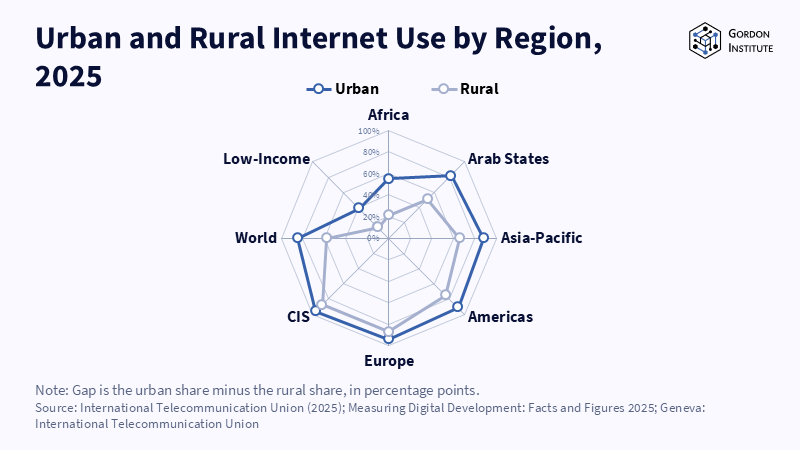
For SIAI, local conditions include the purpose of a course, the knowledge expected of its students, the habits of the staff member using an assistant and the quality standard attached to an output. The institute’s self-paced education and Gordon AI Tutor approach make the distinction especially important. A conversational interface can help a student navigate material, but a useful learning interaction must remain connected to the intended subject and to the learner’s ability to explain the result. The tutor’s institutional presentation is not a claim that every generated explanation is reliable. Similarly, the institute’s own tools must fit the task instead of requiring the task to be reorganised around an impressive demonstration. The contrast with rural African deployments is instructive: ITU figures place internet use at only 21 percent in rural Africa in 2025. There, connectivity can block participation before educational design is tested; at SIAI, access to the technology does not remove the separate constraints of judgment, workflow and verification.
Customisation should therefore be understood broadly. It can involve course-linked prompts, relevant examples, an appropriate sequence of questions and a clear route for human review, rather than merely changing a product’s branding. An assistant used in a course may need to help a learner diagnose an error without completing the entire reasoning process on their behalf. A system used in research may need to expose assumptions, preserve sources and make uncertainty visible. An administrative assistant may require a more constrained output and a different review threshold. These are design implications drawn from SIAI’s operating experience, not a claim that a particular configuration has already delivered measured gains across every activity. The comparison with Kenya Connect’s curriculum-linked prompts reinforces the general principle: an answer can be linguistically fluent and still fail the institution’s actual requirement.
The user’s working style is another local constraint. A person already capable of evaluating an answer may benefit from a flexible interface, while someone developing that capability may need narrower instructions and more explicit checks. Language and context influence the same decision. Team4Tech’s Dignitas case describes coaches checking comments before they reach teachers because English-language performance and generic examples did not consistently fit Swahili-speaking settings. SIAI faces a different environment, but the supervisory principle transfers: output must be judged against the work and its audience. There is no reason to assume that a tool useful for one institutional function can be copied unchanged into all others. The task is to establish which parts can be standardised and which require adaptation, with the boundary determined through use rather than marketing specifications.
Table 1. Five Implementation Requirements Applied to SIAI’s Institutional Case
| Requirement | SIAI case | Main constraint | Implementation response | Evidence status |
|---|---|---|---|---|
| Problem definition | AI use across education, research and operations | A common model does not define the purpose of each task | Specify the activity and the required output before selecting a tool | Qualitative institutional account; no measured effect claimed |
| Local constraints | Different staff workflows and learning requirements | One configuration may not fit another user or function | Adapt inputs, examples and review thresholds to the setting | Design implications drawn from reported experience |
| Coaching | Professor Lee provides repeated practical guidance | Initial instruction does not ensure dependable subsequent use | Use task-linked explanation, reviewed examples and supervised practice | Operational observation; no causal estimate claimed |
| Governance | Deciding whether failures require better tools or stronger human input | Fluent output can conceal a consequential error | Assign responsibility for evaluation and escalation | Decision framework rather than a validated performance result |
| Evidence generation | Confidence develops through accumulated experience | Tool usage does not establish learning or productivity | Track errors, review effort and accepted outcomes separately | Proposed evaluation criteria; no fabricated SIAI metrics |
Coaching Turns Initial Access into Repeatable Capability
Repeated explanation is part of deployment, even when it is absent from the project budget. SIAI’s experience is that staff do not always retain a procedure after an initial demonstration and do not automatically recognise how a familiar tool should be used for a new assignment. Much of that guidance currently depends on Professor Lee. The policy issue is not to celebrate dependence on one knowledgeable person, but to recognise the capacity it supplies and make it more reproducible. Instructions, reviewed examples and supervised practice can distribute some of the knowledge without pretending that all judgment can be codified. Ebbinghaus’s work and Murre and Dros’s replication show that retention changes without reinforcement, although nonsense-syllable experiments do not quantify how quickly staff forget AI procedures. They support a general reason for practice, not a precise implementation schedule.
Workplace surveys make the support requirement more concrete. BCG’s AI at Work 2025 study of over 10,600 workers in eleven countries found that only one-third considered themselves adequately trained. Regular use was higher among those receiving at least five hours of training, including direct instruction and coaching, while frontline adoption remained at 51 percent. These associations do not isolate the causal contribution of each training format. They are consistent, however, with SIAI’s observation that the tool becomes useful through explanation linked to real work. Guidance needs to cover what to ask, what information to provide, how to inspect an answer and when to stop delegating. For education policy, an AI budget that pays only for licences can consequently omit the human effort required to turn availability into dependable institutional practice.
The objection that increasingly easy interfaces will remove this burden confuses operating the product with deciding whether to trust it. The World Bank’s six-week Edo programme recorded learning gains around 0.3 standard deviations under a design that included computer labs, teacher coordination and English-curriculum alignment. That result cannot be attributed to an unsupervised chatbot alone. McKinsey likewise finds more extensive workflow redesign and clearer verification arrangements among firms reporting substantial value. SIAI’s experience points to the same distinction: simpler operation does not determine whether an error needs a better prompt, a different system, stronger subject knowledge or a person taking over. The institution needs a way to make that decision. A model upgrade can expand useful capability while creating new forms of overconfidence, so coaching remains a judgment function even when the interface becomes easier.
Governance and Evidence Make Reliance Defensible
The practical test comes after an output is produced. At SIAI, someone must decide whether it meets the requirement and, if not, whether the remedy is to improve the tool or improve the human contribution. That decision is often described informally as whether to tool up or man up. A useful governance arrangement makes the distinction operational: identify the failure, establish its consequence and choose the intervention most likely to prevent recurrence. Training, additional review and narrower delegation can be appropriate where the problem is missing knowledge; configuration, integration or a different model can be appropriate where the technology is unsuitable. These options are not mutually exclusive. The important point is that producing an answer creates an evaluation obligation rather than completing the institutional task. Assigning responsibility for that obligation is part of successful adoption.
Evidence generation should start with the same realism. SIAI’s reported experience can illustrate how implementation works, but it does not supply a controlled estimate of learning gains or staff productivity. An institution can build stronger evidence by recording the types of work attempted, errors found, review effort required and results accepted, while separately examining whether students develop independent understanding. Governance also covers access, data ownership and continuity. Educate!’s work on Rwanda’s CAMIS system illustrates why maintenance and state control of data can determine the viability of an educational deployment. For SIAI, the corresponding questions concern which material enters which service, who approves a result and how knowledge survives changes of staff or software. The aim is accumulated, task-relevant evidence that supports a defined level of reliance, rather than an indiscriminate claim that AI has become trustworthy.
The distance between adoption and demonstrated value closes through that accumulation. A tool may initially need close supervision, later become reliable for a narrow activity and still remain unsuitable for another. SIAI’s institutional case makes the sequence explicit: define the problem, identify local constraints, coach the user, assign responsibility and inspect what happens. Education is not exempt from the organisational problem because its output is learning rather than profit. A ministry or university that funds only the model leaves much of the implementation cost unfunded; an institution that measures only usage cannot establish whether its students or staff are becoming more capable. Team4Tech’s cases and SIAI’s experience arise in different settings, but both show why dependable adoption is a system of human and technical work, developed through feedback rather than delivered in a subscription.
This Policy Forum adaptation draws on Team4Tech’s published AI capacity-building work and on SIAI’s institutional experience as described by Professor Keith Lee. The additional SIAI analysis should not be taken as reviewed or endorsed by Team4Tech. The article does not constitute policy advice or an official position of any affiliated institution.
References
Beauchene, Vinciane, Duranton, Sylvain, Kalra, Nipun and Martin, David (2025) AI at Work: Momentum Builds, but Gaps Remain. Boston: Boston Consulting Group.
De Simone, Martín, Tiberti, Federico, Barron Rodriguez, Maria, Manolio, Federico, Mosuro, Wuraola and Dikoru, Eliot Jolomi (2025) From Chalkboards to Chatbots: Evaluating the Impact of Generative AI on Learning Outcomes in Nigeria. Policy Research Working Paper 11125. Washington, DC: World Bank.
Dougherty, Rachel (2026) '5 Key Takeaways from Team4Tech's AI Capacity-Building Cohorts', Team4Tech, 27 August.
Ebbinghaus, Hermann (1885) Über das Gedächtnis: Untersuchungen zur experimentellen Psychologie. Leipzig: Duncker & Humblot.
International Telecommunication Union (2025) Measuring Digital Development: Facts and Figures 2025. Geneva: International Telecommunication Union.
Miao, Fengchun and Holmes, Wayne (2023) Guidance for Generative AI in Education and Research. Paris: UNESCO.
Murre, Jaap M. J. and Dros, Joeri (2015) 'Replication and analysis of Ebbinghaus' forgetting curve', PLOS ONE, 10(7), e0120644.
Singla, Alex, Sukharevsky, Alexander, Hall, Bryce, Yee, Lareina, Chui, Michael and Balakrishnan, Tara (2025) The State of AI in 2025: Agents, Innovation, and Transformation. New York: McKinsey & Company.
Team4Tech (2025) Dignitas, Kenya: Strengthening Teacher Practices Through AI-Powered Teacher Coaching. Generative AI Cohort Case Study. Menlo Park, CA: Team4Tech.
Team4Tech (2026) Rising Hope Girls Educational Foundation, Nigeria: Cohort-Based Learning Supports RHGE in AI Implementation. Generative AI Cohort Case Study. Menlo Park, CA: Team4Tech.
Similar Post
















