Beyond Degree Duration - Aligning Accreditation with Demonstrated Learning

Input
Modified
Degree duration is an incomplete indicator of educational achievement
AI strengthens the case for reviewing workload and assessment
Flexible pathways need credible standards for breadth and competence

The expansion of three-year bachelor’s programmes in the United States has reopened a longstanding question: what does the duration of a degree actually certify? The debate describes around ninety participating campuses, with almost sixty joining coordinated efforts in the preceding two years. These developments coincide with tools that can produce outlines, translate documents, summarise case material and assist with calculations much faster than before. Faster production does not establish faster learning, but it exposes weaknesses in programmes whose workload assumptions depend on the time formerly needed to complete such tasks. Students, families and public funders reasonably ask whether the years required remain aligned with the educational result. Gordon Institute’s Policy Forum approaches this as a quality-assurance issue. The purpose of reform should be to make meaningful learning visible and preserve its breadth, while allowing institutions to reconsider schedules and requirements that do not contribute proportionately to that outcome.
Time-Based Credits Became an Administrative Standard
The Carnegie unit emerged in 1906 from the Carnegie Foundation for the Advancement of Teaching’s efforts to define educational standards connected with its pension scheme. Its original secondary-school measure represented approximately 120 hours of study; that unit should not be confused with a modern university credit hour. A related time-based convention became embedded in higher education, where a typical US bachelor’s degree requires around 120 semester credits. Those credits generally incorporate expected work beyond classroom contact. Their institutional importance extends to funding, transfer, progression and staff workload. Time provides a practical way to describe the scale of a programme, but it does not directly measure what an individual student has understood. That distinction explains the continuing attraction of competency-based approaches without implying that all uses of credits are educationally arbitrary.
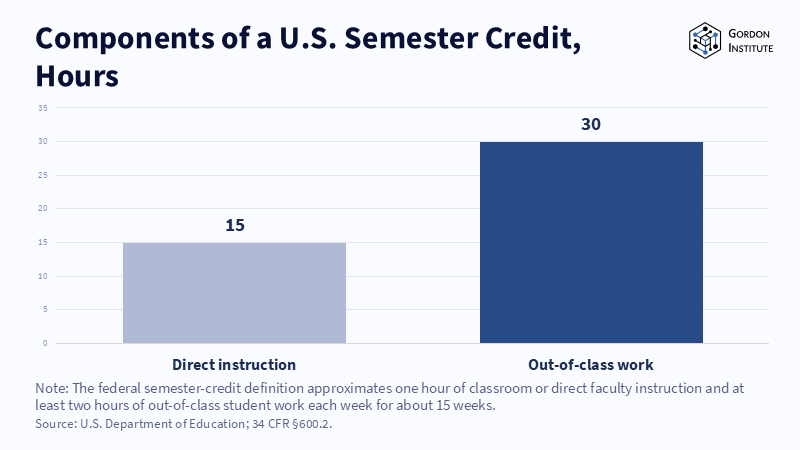
Credits supply a comparable administrative quantity across institutions, making records easier to exchange and requirements easier to audit. Assessing the quality of reasoning, writing or professional judgment is more difficult and requires discipline-specific standards. That does not mean time-based systems ignore outcomes; it means outcomes and workload are separate dimensions that can become poorly aligned. Chile’s debate adds another consideration. Some long degree pathways combine academic study with professional qualification, whereas other countries distribute those functions between universities, employers and licensing bodies. A five- or six-year programme may therefore include responsibilities absent from a shorter foreign degree. The discussion about reform in Chile needs to account for that institutional difference before deciding which requirements can be reduced or transferred elsewhere.
International Credit Systems Measure Different Things
Calendar comparisons become misleading when they treat all credits as equivalent units. European ECTS credits describe expected total student workload, including classes, independent study and assessment; one credit commonly represents 25–30 hours, with 60 credits corresponding to a full-time academic year. US semester credits have a different convention, while UK credits also generally express notional learning time rather than attendance alone. These measures cannot be compared by equating their numbers. Nor is a shorter calendar necessarily a reduced curriculum. A proposal to place approximately seventy-nine teaching weeks into two fuller years of study would chiefly redistribute time, potentially preserving content while reducing long intervals between terms. Whether that arrangement is feasible depends on student workload, staff capacity, placement requirements and the educational value of time spent outside scheduled instruction.
Professional preparation complicates the comparison further. A Chilean engineering or law pathway may combine academic learning with elements of qualification that occur after graduation elsewhere. In the United States or United Kingdom, additional supervised experience, examinations or employer training may be needed for particular professions. Requirements vary by occupation and jurisdiction, so neither country can be described by a single universal pattern. The total time to independent practice may consequently differ less than the degree calendars suggest. For reform, the relevant questions are which competences the university is responsible for, which require supervised practice and which a separate body can assess. Moving a requirement outside the degree does not make it disappear; it changes who finances, provides and verifies it.
These differences undermine the idea that a fixed duration or credit total is a universal natural measure of competence. They do not establish that time has no educational significance. Practice, reflection and cumulative exposure can matter even when the final outcome is assessed directly. A useful reform separates three questions: the volume of expected learning, the timetable over which it is organised and the evidence that the learner has achieved it. Institutions can change one without necessarily changing the others. Accreditation should make those distinctions explicit so that a faster programme is evaluated against its actual design rather than praised or rejected solely because of its calendar.
AI Changes Task Duration Without Automatically Changing Learning
Generative AI can shorten parts of academic production: preparing an outline, generating standard code, applying a familiar statistical procedure or reviewing documents. A workload estimate built around unaided completion may therefore cease to describe the same task. The educational implication is not that all the saved time should be removed from the programme. Students still need to understand assumptions, recognise errors and use results appropriately. Institutions can redirect effort toward those capabilities, revise assignments or require independent demonstration. The central question is what the task is intended to teach. If its former duration mainly reflected repetitive production, the estimate deserves review. If the duration reflected necessary practice, removing that practice may weaken learning even when a tool can supply the final product.
Critics of reduced-duration degrees offer an important counterweight. The American Association of University Professors warned in 2026 that shortening programmes can sacrifice intellectual development, while Christopher Rim argued that electives and apparently indirect learning experiences may cultivate adaptability and interdisciplinary reasoning. Those concerns cannot be resolved simply by asserting that AI makes education faster. A stronger reform protects breadth through explicit requirements and assessments, rather than assume it will survive any reduction in credits. It also avoids assuming that every elective is redundant or that every traditional requirement is indispensable. Reviewing the purpose and contribution of each component can create space for exploration as well as efficiency. The defensible objective is a better relationship between required effort and educational value, with evidence about both specialist mastery and the broader capacities a degree promises.
Competency-Based Pathways Require More Than a New Calendar
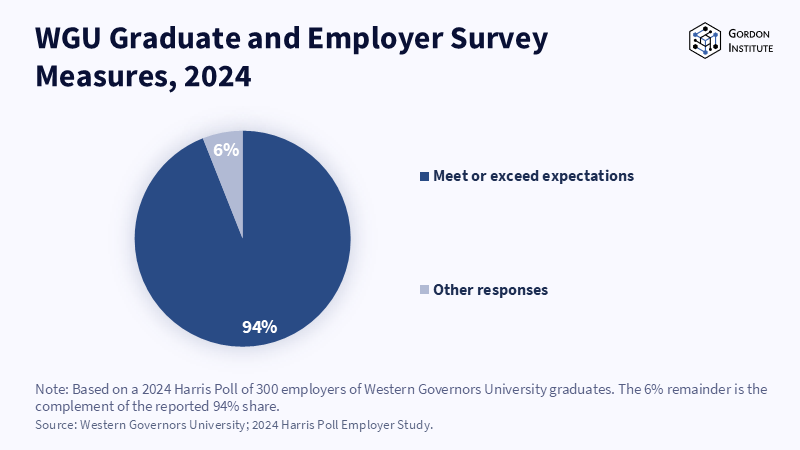
Western Governors University demonstrates that large-scale provision need not depend on the conventional sequence of fixed-length courses. Its competency-based model allows progress through demonstrated mastery, with more than 210,000 students reported during the 2024–2025 academic year. The outcomes discussed in its reporting include a Harris Poll finding that 94 percent of recent graduates were employed and favourable preparation ratings from all 300 surveyed employers. Such figures offer evidence about that institution’s students and respondents, not proof that any shortened model will produce equivalent results. The important contribution is organisational feasibility: assessment, student support and progression can be structured around demonstrated competence. Evaluating that approach still requires attention to entry characteristics, programme mix, completion, transfer and the quality of the assessment itself.
Pressure for change also reflects declining confidence in the value of higher education. The Sutton Trust’s analysis of British Social Attitudes findings reports that the proportion viewing a degree as not worth its time and cost rose from 14 percent in 2005 to 33 percent in the more recent comparison. The share expecting graduates to be substantially better off financially fell from about half to slightly above one-third. These measures do not identify credit conventions as the cause. Fees, labour-market conditions, inequality and perceptions of graduate outcomes may all influence confidence. They nevertheless show why reform proposals receive a hearing. Institutions need to explain what their requirements deliver and why the chosen pathway is proportionate to that value, rather than rely on the historical familiarity of the timetable.
A practical policy route is to permit a parallel pathway with explicit outcome standards, rather than abolish existing credits abruptly. Programmes could identify required competences, design reliable assessments and test whether students reaching the standard can progress more flexibly. Professional regulators would need to determine which components require supervised experience and which can be demonstrated in another way. Funding must adapt too. Support tied to completed modules or verified progression raises questions about assessment quality, student protection and incentives; it should not become payment for weakly validated results. A Chilean pilot could examine these issues alongside established programmes before wider adoption. Transfer recognition and access to subsequent study would be essential safeguards, because a quicker credential is of limited value if its holders encounter restrictions that were not clearly disclosed.
US accreditation practice already supplies a route for reviewing reduced-credit proposals. The Higher Learning Commission introduced a dedicated substantive-change application in September 2024. That procedure permits institutions to propose programmes below the conventional 120-credit bachelor’s requirement and subjects the design to review. It should not be confused with a federal body called the Higher Education Commission. Nor does approval of fewer credits automatically establish a competency-based curriculum: a reduced-credit programme may still use conventional courses and schedules. Policy should distinguish shorter calendars, reduced course volume and direct assessment of mastery. Each can be useful under appropriate conditions, but each presents different risks. Claims that all three represent the same reform obscure the specific quality-assurance questions that an accreditor must address.
Protecting Learning While Removing Unnecessary Delay
The University of Buckingham’s compressed medical programme illustrates the distinction between rearranging time and removing essential preparation. Its four-and-a-half-year structure covers a curriculum delivered over longer calendars elsewhere, in part through shorter vacation periods. The programme received General Medical Council accreditation in May 2019. That example supports the possibility of a more intensive schedule, not a general conclusion that clinical education can be reduced without constraints. Students still need supervised practice, appropriate feedback and manageable workloads, while staff and placement providers must support the revised calendar. Other disciplines face analogous questions. A programme that reduces unused intervals may preserve its learning design; one that removes general education, electives or practical experience must demonstrate how the promised outcomes remain achievable.
The policy distinction is therefore between avoiding unnecessary delay and weakening the learning experience. Credits can remain useful for describing workload and enabling transfer, while direct evidence of competence receives greater weight in progression and accreditation. AI makes that alignment more urgent because the same assignment can now take less production time without proving more understanding. A credible reform makes its educational promises explicit, tests them reliably and discloses the implications of a shortened pathway. Gordon Institute’s Policy Forum does not treat a three-year degree as inherently better or worse than a four-year one. The question is whether the programme supplies the breadth, judgment and specialist capability it claims, and whether the timetable is an effective means of achieving those ends.
This article presents analysis published by Gordon Institute’s Policy Forum. It does not constitute policy advice or an official policy position of Gordon Institute or any affiliated institution.
References
American Association of University Professors (2026) Three-Year Bachelor's Degrees Devalue Student Education and Do Nothing to Address the Root Cause. Washington, DC: American Association of University Professors.
Blackman, T. (2025) A Call for Radical Reform: Higher Education for a Sustainable Economy. Oxford: Higher Education Policy Institute.
Carnegie Foundation for the Advancement of Teaching (2026) What Is the Carnegie Unit? Stanford, CA: Carnegie Foundation for the Advancement of Teaching.
Corey, S. M. (2026) Three-Year Bachelor's Degrees: Why Higher Education Should Shorten the Path, Not the Purpose. Olivet, MI: The University of Olivet.
Datta, J. (2026) Degrees Still Matter: The System Around Them Needs Fixing. London: The Sutton Trust.
European Network of Information Centres and National Academic Recognition Information Centres (2026) European Credit Transfer and Accumulation System (ECTS). Brussels: ENIC-NARIC Network.
Rim, C. (2026) 'What both sides of the three-year college degree debate are getting wrong', Forbes, 31 July.
Rowsell, J. (2026) 'Shorten UK undergraduate degrees to just two years, says v-c', Times Higher Education, 9 March.
Sánchez, I. (2026) 'Should university degrees be shortened? The debate continues', University World News, 6 August.
Tooley, J. and Harris, J. (2023) 'Shortened medical degrees: a threat to quality?', HEPI Blog, 11 September.
Western Governors University (2025) Outcomes That Endure: WGU's FY2025 Annual Report. Salt Lake City: Western Governors University.
Similar Post
















