AI-Enabled Universities - Governing Learning, Assessment and Access

Input
Modified
Student AI use has outpaced institutional learning design
Access and faculty support require coordinated governance
Assessment must reveal understanding behind assisted work

Universities are no longer deciding whether generative AI will enter student work. They are deciding how to govern an activity already widespread. The Higher Education Policy Institute’s 2026 survey reports use by 95 percent of UK undergraduates, compared with 66 percent two years earlier. That scale makes a policy centred only on permission or prohibition increasingly inadequate. The important distinction is between using a tool to produce a deliverable and using it to develop understanding. Summarising a reading, improving a sentence or obtaining an initial explanation can be useful without demonstrating that the student has mastered the subject. The distance between widespread adoption and meaningful learning therefore deserves direct institutional attention. For education policy, the priority is to align assessment, staff development and access arrangements with the conditions under which students now study, rather than assume that an unchanged assignment retains its earlier evidential value.
Widespread Use Leaves Institutions with a Governance Task
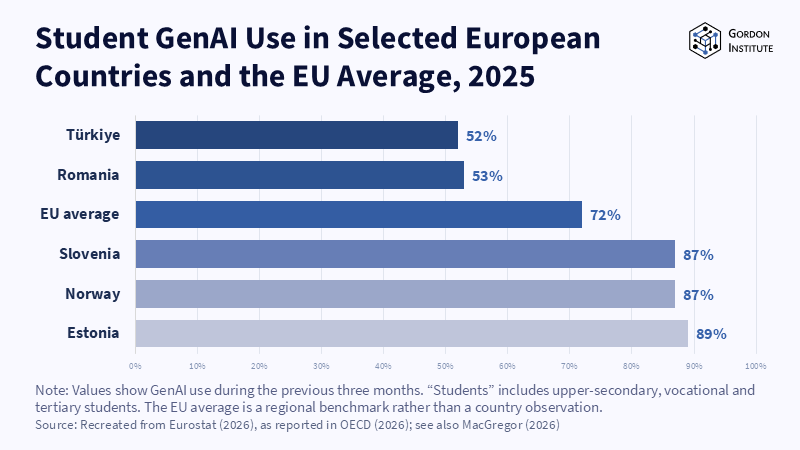
International surveys show that the UK is part of a broader pattern, although their populations and questions differ. A 2024 study across sixteen countries recorded generative AI use in study among 86 percent of higher-education students. The 2025 European figures discussed alongside Eurostat data put the average at 72 percent, with substantial variation: 89 percent in Estonia and 87 percent in Norway and Slovenia, against 53 percent in Romania and 52 percent in Türkiye. These comparisons include countries beyond the EU and should not be treated as a single uniform institutional sample. Faculty participation is also extensive. The Digital Education Council reported weekly use by 61 percent of academics across 28 countries in 2025, while Australian research found use by three-quarters of academics by mid-2024. A broader North American measure including administrative and support staff reached 84 percent in 2024, up from 41 percent a year earlier.
The distribution of use matters as much as its prevalence. German and British surveys find greater engagement among STEM and business students and staff than among those in arts and humanities. German findings also show use by 69 percent of men and 60 percent of women, with prior familiarity and confidence offered as explanations; availability of free tools does not establish equality of effective access. Across the global faculty evidence, only 17 percent describe themselves as advanced or expert users. Among those applying AI in teaching, 88 percent report minimal or moderate use. Students commonly turn to summarising, editing and translation. Such tasks can support study, but they are weak indicators of deeper conceptual engagement. Institutions need to distinguish familiarity with an interface from the ability to use it critically within a discipline.
These figures identify a design challenge rather than demonstrate a universal learning crisis. High uptake and limited depth can coexist because producing an answer is easier than learning to assess one. The policy objective should be to make productive, demanding use more accessible and more visible. That requires specifying what students must understand, what assistance is appropriate and how understanding will be evaluated. Adoption statistics alone cannot show whether a university is succeeding at any of those tasks.
Convenient Outputs Do Not Carry an Educational Purpose
Evidence of shallow use is consistent with the functions of general-purpose tools. In 2025, US students were reportedly less likely than a year earlier to seek AI help with difficult academic tasks or conceptual questions, continuing to turn to instructors for demanding explanations. A system designed to generate responses does not necessarily sequence practice, diagnose misconceptions or ensure that a learner can reproduce the reasoning independently. The 2026 review of ChatGPT’s cognitive effects describes potential benefits for some creative work alongside mixed evidence on deeper critical thinking. It also identifies risks from over-reliance and limited engagement with the reasoning process. These findings do not establish that AI cannot support learning. They show why the educational outcome depends on the surrounding task, feedback and assessment, rather than on the availability of an articulate answer.
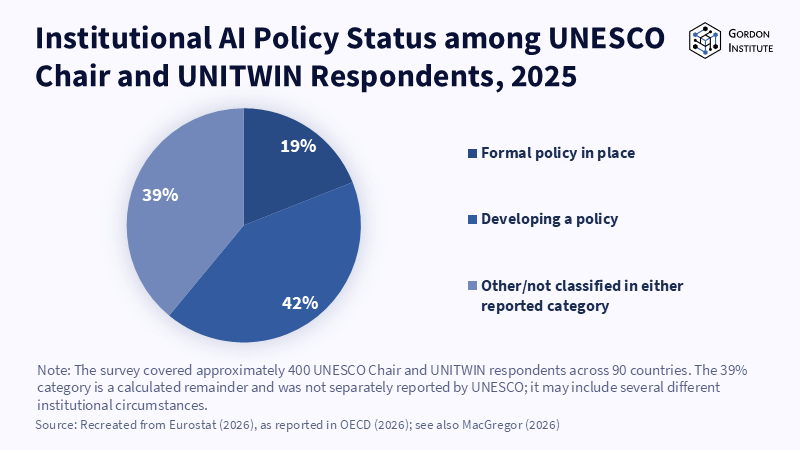
Institutional arrangements have developed more slowly. A UNESCO survey in 2025 covered approximately 400 Chair and UNITWIN respondents in 90 countries; 19 percent reported formal AI policies and another 42 percent reported policies under development. The sample should not be read as a census of all universities. UK researchers located publicly available policies at 96 of 163 institutions examined, which measures public visibility rather than every internal rule. Coursera’s findings add a capability concern: only 25 percent of faculty globally felt equipped to use AI effectively, and 28 percent believed their institution had prepared them to manage student use. Without shared guidance, individual instructors must resolve questions about acceptable assistance, privacy and integrity themselves. That decentralisation can produce inconsistent expectations for students taking courses within the same institution.
Access arrangements introduce a further source of variation. The Digital Education Council identifies ChatGPT, Grammarly and Microsoft Copilot among the tools students commonly use. Yet only 38 percent of UK institutions reportedly provide AI tools directly, while around 30 percent of German universities hold generative-AI licences. Students may consequently rely on free tiers or purchase their own subscriptions, producing differences in capability, availability and privacy protections. Institutional provision is not automatically the best answer in every setting, but institutions should make the choice explicitly. They need to explain which material may be entered into external services, what alternatives exist and how assessment avoids rewarding paid access rather than learning. Procurement and academic policy belong in the same discussion because the tools available shape what students can reasonably be expected to do.
Designing Assessment Around Explanation and Revision
The OECD’s future-skills discussion invites institutions to treat AI as a continuing feature of education planning. This changes the design question from protecting the old assignment to identifying which evidence of learning remains dependable when assistance is available. Prohibitions can still be appropriate for specific assessments, particularly when unaided performance is the capability being tested. They cannot substitute for a broader account of permitted use, learning objectives and supervision. A coherent policy combines opportunities to work with AI with occasions to demonstrate knowledge independently, while explaining the purpose of each.
Programming education provides a useful analogy. Students have long been able to obtain examples from manuals, repositories and discussion forums. An example becomes educationally valuable when they must adapt it to a problem, explain its assumptions and diagnose why it fails. The existence of borrowed code does not remove the need for understanding; an assessment can make that understanding necessary and observable. AI changes the volume and adaptability of the material available, so the analogy has limits. A model may now perform much of the debugging too. The transferable principle is therefore to evaluate the student’s reasoning about the solution, rather than assume that possession of a working result establishes competence.
Assignments can make reasoning visible through connected stages. Students might establish assumptions, apply a method, inspect an AI-generated attempt and justify revisions against course material. They can submit an explanation of what was wrong, why it mattered and how the revised result was checked. Oral follow-up, brief unaided components or variations introduced during assessment can help determine whether that explanation reflects understanding. Interdependent questions and customised materials can support this design, but they are not technically immune to modern models. A student may supply the entire task to a sufficiently capable system. The objective should consequently be valid evidence of learning, not an assurance that a chatbot cannot answer a particular prompt. The assessment needs to reveal decisions the student can defend and apply to a changed situation.
In an introductory statistics course, for example, asking for a generic explanation of a t-test yields little evidence about a student’s ability to analyse data. An instructor can instead provide a dataset with a deliberate assumption problem, ask for a diagnosis and require a comparison of plausible methods. AI may suggest tests, explain terminology or help identify code errors. The student must then justify whether those suggestions fit the data and interpret the resulting uncertainty. A dataset absent from training is not automatically beyond the model’s analytical capability, so novelty alone does not secure the assessment. What matters is the requirement to explain and defend the analytical choices, possibly against a follow-up variation. The same tool can then support practice while the assessment separately establishes what the learner understands.
Producing these assessments takes time. Linked questions, reviewed examples, reliable marking criteria and follow-up checks demand more preparation than reusing a broad essay prompt. Academic staff also face research obligations and large classes. Without workload support, recognition or shared resources, redesign depends on the discretionary effort of individual instructors. Institutions should therefore treat assessment development as funded academic infrastructure. Departments can build reusable task families and moderation processes, test whether they discriminate between levels of understanding and revise them as tool capabilities change. The purpose of shared provision is not to impose identical teaching across disciplines. It is to reduce duplicated effort while maintaining responsibility for the validity of each course’s assessment.
Making Local Experiments Useful Across the Education System
A successful classroom design has wider value when institutions can evaluate and share it. Korea’s designation of twenty universities to develop a common foundational AI curriculum, with support for staff training and shared materials, illustrates one route to coordination. French examples of universities co-developing tools with external partners offer another. Neither is a completed model for every system, but both recognise that isolated experimentation creates unnecessary duplication. Curriculum committees, university networks and ministries can support repositories of tested tasks, professional development and evidence about student outcomes. Quality assurance should examine the learning achieved, not simply whether the institution has purchased software or published a policy. Sector-level coordination can make good practice available beyond the departments with the greatest initial resources.
The adoption figures create an urgent governance obligation without dictating a single technological solution. Universities need assessments that distinguish supported production from understanding, staff equipped to guide use and access rules that students can follow consistently. Integrity procedures and detection tools may have limited roles, but they cannot establish the educational value of an unchanged curriculum. The policy opportunity is to connect the practical work of instructors with institutions capable of evaluating and distributing it. Gordon Institute’s Policy Forum approaches AI in higher education as a question of how public and academic systems protect meaningful learning while adapting to changed tools. A student’s ability to explain, question and apply an answer remains central, even when generating the first answer has become almost effortless.
The views expressed in this Policy Forum article are those of the author(s) and do not necessarily reflect the official position of Gordon Institute or its affiliates. This article does not constitute policy advice.
References
Coursera (2026) Coursera Campus Skills Report 2025. Mountain View, CA: Coursera Inc.
Digital Education Council (2024) Global AI Faculty Survey 2024. Zurich: Digital Education Council.
Eurostat (2026) Digital Skills and AI Use in Tertiary Education, 2025 Data Collection. Luxembourg: Publications Office of the European Union.
Higher Education Policy Institute (2026) Student Generative AI Survey 2026. Oxford: HEPI.
Li, X., Cui, Y. and Hagedorn, A. (2026) 'A systematic review of the cognitive effects of ChatGPT use in higher education', Journal of Computer Assisted Learning, advance online publication.
MacGregor, K. (2026) 'New OECD report explores AI in HE, emerging evidence', University World News, 24 July.
OECD (2025) What Should Teachers Teach and Students Learn in a Future of Powerful AI? OECD Education Spotlights, No. 20. Paris: OECD Publishing.
OECD (2026) Policies Supporting Responsible and Systematic GenAI Adoption in Higher Education. OECD Education Spotlights, No. 23. Paris: OECD Publishing.
UNESCO (2025) Global Survey on AI Governance in Higher Education Institutions. Paris: UNESCO.
Similar Post
















