Japan’s Mobility Divide - Purchasing Power and International Opportunity

Input
Modified
Japan’s inbound success coexists with constrained outbound mobility
Exchange rates and household income affect international access
Education and employment policies can reduce additional barriers
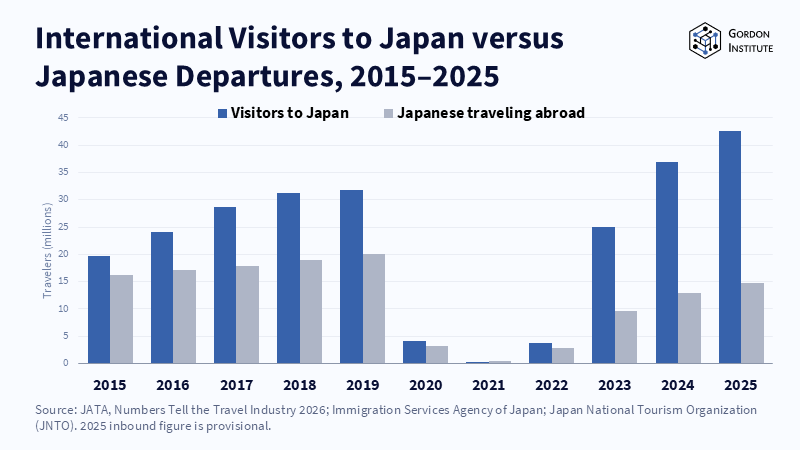
Japan’s tourism success presents two very different perspectives on international mobility. The country received 42.7 million overseas visitors in 2025, 33.9 percent above the 2019 level, while Japanese outbound journeys numbered only 14.7 million. Valid passports were held by 18.5 percent of the population, compared with 24 percent in 2019. These figures do not prove that Japanese citizens have become less interested in the world. They invite a closer examination of the cost of participation. A weak currency makes Japan more affordable to visitors while reducing what Japanese incomes can purchase abroad. The experience of Japanese travellers therefore raises a policy question extending beyond holidays: how can a society retain broad access to international education, work and exchange when household purchasing power is constrained? Cultural explanations may describe some preferences, but they should not displace economic evidence.
Internationalisation Is Advancing Unevenly
Waseda researcher Peter Chai describes a pattern of internationalisation flowing predominantly inward. Japan had 22.82 million valid passports at the end of 2025. The share rose from 17.3 percent a year earlier, but remained below its pre-pandemic level. Educational mobility shows a similar imbalance: the country hosted 408,069 international students as of May 1, 2025, while 91,054 students enrolled at Japanese higher-education institutions undertook study abroad in fiscal 2024. Two-thirds of the outbound experiences lasted less than one month. These counts measure different populations and periods, so they cannot be read as a direct exchange ratio. They nevertheless show that increasing the number of international students in Japan does not automatically provide Japanese students with comparable experience of institutions and daily life overseas.
The government’s targets make the asymmetry more visible. Its aim of attracting 400,000 international students had already been exceeded by 2025, while the ambition to send 500,000 pupils and students abroad by 2033 remains prospective. Inward and outward mobility require different policies. Japan’s attractiveness as a destination can rise without households becoming better able to finance foreign study, accommodation and travel. The duration of exchange matters too: a brief visit and a longer period of study offer different opportunities for language acquisition and familiarity with another institutional environment. Policy evaluation should therefore track participation, length, affordability and who receives the opportunity, rather than assume that successful recruitment of foreign students establishes a balanced international education system.
Historical Travel Growth Challenges Fixed Cultural Explanations
Japan’s earlier expansion of overseas travel provides a useful comparison. After liberalisation in 1964, outbound travellers numbered approximately 128,000. The count exceeded five million in 1986 and ten million in 1990, later reaching 18.49 million in 2012 and a record 20.08 million in 2019. The Plaza Agreement of 1985 was followed by a sharp appreciation of the yen, from roughly 240 to 120 per US dollar within two years. That change materially increased the foreign purchasing power of Japanese incomes. Rising prosperity, transport access and other developments also contributed, so the exchange rate should not be treated as the sole cause. The history nevertheless makes it difficult to explain current subdued travel through an unchanging national preference for staying at home.
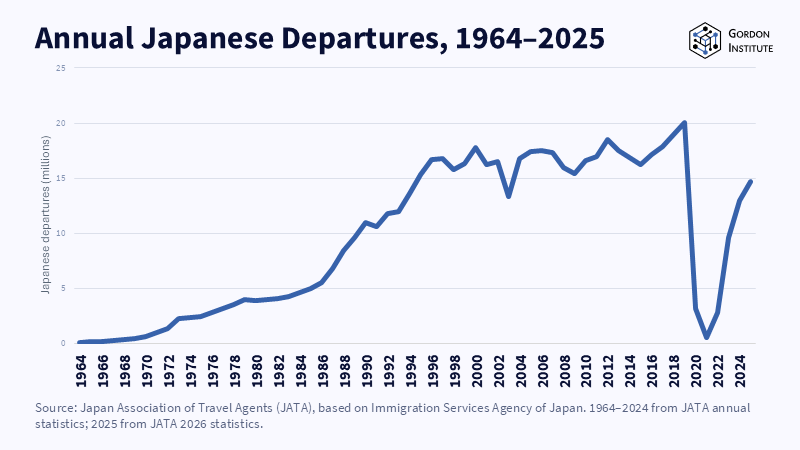
A stronger currency reduced the cost of overseas goods and services relative to household income, helping make travel accessible to a wider population. The United States was a leading destination, while France occupied a prominent position among European destinations. Economists at Natixis have drawn a comparison with China’s later increase in outbound tourism as incomes and purchasing power grew. Such comparisons support an economic mechanism without implying that travel preferences are identical across countries. Households weigh prices, available time, familiarity and expected benefits together. When income and exchange rates improve the affordability of a journey, more of those interested can act on that interest. When affordability worsens, a decline in participation need not mean that curiosity or willingness has disappeared.
Foreign Travel Costs Have Outpaced Household Resources
The exchange-rate conditions cited in the underlying account are markedly different from those of the late 1980s. The yen reached about 162 per dollar at the end of June and nearly 164 at the end of July, while its real effective exchange rate remained near early-1970s lows. These are period-specific observations rather than current quotations. Weak productivity forms part of the wider economic context, although it does not alone explain currency movements. The Japan Productivity Center places hourly labour productivity at $60.10 in purchasing-power-parity terms for 2024, ranking Japan twenty-eighth among 38 OECD members; output per worker ranked lowest in the G7. Purchasing-power-parity comparisons describe domestic economic capacity, while the market exchange rate directly affects the yen cost of foreign expenditure. Both are relevant, but they should remain analytically distinct.
Long-term wage evidence helps explain why rising foreign costs are difficult to absorb. The OECD series cited reports Japanese average annual wages of approximately $51,461 in 1991 and $51,129 in 2022 in purchasing-power-parity terms, against a 32.5 percent increase in the OECD average over the comparison. These figures are a historical benchmark, not a direct estimate of every household’s present disposable income. JTB’s travel outlook puts the average overseas-trip cost around $2,098 in the period discussed, 6.2 percent higher than a year earlier. Airfare, accommodation and exchange-rate changes all influence that bill. The combination of limited real wage growth and more expensive foreign services can reduce participation even among households that previously travelled regularly. The adjustment may involve shorter stays, cheaper destinations or deciding not to travel at all.
JTB’s survey illustrates the importance respondents attach to affordability. Some 78.9 percent reported no plans to travel abroad. High costs were cited by 33.6 percent, inadequate household finances by 26.4 percent and yen weakness by 24.4 percent. These reasons overlap, but are not interchangeable: the exchange rate affects foreign prices, while disposable resources also depend on domestic expenses, saving and employment circumstances. Together they indicate a substantial household-budget constraint. They do not establish that every non-traveller would otherwise have taken a trip. A policy response should therefore identify which barriers are binding for different groups and whether a proposed intervention can change the decision, rather than infer a single cause from aggregate survey shares.
Reducing Entry Fees Addresses Only Part of the Barrier
The passport-fee reduction cited for July 1, 2026 lowered the adult charge from ¥15,900 to ¥8,900. A ¥7,000 saving can matter to a household and may help a first-time traveller obtain the document. It does not materially change the price of flights, accommodation and living expenses abroad. The original discussion places the passport cost at less than 3 percent of an average overseas trip, illustrating the limited reach of the measure. The Economy’s economics editor Matthew Reuter similarly argues that a lower application charge cannot by itself overcome weak purchasing power. Policymakers should distinguish reducing a one-time administrative barrier from supporting the recurring costs of international participation. A fee measure may complement broader action, but it is a poor substitute for support directed at the expenses that dominate the journey.
Evidence on younger travellers also weakens claims of a general generational withdrawal. Research discussed by East Asia Forum places the 2024 outbound travel rate among women aged 20–29 at 29.4 percent, compared with a population-wide rate of 10.5 percent. Younger respondents were also less likely to identify a stronger yen as a prerequisite for visiting an appealing destination. These subgroup findings do not represent all young people, but they are inconsistent with a simple claim that youth have uniformly lost interest. Reiwa Travel’s survey of 4,127 people aged 18–29 found concerns about costs, language, health and safety among those without previous overseas experience. Such anxiety may be an obstacle that information and supported experience can reduce, rather than evidence of an established preference against travelling.
An extended period of low mobility may also affect familiarity within families. Parents who travel less have fewer opportunities to introduce children to foreign languages, practical arrangements and everyday experiences abroad. The next generation may then face both an economic barrier and greater uncertainty about the process. This is a plausible reinforcing mechanism, not a causal effect demonstrated by the aggregate figures. It nevertheless suggests why first-time participation deserves attention. Universities, schools and exchange providers can make costs transparent, offer preparation and provide reliable guidance. Those measures cannot cancel a weak exchange rate, but they can prevent avoidable uncertainty from adding to a financial constraint and help ensure that access is not limited to families with prior experience.
Mobility Policy Is Also Education and Labour-Market Policy
The implications extend beyond tourism spending. Sustained overseas experience can contribute to language capability, knowledge of foreign markets and familiarity with different institutional practices. Businesses may find it harder to develop those skills if fewer employees have access to international study or work. Japanese universities can host more foreign students without Japanese students acquiring equivalent experience abroad, although domestic international interaction can still provide substantial benefits. Meanwhile, Japan’s foreign-resident population reached approximately 4.1 million amid demographic decline and labour shortages. That growth has coincided with more contentious immigration debate. These developments should not be collapsed into a claim that travel alone determines social attitudes. They do show why international exposure, educational opportunity and workforce needs belong in a connected policy discussion.
The fiscal context limits the scope for an indiscriminate spending response. The IMF projection cited places gross public debt around 203 percent of GDP in 2026 and points to rising interest expenditure, potentially approaching twice its earlier 1.5-percent-of-GDP level by 2031. The government’s announced plan to mobilise more than $2.32 trillion in public and private investment by fiscal 2040 also raises questions about implementation and returns. The effect on yields and the currency depends on funding, market expectations and productivity outcomes, not simply the size of the announcement. More targeted mobility measures include support for longer study abroad, compatible academic calendars and recruitment practices that do not penalise time overseas. These proposals address specific costs and institutional obstacles, and can be evaluated by participation and learning outcomes rather than headline expenditure.
Japan’s visitor record and weaker outbound travel are consistent with an exchange-rate environment that helps foreign visitors while constraining domestic households. They are not a complete explanation of two populations’ behaviour, nor proof that preferences play no role. The stronger-yen travel expansion of earlier decades nevertheless shows that Japanese participation abroad can change substantially when conditions permit. Gordon Institute’s Policy Forum therefore frames the issue as access to international opportunity. Passport fees, household resources, study support and employment calendars affect different parts of that access. The policy task is to identify which combination can broaden meaningful participation, particularly for those excluded by cost or lack of familiarity, while recognising that durable gains in purchasing power depend on the wider economy.
This article presents analysis published by Gordon Institute’s Policy Forum. It does not constitute policy advice or an official policy position of Gordon Institute or any affiliated institution.
References
Benoza, K. (2023) ‘Why Japan has so many “never travelers”’, CNN, 19 February.
Chai, P. (2026) ‘Japan’s global exposure has a one-way ticket’, East Asia Forum, 31 August.
International Monetary Fund (2026) Japan: 2026 Article IV Consultation. IMF Country Report No. 26/075. Washington, DC: IMF.
Japan Association of Travel Agents (2024) ‘Trends in the number of overseas travellers’, Travel Statistics. Tokyo: JATA.
Japan National Tourism Organization (2026) Visitor Arrivals for December 2025. Tokyo: JNTO.
Japan Productivity Center (2025) International Comparison of Labor Productivity 2025. Tokyo: Japan Productivity Center.
Japan Student Services Organization (2026) Results of the 2024 Survey of Japanese Students Studying Abroad and the 2025 International Student Survey. Tokyo: JASSO.
JTB Corp. (2025) 2025 Travel Trend Outlook. Tokyo: JTB.
Ministry of Foreign Affairs of Japan (2026) Passport Statistics for 2025. Tokyo: MOFA.
Organisation for Economic Co-operation and Development (2026) Average Annual Wages. Paris: OECD.
Reuter, M. (2026) ‘“Overseas Travel Is a Luxury”: 80% of Japanese Lack Passports as Three Decades of Stagnation Entrench Travel Aversion’, The Economy, 11 August.
Similar Post
















