Thinking with AI: Why Human Judgment Still Matters

입력
수정
AI-assisted output can improve while independent understanding weakens
Cognitive support depends on retaining the ability to question results
Scientific responsibility requires reasoning that humans can defend

A polished answer is an uncertain measure of understanding. In a study of secondary education in China, nearly 27,000 students were observed as generative AI became part of their homework. After six months, assignment time fell from 64 to 45 minutes and assignment grades rose by 18 percent, while closed-book examination scores fell by 20 percent. The contrast raises a question that reaches beyond education: what capability remains with the person when a system performs the reasoning? For scientists, analysts and citizens evaluating complex claims, the issue is whether assistance strengthens the capacity to investigate or gradually substitutes for it. A completed task and a developed mind are different outcomes, even when they initially look alike.
Performance and Understanding Can Diverge
The study reports that the relationship between homework performance and examination results changed after AI adoption. Faster completion and stronger assignments no longer reliably indicated stronger independent performance. Reported losses in high-school and university entrance examinations reached 24 percent and 18 percent respectively, with effects developing over a longer period. Differences also appeared across subjects and groups: losses were larger in social subjects and STEM than in English, and younger students and high performers were among those more affected. These findings concern a particular educational setting rather than every form of AI use. Their wider significance lies in the distinction between producing an answer with assistance and retaining the knowledge needed to reconstruct it.
About one in five AI users continued to spend roughly as much time on assignments as non-users. Their examination performance was similar to that of students who did not use the tool, although their homework grades also improved. Time spent does not reveal exactly how they reasoned, but the pattern suggests that assistance and retained effort can coexist. It challenges the assumption that better technology necessarily makes independent practice dispensable.
Supporting Thought Without Surrendering Judgment
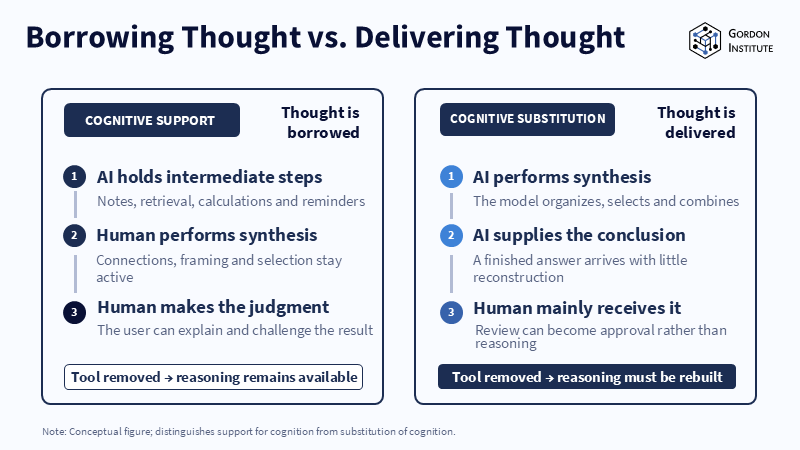
Externalising parts of cognition has always supported intellectual work. A notebook preserves observations; a diagram makes relationships visible; a calculator handles arithmetic that would otherwise occupy working memory. Such cognitive offloading can leave more attention for interpretation. Language models can play a similar role, but can also select premises, assemble explanations and propose conclusions. The boundary depends on the user's engagement. A drafted argument can support thinking if its assumptions are tested and its evidence checked. It can replace thinking if fluency is accepted as justification. The relevant distinction is therefore the intellectual control retained over the process, rather than the particular task delegated.
Consider a researcher asking AI to identify inconsistencies in a dataset or suggest an explanation for an unexpected result. Both requests can be useful, provided the researcher examines the data, considers alternatives and tests the proposed explanation. Even a generated conclusion may be a legitimate starting point. The risk emerges when it becomes the endpoint without investigation. As in the workplace, the visible deliverable may conceal whether its author can distinguish a defensible inference from an attractive mistake.
Scientific Responsibility Remains Human
Scientific responsibility cannot be satisfied by naming the system that generated a claim. Authors remain responsible for the evidence they present, the methods they describe and the conclusions they endorse. An AI model can assist with these activities, but cannot answer a peer review challenge or repair a misleading result on its own initiative. Responsibility also extends to institutions providing tools, training and incentives. A researcher working under unrealistic deadlines or without access to reliable sources faces a different environment from one supported by proper verification. Human responsibility should therefore mean an organised capacity to inspect claims, rather than a convenient attribution of blame after failure.
A credible arrangement of shared responsibility gives each participant something concrete to examine. Developers document limitations; institutions provide review procedures; users verify relevant evidence and explain their decisions. In research, this can mean retaining source documents, recording substantive assistance and checking that code implements the intended method. The person approving a result needs the knowledge and authority to challenge it. A nominal human signature offers little protection when the signer lacks either.
Keeping Reasoning Within Reach
Delegation becomes fragile when understanding can be recovered only after someone asks for an explanation. A reviewer may question a citation, a colleague may challenge a modelling assumption, or a public audience may ask why a recommendation follows from the evidence. Reconstructing an unfamiliar chain of reasoning at that point can be costly and uncertain. The alternative is to preserve engagement while the work develops. Researchers can inspect intermediate outputs, compare explanations and test conclusions against observations. Educational institutions can protect opportunities for independent reasoning alongside assisted work. The Chinese study suggests that retaining effort need not prevent useful assistance, although it does not establish an optimal amount of time for every task. The aim is accessible reasoning at the moment it matters.
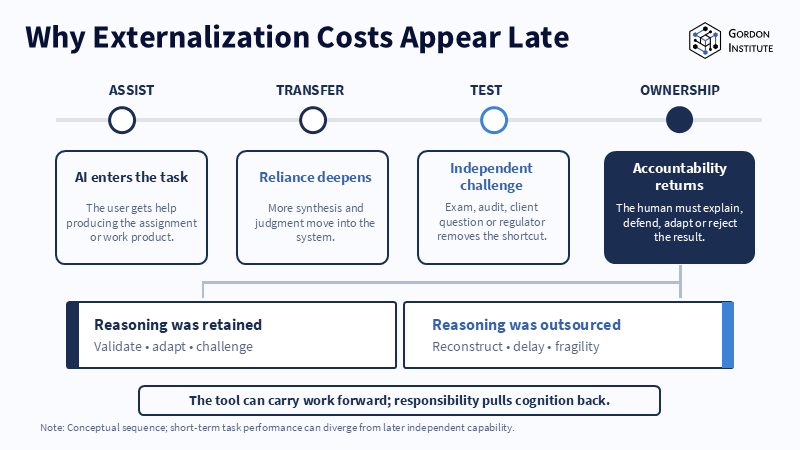
This approach may reduce some immediate time savings, but it can also prevent errors and repeated work. The balance depends on the task: checking a routine transcription is different from evaluating a causal claim. Verification should follow the consequences of being wrong and the uncertainty of the evidence. Human judgment is valuable because it can decide where additional attention is needed, including when the model's confident answer should be set aside.
The classroom evidence opens a broader scientific discussion about what humans should retain as AI becomes more capable. Generating language, calculations or candidate explanations may become easier; deciding which claims deserve trust still requires cultivated understanding. Institutions should evaluate assisted performance together with the capacity to explain, revise and independently assess it. The lasting benefit of AI will depend partly on whether it expands the number of people able to reason well. That is a different ambition from expanding the number of answers they can obtain.
This Science Forum article is adapted from material published within Gordon Institute’s network. It presents editorial analysis and does not constitute professional advice or an official institutional policy.
관련기사
















