AI Detection in Universities: What Counts as Reliable Evidence

입력
수정
A detector score is an inference about text, not proof of misconduct
Language, editing and deployment conditions affect errors and fairness
Integrity procedures need corroboration, clear rules and a fair opportunity to respond

Universities face a difficult evidentiary question: what does an AI detector's score establish about a student's conduct? It may indicate that a text resembles examples classified as machine-generated. It does not reveal who produced it, what assistance was used or whether that assistance violated the assignment's rules. The University of Nevada, Reno's decision reported in its institutional account to discontinue AI detection illustrates the practical consequences of this gap. Institutions must investigate integrity concerns without turning a probabilistic classification into an automatic accusation. For Science Forum, the issue is the quality of inference: how an observed feature of text becomes a claim about authorship and then a claim about misconduct. Each step needs evidence, and uncertainty at the first step cannot disappear simply because the decision has serious consequences.
Define the Allegation Before Testing the Text
Earlier disputes about plagiarism show why this chain matters. Textual similarity can identify material that warrants examination, but context determines whether it represents quotation, inadequate attribution, developmental writing or deliberate misrepresentation. Second-language writers may need explicit teaching about unfamiliar scholarly conventions. That does not remove integrity standards; it requires standards that distinguish the relevant behaviours fairly. AI detection adds another layer of uncertainty because a classification often concerns writing style rather than a match to a recoverable source. A student can produce predictable prose without using AI, and an AI-assisted passage can be heavily revised. Procedures should begin with a clear allegation and a clear rule, not with a percentage whose meaning has not been established for the case.
Özgür Çelik's discussion of university policy recommends explicit assessment expectations, attention to second-language students, caution about detector scores and examination of writing processes. These proposals can be understood as principles of evidence design. The institution should know what it is evaluating and which observations support its conclusion. If an assignment permits editing assistance but prohibits outsourcing analysis, identifying possible AI-like language does not resolve whether the prohibited act occurred. A fair procedure should distinguish permitted support from undeclared or prohibited contribution. It should also give students an understandable opportunity to explain their work. Clear expectations improve the interpretation of evidence; they do not depend on assuming that either the detector or the student is always correct.
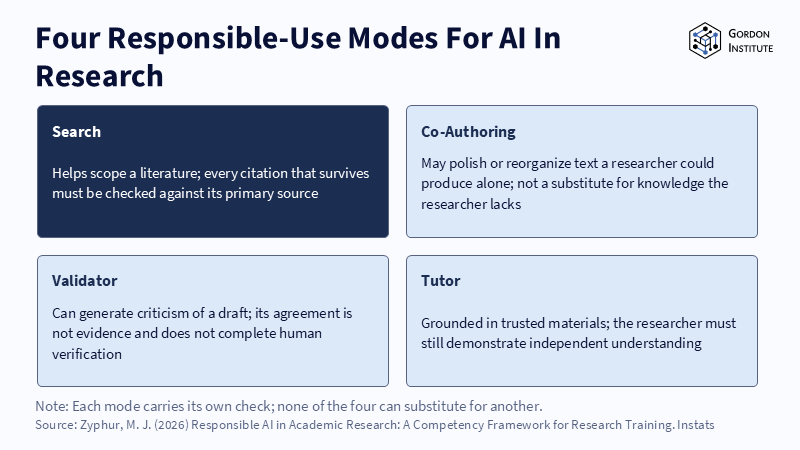
Research on institutional AI policies also identifies a distinction between declaring assistance and demonstrating competence. Zyphur's review examined here examined 38 doctoral universities alongside funders and publishers, finding substantial variation in expectations about responsible use. For detection disputes, this variation matters because the same use can be allowed in one setting and prohibited in another. A system cannot infer the applicable rule from prose alone. Institutions should specify which assistance is permitted and what must be disclosed, while considering whether the researcher can substantiate the result. Competence and misconduct are related but separate questions. A student may lack understanding without breaching a rule, or breach a disclosure requirement while understanding the work. A credible procedure should avoid collapsing these possibilities into a single authenticity score.
Detector Accuracy and the Risk of Unequal Errors
Detector studies show why general accuracy claims need careful interpretation. Performance depends on the test population, the language, the generator, the type of writing and whether the material has been edited. A favourable result on one benchmark does not establish reliable use across university assignments. Stanford researchers found that several GPT detectors frequently misclassified non-native English writing, with predictable language patterns contributing to false positives. This is an empirical concern about unequal errors rather than proof that every detector behaves identically. False negatives also matter: revised machine text may escape classification. An evaluation should report the relevant error rates and testing conditions, not simply an overall percentage. The prevalence of prohibited use affects how many flagged submissions are likely to represent real violations, which further limits what a score can tell an investigator.
Nevada’s account of its experience describes anxiety among students and uncertainty among faculty about how to use detector results. These are plausible consequences of a tool whose institutional significance exceeds its demonstrated evidentiary strength. Teachers may feel obliged to act on a flag even when they cannot explain its basis. Students may struggle to contest an inference presented as technical fact. Scientific evaluation should examine these effects rather than assume that deployment necessarily deters misconduct or improves learning. A tool can increase the number of investigations without increasing the number of sound conclusions. Its value must be judged against the complete decision process, including errors, appeals, staff time and the clarity of communication with those affected.
Replacing detection with writing guidance changes the educational intervention, but its benefits also need evidence. A guidance platform may support planning and revision; it does not automatically establish authorship or eliminate dishonest use. Nevada's reported change is therefore best treated as an institutional case rather than a universal proof of what universities should purchase. The important distinction is between helping students develop work and inferring misconduct from its surface. Institutions considering either approach should ask what problem the tool addresses, how its effectiveness is measured and what happens when it fails. Procurement should follow those questions. A software category labelled as integrity protection is not, by itself, an evidence-based integrity strategy.
From Suspicion to Corroborated Evidence
Corroboration can come from information closer to the alleged conduct. Drafts, notes, source use and explanations of methodological choices may help clarify how an assignment developed. They are not perfect records, and institutions should avoid demanding that every student archive every keystroke. A discussion might instead focus on a small number of consequential decisions: why a source was used, what an argument means or how a calculation was performed. Such evidence is relevant because it concerns the work itself. It should be interpreted with attention to language, accessibility and the pressure of an investigation. Difficulty answering an unexpected question is not automatically proof of outsourcing. The procedure needs several converging observations and a proportionate standard.
Studies of AI and critical thinking provide context for education, but do not validate detectors as misconduct evidence. The survey of 319 knowledge workers examined here links confidence in AI with self-reported cognitive engagement. It concerns how people describe their work, not whether a particular passage was generated. Universities should keep these research questions separate. Concerns about reduced practice may justify changes in teaching even when no integrity rule has been broken. Similarly, evidence that assistance can improve performance does not settle whether a student complied with disclosure requirements. Clear distinctions allow institutions to respond to learning problems through teaching and to substantiated misconduct through appropriate procedures, without treating every concern about AI as the same kind of allegation.
An observable account of reasoning can be useful even when authorship remains uncertain. Asking students to explain a choice or evaluate a limitation gives evidence about understanding that a stylistic detector cannot supply. However, process evaluation should not be presented as infallible detection by another name. Students can prepare convincing explanations, and genuine authors can struggle under pressure. Its educational value lies in developing and assessing competence. Its evidentiary value depends on the question being investigated and the surrounding facts. Universities should state which function a particular exercise serves. This avoids promising that a redesigned assignment will solve every integrity dispute while recognising its contribution to better assessment.
Design Integrity Procedures That Can Be Defended
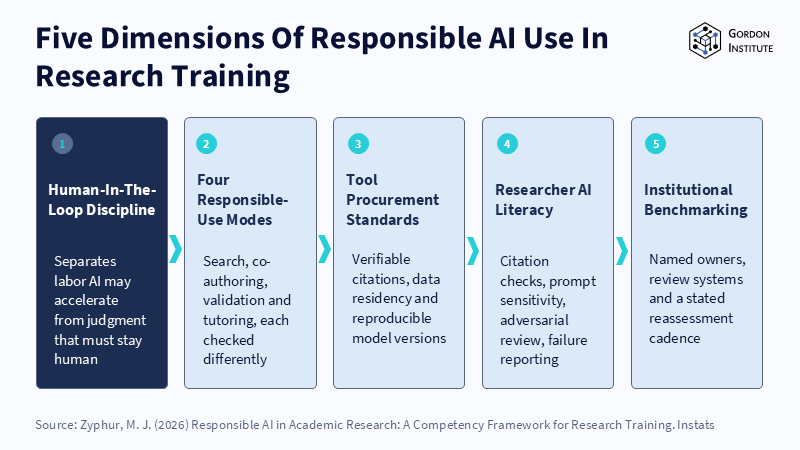
A defensible integrity procedure needs clear rules, relevant evidence and an opportunity to respond. Faculty should understand the limits of any detector used, including the difference between a classifier score and a calibrated probability of misconduct. Students should know what assistance is allowed and how to declare it. Investigators should examine corroborating information and document why it supports the conclusion. Institutions selecting AI tools can also consider verifiable sources, uncertainty information and audit trails, but those features should be tested rather than accepted as marketing claims. These requirements apply whether the allegation involves AI, plagiarism or another form of misrepresentation. The scientific contribution is to align the strength of the conclusion with the strength of the evidence.
Removing a detector does not establish that misconduct will disappear, nor does retaining one establish that it will be prevented. The relevant evidence would compare soundly adjudicated cases, false accusations, deterrence and administrative costs under different arrangements. A detector might sometimes identify material worth examining, but that possibility is different from using its output as sufficient grounds for a finding. Institutions should also consider incentives: harsh procedures based on uncertain evidence can encourage students to focus on avoiding a classifier rather than meeting an intellectual standard. A fair system directs attention towards honest representation and demonstrable understanding. It should be capable of correcting its own mistakes as readily as it expects students to correct theirs.
Scale is a real constraint. Large courses cannot routinely review extensive histories or conduct long interviews for every submission. Proportionate checks, targeted discussion and clearer assignment design can reduce the burden, but they still require time and training. Claims that changing procedures will automatically save resources should be tested. Universities can compare investigation workloads, appeal outcomes and the quality of decisions, rather than measure only how many texts were screened. A process that produces fewer unjustified accusations while retaining effective scrutiny may be valuable even if it does not maximise the number of flags generated.
AI detection is ultimately a case study in the limits of inference. A pattern in text is not a direct observation of the person, process or rule that produced it. Universities should evaluate classification tools under realistic conditions, make uncertainty visible and resist converting a score into a verdict. They also need educational designs that support competence and procedures that address genuine misrepresentation fairly. These aims can coexist without requiring perfect authorship detection. For Gordon Institute's Science Forum, the central principle is straightforward: consequential claims about people should be supported by evidence that can be examined and challenged. An institution's integrity is demonstrated partly by the care with which it reaches those conclusions.
This Science Forum article is adapted from material published within Gordon Institute’s network. It presents editorial analysis and does not constitute professional advice or an official institutional policy.
관련기사
















