The Measurement Problem in AI and Employment: From Exposure Scores to Causal Evidence

입력
수정
AI removes some tasks while creating demand elsewhere
Single exposure scores hide these opposing task effects
Hiring of young workers falls while aggregates stay calm

Current occupational AI exposure indices aggregate diverse task-level impacts into a single score, obscuring distinct mechanisms by which AI influences labor within jobs. For example, medical secretaries and secondary school teachers receive nearly identical exposure ratings—differing by only 0.027 points—though about two-thirds of a medical secretary’s tasks are automatable by AI, while approximately one-fifth of a teacher’s tasks fit this profile, many being complemented rather than replaced by AI. These contrasting substitution and complementarity effects operate simultaneously within the same occupation,and collapsing these divergent task dynamics into a singular occupational exposure score masks the nuanced economic realities affecting employment and productivity.
Artificial Intelligence Acts on Tasks, Not on Whole Occupations
Economic analyses increasingly recognize that tasks—not occupations—are the appropriate unit for studying technology’s labor impacts. Job roles consist of heterogeneous activities, some of which AI can automate end-to-end, while others depend on human discretion, physical presence, or licensing. Despite this insight, most AI exposure metrics remain aggregated at the occupation level, largely due to data constraints and historical feasibility. However, the advent of large language models enables task-level classification, exposing substantial variation in task automation potential within the same occupation and across models. occupational exposure measures revealed wide variability; for example, depending on the language model used, between 2.7% and over 50% of occupations were classified as highly exposed to AI. This highlights dependency on model architecture, training data, and classification criteria, raising questions about reproducibility and construct validity when using AI to quantify exposure.
The limitations imposed by aggregating to a single occupational exposure number extend beyond mere measurement error to fundamental issues of construct validity. In the widely referenced AIOE index, medical secretaries and secondary school teachers register nearly identical exposure scores—differing by only 0.027 points on a multi-point scale—implying comparable AI impact. However, dissecting their job tasks reveals stark contrasts: approximately two-thirds of a medical secretary's functions, such as summarizing, transcribing, and scheduling, are fully automatable by AI, whereas only about one-fifth of teaching tasks fall into this category, with a significantly larger share representing AI-complementary activities that augment rather than replace human effort. These two occupations together encompass close to two million U.S. workers and experience divergent AI-driven labor dynamics that a homogenous occupational index cannot differentiate, thus obscuring the underlying economic mechanisms and potentially misleading empirical inferences about AI's employment effects.
Substitution, Complementarity and the Inert Majority
Scientific measurement of AI’s labor market effects requires precise conceptual distinctions at the task level. A meaningful theoretical framework classifies individual job tasks by their human requirements and AI capabilities, an approach articulated by Liminal Capital researchers in 2026. They propose three operational categories: substitution tasks, which AI can fully perform without human intervention—such as drafting legal documents or completing standardized forms; complementary tasks, requiring ongoing human presence or specialized credentials—like psychotherapy sessions or teaching, where AI supports rather than replaces human effort by enhancing productivity or lowering costs; and inert tasks, which remain inaccessible to current AI technologies due to their reliance on physical dexterity, personalized judgment, or licensed authority. The inert category encompasses occupations and activities that artificial intelligence systems, as presently constituted, cannot effectively replicate or automate.Examples include trades such as plumbing, construction, and personal services like barbering, which continue largely unaffected by AI advancements. Empirically, when weighted by employment shares, tasks in the US labor market are approximately distributed as 32% substitutable, 15% complementary, and 53% inert. This quantification underscores that while a significant portion of labor is influenced by AI—either via substitution or complementarity—the majority remains insulated. Importantly, this task-level decomposition highlights the coexistence of distinct mechanistic effects within the labor market, necessitating separate identification rather than collapsing effects into aggregate occupational exposure metrics, thus enhancing construct validity in measuring AI’s economic impact.
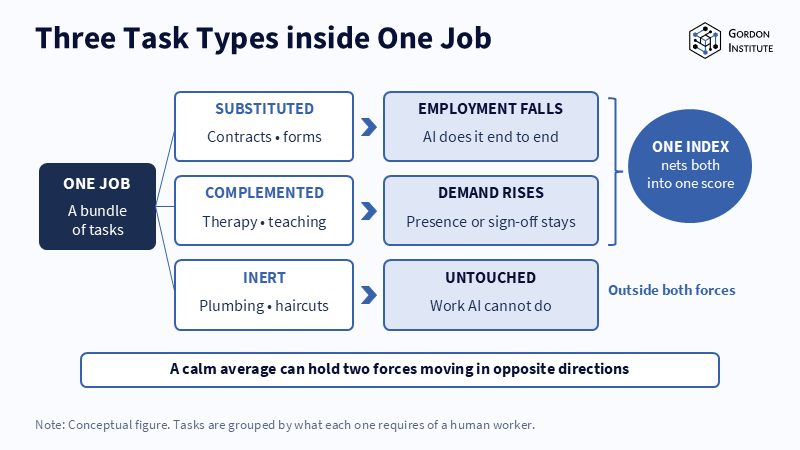
Disaggregating labor-market data by separate task-level categories of substitution and complementarity reveals opposing employment trends within the same analytical model. Specifically, substitutable tasks exhibit an annual employment growth rate approximately 3.3 percentage points lower than tasks unaffected by AI, while complementary tasks grow approximately 3.3 percentage points faster per year. Translating these rates into employment counts yields an estimated annual loss of roughly 1.5 million jobs attributable to substitution, offset by a gain of approximately 0.7 million jobs from complementarity effects. Because these rates evolve at comparable speeds, the net employment impact hinges more on the differing task composition across industries and occupations than on the magnitude of the individual forces. Importantly, these statistically significant relationships emerge only in data from 2021 onward—postdating large-scale generative AI adoption—and vanish in the preceding 2015–2019 period, reinforcing their mechanical association with technological diffusion rather than spurious trends.
This fundamental distinction clarifies the conflicting empirical results pervasive in the literature regarding AI's labor-market impact. Aggregate exposure indices conflate substitution and complementarity effects, yielding inconsistent significance and direction depending on their task composition. Specifically, indices weighted toward substitution-dominant tasks tend to indicate employment declines, whereas those capturing complementarities show gains. Moreover, a 2025 independent time-use analysis that separately classified tasks found opposing effects of substitution and complementarity on weekly working hours, reinforcing the necessity of disaggregating these mechanisms. This underscores the critical importance of construct validity in measurement: research instruments must align precisely with the underlying economic phenomena to produce reliable, interpretable findings.
Artificial Intelligence and the Job Market: Why Aggregates Look Calm
If AI merely displaced workers, highly exposed occupations would experience higher unemployment. However, recent evidence from the Stanford Institute for Economic Policy Research shows marginally lower unemployment growth in the most exposed quintile compared to the least. This suggests that aggregate unemployment masks complex underlying shifts. Rather than simple job destruction, AI’s impacts involve redistributions between substitution and complementarity forces that net out at occupational or economy-wide scales. general easing of the labor market was underway,and aggregate indicators conflate offsetting mechanisms that obscure clear trends in either margin.
Empirical evidence reveals a nuanced productivity picture where AI facilitates complementary gains in specific contexts. For instance, a generative AI assistant deployed in a large call center increased overall productivity by 15%, notably driving a 30% improvement in hourly service resolutions among less experienced workers, with no measurable gain for veterans. Similarly, an experimental deployment of GitHub Copilot enabled software developers to complete programming tasks 56% faster. These findings illustrate how AI augments human labor rather than solely substituting it, offering productivity enhancements concentrated among certain worker groups. This pattern aligns with the established "productivity J-curve" concept in economic history, which captures how transformative technologies often induce an initial phase of muted or even declining measured productivity before substantial organizational investments in software, training, and workflow redesign generate clear productivity improvements. Recognizing this temporal disjunction between technological capability and aggregate output statistics is essential for researchers aiming to link AI adoption causally to labor market outcomes.
Adjustment Runs Through Hiring and Falls on Young Workers
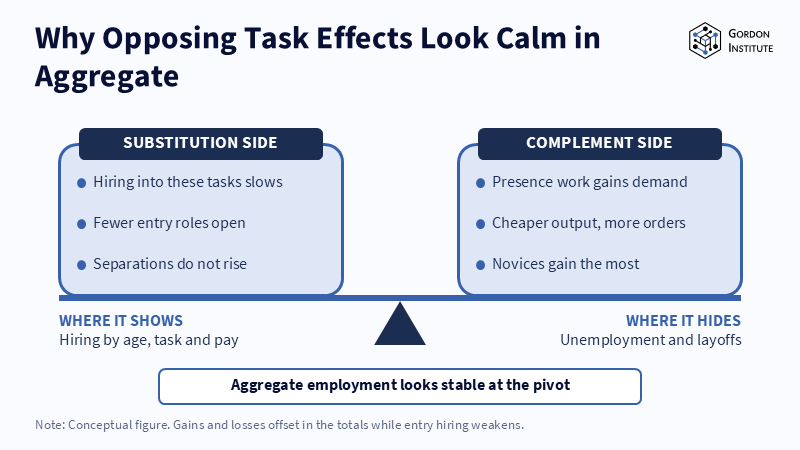
Studies reveal that post-AI adoption labor market adjustments manifest primarily through hiring rather than layoffs. For example, exit rates among workers in highly substitutable occupations did not rise after ChatGPT’s release, indicating minimal forced separations. instead, reductions impact early-career recruitmentWith respect to younger workers aged 22–25, hiring in highly substitutable jobs declined by approximately one third, while recruitment in non-substitutable occupations remained stable. Payroll data also shows stable or growing employment for older cohorts in these roles. Rising unemployment among recent graduates suggests initial labor market entry barriers linked to AI substitution. Analyses controlling for confounding factors such as the 2022 interest rate cycle and post-pandemic recovery confirm these differential hiring trends, emphasizing age-stratified recruitment flows as early detectors of technological labor market shifts. interest rate cycle since 2022, and controls for post-pandemic labor market recovery do not eliminate the observed two-margin effects.
The observed impact extends beyond wage distributions, initially manifesting with statistical significance in low-wage, high-turnover occupations and progressively emerging within middle-wage roles. This pattern underscores the critical need for granular labor market metrics—including detailed recruitment flow data segmented by worker age, specific task categories, and wage brackets—to accurately detect and monitor early-stage shifts attributable to AI-driven labor transformations that aggregate unemployment figures obscure.
From Shifting Tasks to Redistributing Labor
Projections over the next decade indicate substantial labor hours could be automated—estimated at 54% by 2035. However, multiple offsetting factors limit net reductions in labor demand: alleviation of overwork in labor-short sectors, increased demand from cost reductions, growth in oversight and control tasks, plus institutional constraints on layoffs. Collectively, these reduce net labor displacement to around 21% of hours, which may be counterbalanced by demographic and economic growth in sectors such as healthcare, construction, energy, and digital services. via demographic and economic growth in aging populations, construction, energy, and digital economies,although labor reallocations occur mostly within occupations, a smaller subset of workers face cross-occupation transitions,.
A key theoretical implication is the distinction between the existence of growing occupations and workers' realistic ability to transition into them. Empirical evidence indicates that only about 14% of workers who need to change jobs face a direct, seamless pathway into expanding fields without significant retraining or income loss. Furthermore, approximately 85% of these growing occupations require formal certification, and around 76% demand physical presence, limiting remote work opportunities. While historical precedent shows market adaptation to prior general-purpose technologies—where newly created occupations now constitute about one-third of US employment—this does not guarantee similar speed or ease of transition. The rapid pace of AI-driven labor market shifts poses unprecedented challenges for occupational mobility and workforce retraining programs, underscoring the necessity for policy frameworks that recognize the complexity and scale of these transitions.
The coexistence of optimistic and pessimistic interpretations stems from the aggregation of divergent task-level mechanisms into a single occupational AI exposure index, which permits selective validation of contrasting narratives within the same overall labor market trend. Empirical evidence indicates that substitution effects have emerged first within low-wage, high-turnover occupations and have recently become detectable among middle-wage jobs. However, current datasets lack sufficient granularity and longitudinal scope to determine whether this substitution trend will extend further into higher-wage roles constrained by requirements such as physical presence or professional licensing. To rigorously discern these dynamics, researchers must develop and apply scientifically grounded, task-disaggregated metrics that separately capture substitution and complementarity effects, supplemented by detailed labor-market data on hiring flows stratified by worker age, task category, and wage level. This approach promises enhanced measurement validity and causal insight into how AI-driven labor transformations unfold across the occupational wage structure.
This article reflects the analytical judgment of the author and does not constitute policy advice or the official position of any affiliated institution.
Autor, David H., Levy, Frank and Murnane, Richard J. (2003) 'The skill content of recent technological change', Quarterly Journal of Economics, 118(4).
Brynjolfsson, Erik, Chandar, Bharat and Chen, Ruyu (2025) Canaries in the coal mine? Stanford Digital Economy Lab.
Brynjolfsson, Erik, Chandar, Bharat and Chen, Ruyu (2026) Canaries, interest rates, and timing. Stanford Digital Economy Lab.
Brynjolfsson, Erik, Li, Danielle and Raymond, Lindsey (2025) 'Generative AI at work', Quarterly Journal of Economics, 140(2).
Brynjolfsson, Erik, Rock, Daniel and Syverson, Chad (2021) 'The productivity J-curve', American Economic Journal: Macroeconomics, 13(1).
Felten, Edward, Raj, Manav and Seamans, Robert (2021) 'Occupational, industry, and geographic exposure to artificial intelligence', Strategic Management Journal, 42(12).
Jiang, Wei, Park, Junyoung, Xiao, Rachel J. and Zhang, Shen (2025) AI and the extended workday. SSRN Working Paper.
Mahoney, Neale, McEntarfer, Erika and Wahal, Karsen (2026) What is really happening to jobs? SIEPR Policy Brief.
Peng, Sida, Kalliamvakou, Eirini, Cihon, Peter and Demirer, Mert (2023) 'The impact of AI on developer productivity', arXiv.
Ramírez, María Jesús, Ellingrud, Kweilin, Catlin, Tanguy, Castresana, Diego and Kortis, Anna (2026) Workforce in motion. McKinsey Global Institute.
Solow, Robert M. (1987) 'We'd better watch out', New York Times Book Review, 12 July.
Verschuere, Benjamin and Cameron, Angus (2026) Hiding in the mean. SSRN Working Paper 7195359.
Yin, Michelle (2026) 'When the ruler is made of the thing it measures', VoxEU, 12 May.
Adapted from Artificial Intelligence and the Job Market: Jobs Created and Lost at Once.
관련기사
















