Research Training with AI: From Disclosure to Scientific Competence

입력
수정
Declaring AI use does not demonstrate understanding of the resulting research
Training should develop verification, methodological judgment and reproducibility
Institutions and researchers share responsibility for competent AI-assisted work

A researcher can disclose AI assistance accurately and still misunderstand the analysis it helped produce. This gap separates compliance with an integrity rule from competence in scientific work. University policies commonly address authorship, permitted use and disclosure, but training must also develop the ability to select methods, check evidence and explain conclusions. Studies of AI use raise concerns about reliance on AI and reduced reported cognitive effort. They do not prove that a particular age group loses its capacity to think because of AI. Their value is to identify questions for education: which forms of assistance support expertise, and which allow polished work to conceal missing understanding? Research training should make that distinction observable through the way projects are planned, reviewed and defended.
Integrity Rules and the Competence They Leave Unmeasured
The history of plagiarism policy offers a warning about confusing a suspicious text with an understood learning problem. Novice scholars, including those writing in a second language, may need explicit teaching about attribution, paraphrase and disciplinary conventions. That need does not excuse deliberate misrepresentation, but it changes what an institution should provide before relying on disciplinary procedures. AI introduces additional questions about evidence, analysis and intellectual contribution. A disclosure statement can identify a tool without explaining what the author verified. Training should therefore connect integrity expectations to the capabilities required to fulfil them. A student told to take responsibility for an output needs to learn how to inspect its sources, reproduce its calculations and judge whether its claims follow.
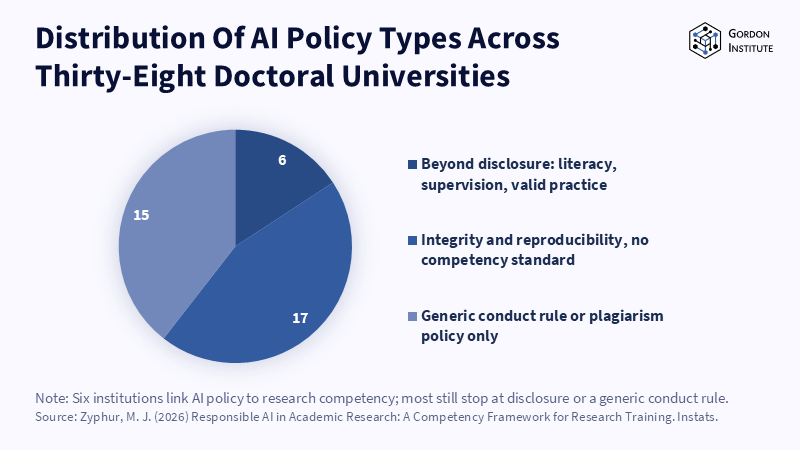
Michael Zyphur's account of policies at 38 doctoral universities in 15 countries distinguishes rules about conduct from more developed expectations of research competence. The research discussed here describes six institutions moving towards substantive guidance, with the remainder concentrated on general integrity or reproducibility requirements without clear competency standards. This is a bounded review, not a census of university practice. It nevertheless identifies a useful institutional question: what must a researcher be able to demonstrate after using AI? Editing a manuscript is insufficient if the method is inappropriate or the references do not support its argument. A competence framework should specify the knowledge and review practices needed at consequential stages of inquiry, alongside clear rules about disclosure.
Responsibility is shared rather than transferred entirely to either the student or the institution. Universities choose tools, design supervision and establish incentives; researchers choose how to use assistance and which results to endorse. A poorly designed environment can make responsible practice difficult, but does not remove the user's obligation to avoid misrepresentation. Conversely, an institution cannot satisfy its duty simply by requiring a signature beneath an AI-assisted result. Research training should align expectations with available resources. Students need access to appropriate sources, methodological advice and time for verification. Supervisors need a workable way to review important decisions. Competence develops through this supported practice, rather than through declarations that every consequence belongs to an individual who may not yet know how to detect an error.
What Cognitive Studies Can Establish
Gerlich's study in Societies reports associations between AI use, cognitive offloading and critical-thinking measures, with differences across age and education groups. These findings can motivate research on how assistance interacts with prior knowledge and habits. They cannot establish from association alone that AI caused a decline, that age determines dependence or that an observed relationship applies uniformly to doctoral researchers. Selection and other differences may influence the pattern. For training, the appropriate response is to investigate actual behaviour: whether students inspect an explanation, check an assumption or recognise an unsupported claim. Measures of tool frequency offer context, but cannot substitute for observing the quality of the intellectual work performed with it.
A separate study of 319 knowledge workers collected 936 examples of generative AI use and examined self-reported critical thinking. Greater confidence in AI was associated with less reported critical engagement, while confidence in one's own ability showed a different relationship. The evidence concerns reported experience, not a direct test demonstrating permanent skill loss. It suggests that trust and task conditions deserve attention. In research training, students should learn to calibrate trust according to the evidence available and the consequences of an error. Familiarity with a fluent interface should not be mistaken for expertise in the underlying scientific method. Equally, useful assistance should not be rejected merely because it changes the distribution of cognitive effort.
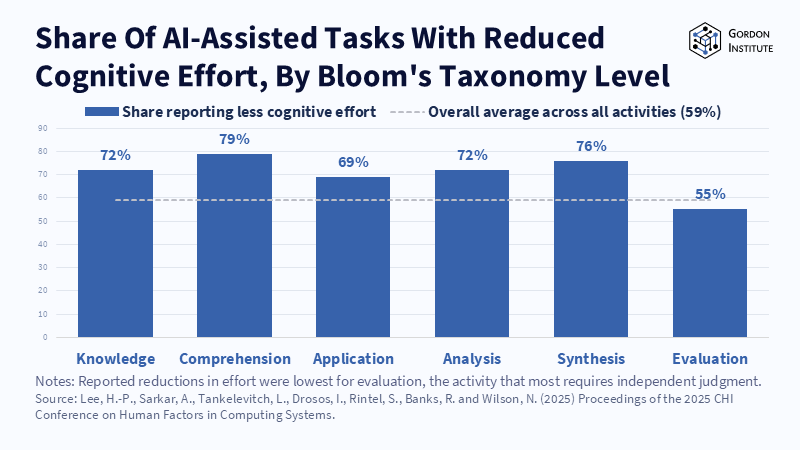
Long-form reading, explanation, comparison of methods and work on unfamiliar problems can make intellectual engagement more visible. AI can assist each activity, but the learner should retain opportunities to practise the judgment being developed. A doctoral student might compare a model's account of a paper with the paper itself, explain why an alternative specification was rejected or identify a limitation missing from a generated summary. These exercises focus on scientific competence rather than on proving that every sentence was typed unaided. They can reveal whether the student understands the evidence and can apply the relevant knowledge beyond the immediate output.
The relevant boundary is task-specific. Asking AI to organise notes or suggest a coding approach may support work the researcher can independently assess. Using it to select a statistical method without understanding the assumptions creates a different risk. The cognitive studies discussed here do not establish a universal safe frequency of use or a threshold above which harm necessarily accelerates. Training should instead examine the relationship between delegation, expertise and verification. A useful programme would test whether particular instructional practices improve independent performance and appropriately calibrated trust, while recognising differences between disciplines and levels of experience.
Designing Research Training Around Judgment
Research training needs to be designed around the work students actually perform. Universities can begin by identifying consequential decisions in a project: defining a question, selecting evidence, choosing a method, interpreting an unexpected result and stating the contribution. Each decision requires a form of justification. Software can assist, but students should know what evidence would support or overturn the proposed choice. This approach avoids making the curriculum a succession of rules tied to particular interfaces. It prepares researchers for changing tools by developing capabilities that travel across them. The institution's responsibility is to provide a structure in which those capabilities can be learned and reviewed.
Cognitive internalisation is useful here as an educational aim: the researcher develops enough understanding to explain and challenge the assisted work. It need not mean reproducing every mechanical operation by hand. A student can rely on established software while understanding the model, diagnostics and limitations that make its use defensible. The same principle applies to AI, with additional attention to uncertain or fabricated output. Supervision can ask what the system contributed, what was checked and why the researcher accepted the result. A generated suggestion becomes part of scholarly work through that accountable process, rather than through a disclosure statement alone.
Fairness requires institutions to distinguish support needs from misconduct and to provide intelligible standards. Students with different language backgrounds may use assistance for different reasons; that does not establish different levels of scientific understanding. Research supervision should examine the substantive decisions and evidence, while applying clear rules about representation and attribution. Process documentation can help, but excessive logging may create burdens without revealing competence. A proportionate account of the decisions that affected the result is often more useful. The aim is a consistent standard of defensible research that students have a realistic opportunity to learn.
Making Scientific Competence Observable
A training project can include a research plan, a method justification, a reproducible analysis and a discussion of revisions. These stages give supervisors evidence of development and allow feedback before an error becomes embedded in a manuscript. Students may be asked to explain how a generated recommendation compares with the primary literature or why a proposed analysis fits the data. Discussion of AI and human skills highlights the distinction between improved assisted performance and capabilities retained later. Research training needs to examine both. Institutions should also train supervisors to review AI-assisted work, rather than assume that familiarity with a tool is sufficient for guiding its scientific use.
This approach has resource costs. Supervisors cannot examine every interaction, and large programmes need practices that scale. Representative checks, shared examples and structured discussion of important decisions may offer a workable balance. Institutions should compare their costs and effects with existing procedures rather than assume that redesign either saves time automatically or requires unlimited staffing. Nor does an association between education and critical-thinking measures prove the effectiveness of a particular curriculum. Programmes need their own evaluation. Useful outcomes include improved methodological explanations, fewer unsupported claims and better independent performance on unfamiliar tasks, assessed against the resources required to achieve them.
The supervisor's role is to create occasions for the researcher to demonstrate understanding and revise it. A plausible manuscript is an important product, but it is also an uncertain measure of how the author reasoned. Discussion of alternative methods, limitations and surprising observations can expose gaps that prose quality conceals. Such exchanges should support learning while retaining a clear standard for scholarly responsibility. Trust is strengthened through visible, defensible practice; it cannot be assumed merely because a process includes more stages or because a university adopts a new framework.
Different forms of AI assistance require different review. Search needs source verification; drafting needs attention to meaning and attribution; analysis needs checks on assumptions and implementation; feedback needs evaluation of whether the criticism is relevant. A research curriculum can make these distinctions explicit without demanding that AI be excluded from every intellectual decision. Students should understand which judgments they must be able to defend, regardless of how a suggestion originated. The institution can then select tools and supervision practices that support those requirements. Competence provides a durable basis for responsible use as particular systems change.
Universities should assess AI-assisted research through the knowledge researchers acquire and the claims they can justify. Disclosure remains useful, but it answers only part of the question. A competent scholar must also be able to evaluate evidence, explain a method, recognise uncertainty and respond when a result does not withstand scrutiny. The cognitive studies discussed here motivate investigation of these capabilities without settling every causal question about AI and thinking. For Gordon Institute's Science Forum, the educational priority is to make scientific competence accessible and demonstrable. Research training should help students become people who can direct and examine their tools, while giving them the institutional support needed to do that work well.
This Science Forum article is adapted from material published within Gordon Institute’s network. It presents editorial analysis and does not constitute professional advice or an official institutional policy.
References
Abrams, Z. (2026) 'How AI is reshaping human skills and thinking', Monitor on Psychology, 57(5).
Çelik, Ö. (2026) 'AI policies are repeating every mistake of plagiarism policies', Times Higher Education, 28 August.
Gerlich, M. (2025) 'AI tools in society: impacts on cognitive offloading and the future of critical thinking', Societies, 15(1), p. 6.
Lee, H.-P., Sarkar, A., Tankelevitch, L., Drosos, I., Rintel, S., Banks, R. and Wilson, N. (2025) 'The impact of generative AI on critical thinking: self-reported reductions in cognitive effort and confidence effects from a survey of knowledge workers', in Proceedings of the 2025 CHI Conference on Human Factors in Computing Systems. New York: ACM, pp. 1-22.
Trinka AI (2026) University of Pittsburgh AI Policy. AI Policy Repository.
Zyphur, M. J. (2026a) Responsible AI in Academic Research: A Competency Framework for Research Training. Instats.
Zyphur, M. J. (2026b) 'Universities must look beyond plagiarism to govern AI research', University World News, 25 August.
관련기사
















