Designing AI Education: For Learning Beyond the Answer

입력
수정
Stronger homework can conceal weaker independent learning
Teaching should combine useful AI assistance with practice and verification
Assessment and incentives determine whether students develop lasting skills

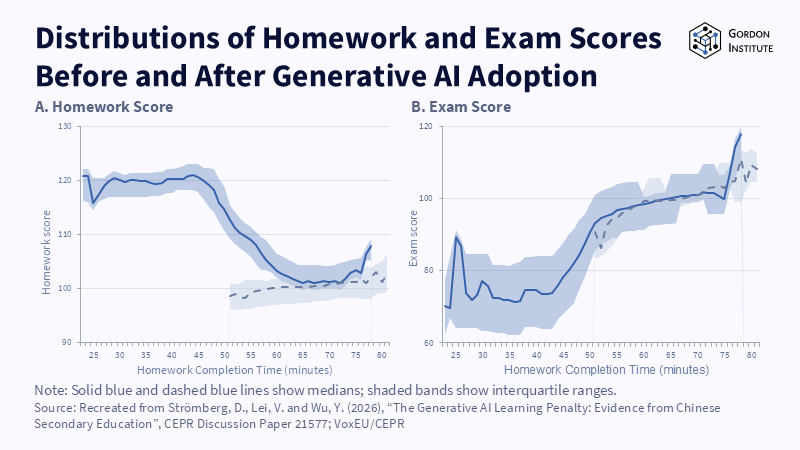
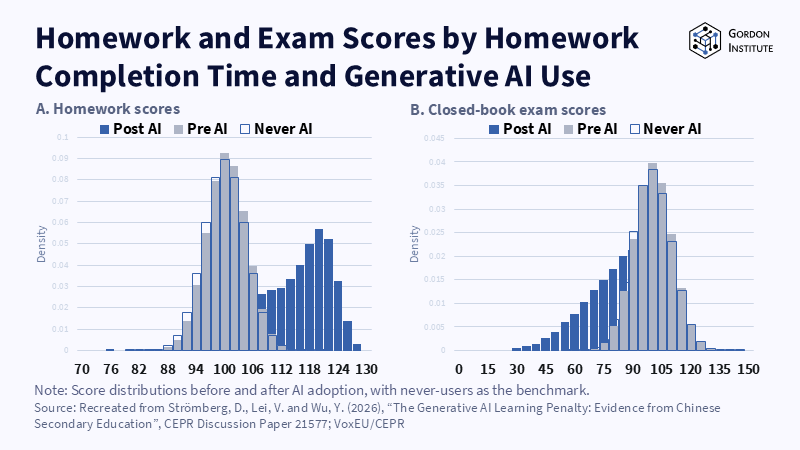
AI changes what a completed assignment can tell a teacher. A student may submit a stronger answer while understanding less of the material it contains. In a study of 26,811 secondary-school students in China, six months after generative AI adoption, homework grades were 18 percent higher while closed-book examination scores were 20 percent lower relative to their pre-adoption means. The divergence grew over time. These findings concern self-directed use in a particular setting, rather than every educational application of AI. They nevertheless make curriculum design an urgent scientific question. If homework is intended to develop understanding, schools need to investigate whether assisted practice still performs that function. The goal is an educational environment in which accessible tools support learning that students can demonstrate beyond the answer on the page.
Make Mastery Visible
The study identifies different patterns among AI users. About one in five continued to spend roughly as much time on homework as non-users and achieved similar examination results, despite higher assignment grades. Most completed homework much faster and performed worse on tests. The comparison is consistent with a distinction between assistance that supports practice and assistance that substitutes for it. It does not establish that requiring a fixed amount of homework time would remove the penalty: students may also differ in motivation and how they use the tools. A practical response is to make control over the reasoning process observable. Students can attempt a problem, inspect an AI suggestion, explain a disagreement and revise their own answer. Each step gives the teacher evidence of understanding that the final submission alone cannot provide.
Reported losses varied across subjects: approximately 27 percent in social-science subjects, 22 percent in STEM and 17 percent in English, with a smaller decline in Chinese. Initially high-performing students were disproportionately affected. These differences help identify questions for further research, but do not by themselves explain the mechanism. The demands of the subject, the type of assistance and the student's prior knowledge may all matter. Comparisons with workplace productivity studies also require care. Improving an employee's deliverable and developing a student's future capability are different objectives. Education should assess both the quality of assisted work and the ability subsequently retained, particularly where an apparently successful assignment would otherwise conceal a loss of practice.
Mastery can provide a useful guide for deciding how much to delegate, without becoming a rigid rule that excludes novices from help. A learner may benefit from an explanation before mastering a skill; the issue is whether the assistance leaves opportunities to practise and check understanding. Teachers can introduce more delegation as students demonstrate the ability to identify errors, justify choices and perform essential steps independently. That progression needs evidence from the learner, rather than assumptions based on age or tool familiarity alone.
Design Lessons Around Active Judgment
A teaching framework described by researchers at Newcastle Business School offers one approach to integrating AI into the learning process. Developed through experimentation in entrepreneurship courses, it connects teacher preparation, personalised learning, active classroom participation, assessment and continuing feedback. Its educational value lies in making students' engagement visible. Documentation of tool use and reflective records can show where a suggestion was accepted, challenged or changed. These are promising design practices rather than proof that one framework will work across all subjects and ages. Their transfer should be evaluated through learning outcomes. For a science-oriented curriculum, the same principles can be applied to checking a source, explaining an analytical choice or comparing a generated hypothesis with observations.
Reflection is useful when it demands more than a description of which tool was opened. A student might identify an incorrect claim, explain why a model's reasoning was incomplete, or compare an assisted answer with an independent attempt. Such tasks connect AI literacy with subject knowledge. Teachers can then distinguish technical fluency from understanding and provide targeted feedback. The additional record should be proportionate: lengthy logs may reward documentation effort without improving learning. A short account of the consequential decisions can be more informative than a complete transcript.
Match Assistance to Developing Skills
Students at different stages require different kinds of support. Younger learners may need more structured opportunities to develop basic reading, writing and quantitative reasoning before routinely delegating substantial parts of an assignment. More advanced students can work with increasingly open tasks, provided they are asked to explain and verify the result. Age is relevant, but prior knowledge and educational circumstances also vary widely within an age group. A thirteen-year-old with strong subject knowledge and an eighteen-year-old encountering unfamiliar material may need different assistance from what their ages suggest. The teaching decision should therefore consider the skill being developed and the learner's demonstrated capacity to evaluate help. Accessibility needs may also make assistance essential rather than optional.
The larger losses reported among younger students support investigation of staged approaches, but do not establish that metacognitive development caused the difference. That distinction matters for curriculum research. Institutions should test whether explicit guidance, supervised practice and gradual delegation improve independent performance, rather than assume a single age rule will suffice. A credible programme would examine benefits and harms across students with different starting points, including those who need additional support.
Align Tutoring Tools with Learning Incentives
Tools designed to tutor rather than supply answers offer a promising direction, but their availability does not guarantee sustained engagement. The source discussion cites a two-year Khanmigo experiment in which access to a coaching tool did not produce the consistent use needed to fulfil its intended role. This raises a problem of incentives. When assessment primarily rewards a finished answer, students may prefer a general-purpose system that supplies one immediately. A tutoring system asks for effort whose value may only become visible later. Research should therefore examine the tool together with classroom expectations, teacher support and assessment. Better technology can improve the opportunity to learn, but the surrounding educational design influences whether students take that opportunity.
Incentives can be changed through the work students are asked to demonstrate. A task may require an initial attempt, an explanation of a key step and a response to feedback, with marks linked to those elements. Teachers can value well-reasoned correction rather than only an initially correct answer. These practices do not require every lesson to become an examination of AI use. They align the visible reward with the intended learning process. The appropriate balance should be tested against actual gains in understanding and the demands placed on teachers.
Assess Understanding Beyond the Finished Product
Assessment should combine assisted performance with evidence of independent understanding. Short classroom exercises can reveal whether homework concepts have been retained; oral explanation can test why a method was chosen; error analysis can show whether a student recognises a plausible but false claim. Teachers also need support in deciding which capabilities students must develop themselves and which routine operations can be delegated. In open education, the same issue arises when learners study without continuous supervision. Clear exercises, feedback and opportunities to check independent performance can help them judge their own progress. The objective is to make competence visible and support its development, rather than rely on detecting every instance of tool use. Research can compare these approaches across subjects and learning environments.
AI education succeeds when students acquire capabilities that remain useful beyond a particular interface or generated answer. That includes understanding evidence, recognising uncertainty, testing explanations and knowing when additional help is needed. The Chinese findings warn against using stronger homework as sufficient proof of learning, while the subgroup differences suggest that productive assistance remains possible. Institutions should use that tension to design and evaluate better practice. For Gordon Institute's Science Forum, free and accessible AI education should widen the opportunity to develop independent competence. The quality of the learning environment matters as much as access to the tool: students need a credible way to discover whether they have learned to solve a problem, rather than merely learned to obtain its answer.
This Science Forum article is adapted from material published within Gordon Institute’s network. It presents editorial analysis and does not constitute professional advice or an official institutional policy.
References
Dolman, J. (2026) ‘From cognitive offloading to cognitive enhancement’, The AI English Teacher, 25 January.
Kirschner, P.A. (2026) ‘Understanding AI: Offloading or outsourcing thinking?’, kirschner-ED, 13 January.
Pedley-Smith, S. (2024) ‘Cognitive offloading: You can’t outsource thinking’, Accounting Cafe, 31 May, updated 25 August 2025.
Stavissky, Y. (2025) ‘The Human-Centered AI Pedagogical Engagement (HCAI-PE) Framework: A foundational paradigm shift in AI pedagogy’, SCIREA Journal of Education, 10(6), pp. 344–365.
Strömberg, D., Lei, V. and Wu, Y. (2026) ‘The generative AI learning penalty in secondary school’, VoxEU, Centre for Economic Policy Research, 4 September.
Swiss Institute of Artificial Intelligence Research Editorial (2026) ‘Cognitive outsourcing in education: Why AI’s real classroom crisis is verification, not cheating’, SIAI Research, 24 July.
Verhoeven, B. and Hor, T. (2025) ‘A framework for human-centric AI-first teaching’, AACSB Insights, 12 February.
관련기사
















