The Superhuman Bottleneck - Why AI Productivity Does Not Spread Equally

입력
수정
AI can amplify scarce human judgment as well as automate routine work
A small group may capture gains while wider capability develops slowly
The scientific question is how to reproduce expert reasoning at scale

Artificial intelligence can make information processing abundant without making high-quality judgment abundant. The resulting productivity problem is not simply whether a model can produce a useful answer. It is whether enough people can define the right problem, recognise what the answer overlooks and convert it into a reliable decision. SIAI’s discussion of superhuman labour uses the term for a human–AI combination capable of exceptional task-specific performance, rather than a new biological category or a demonstrated universal multiplication of an entire job. If only a small group can consistently operate that combination, model access may spread while the most valuable work remains concentrated. This Science Forum article examines the capacity constraint behind that outcome: the production, allocation and renewal of human ability. The companion Policy Forum article addresses the financial consequences. Here the primary issue is why strong workers can expand their reach much faster than institutions expand the supply of people able to supervise complex work.
Technical Assistance Does Not Standardise Human Ability
A useful analysis separates what the machine contributes from what the human must supply. The machine can search, draft, calculate and compare alternatives at a scale unavailable to an unaided worker. The human establishes the objective, identifies relevant constraints, decides which evidence is persuasive and accepts responsibility for the result. Domain knowledge and general reasoning interact within those responsibilities. A person may know the terminology of a field yet struggle to infer which assumption would invalidate a conclusion; another may reason well but lack the subject knowledge needed to detect a subtle error. Access to the same model therefore need not produce comparable performance. In open-ended work, the capacity to frame and verify can become the limiting input precisely because generating a plausible answer has become cheap.
This mechanism creates a possible concentration effect. A stronger problem-solver can use AI to cover more material, test more alternatives and deliver more projects, competing for work previously distributed among several competent professionals. Those professionals may also become faster, but the most valuable assignments may move toward the person who combines speed with better judgment. The outcome depends on the market: growing demand can create opportunities for many workers, while relatively fixed demand can intensify competition for existing work. It also depends on the task. Standardised assistance may narrow gaps where good practice is readily transferable, while uncertain diagnosis and novel decisions may reward prior expertise. The scientific claim is therefore conditional complementarity, not a universal assertion that stronger people gain more from every AI tool.
The Superhuman Advantage Can Concentrate Valuable Work
The contrast between an IQ-150 worker and an IQ-120 worker illustrates the proposed asymmetry, but it is not an empirical threshold established by the studies discussed here. IQ measures particular cognitive abilities; it does not exhaust expertise, motivation, practical judgment or institutional knowledge. There is no evidence in this material that an IQ of 150 guarantees effective AI use or that people scoring 120 or below inevitably lose their work. The economic hypothesis is narrower and still consequential: when AI gives someone with unusually strong relevant reasoning the means to scale that reasoning, the resulting advantage may allow them to take a disproportionate share of demanding assignments. The more ordinary professional can remain productive while losing market share. The relevant comparison is not a score alone, but demonstrated ability on the problems that customers or institutions need solved.
This helps explain why spectacular demonstrations and broad productivity statistics can diverge. An exceptional user may save days on a carefully selected task, but an organisation still needs coordination, implementation and accountable review. The AI productivity-paradox discussion concerns this gap between visible local gains and aggregate performance. A further possibility is that exceptional gains are genuinely large but concentrated among too few workers or activities to transform the whole economy immediately. That possibility should be investigated rather than asserted as the established explanation. Researchers need distributions of performance, not just averages, and measures separating supported output from independent competence. If a small group is responsible for most of the high-value improvement, diffusion means reproducing their capability, not merely issuing the rest of the workforce the same subscription.
Investment in chips, data centres and energy can expand technical supply without removing this human constraint. The demand for those investments also interacts with the cost of financing, as the cited bond-market discussion illustrates. Yet cheaper computation would not automatically solve a shortage of people able to evaluate unfamiliar or consequential work. An organisation may have plentiful tools and still route difficult decisions to one or two reviewers. Their capacity then determines how much output can be accepted safely, even when many staff can generate drafts. This is a system constraint: increasing production at the drafting stage can increase the review queue, and an overextended expert may become less effective. The relevant resource is reliable decision capacity across the complete workflow, rather than the number of answers the model can produce.
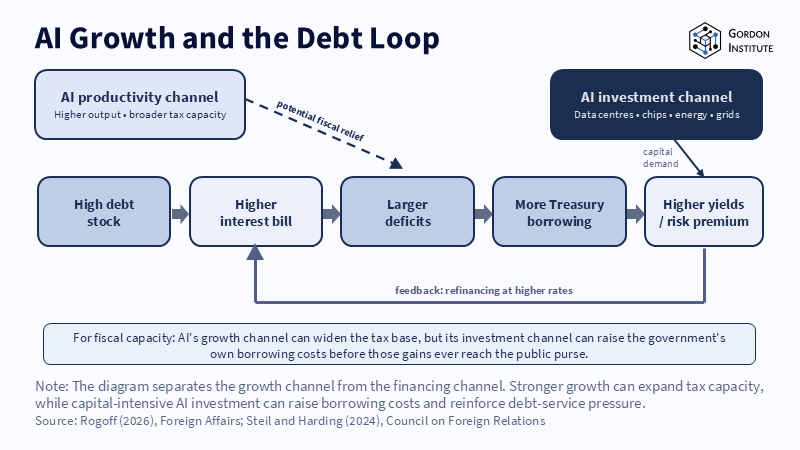
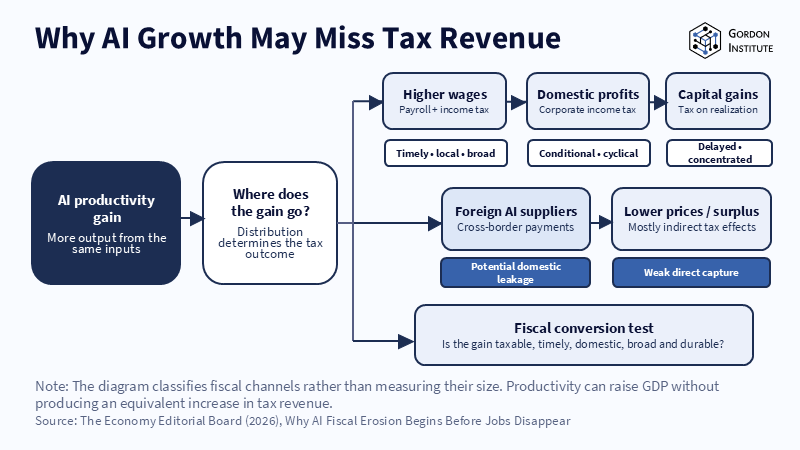
Concentration also needs to be separated into ability and ownership. An exceptional employee may receive a wage premium, but the employer, platform or investor can capture much of the surplus through control of clients, infrastructure and intellectual property. The fiscal-erosion analysis is relevant at this boundary because the distribution of value determines whether labour income expands along with output. It does not follow that every stronger worker captures all the benefits personally. A small group may perform the decisive reasoning while capital owners retain the financial gain, and many workers may see neither higher income nor access to comparable assignments. The Science Forum’s concern precedes the tax question: an economy cannot rely on broad productivity diffusion if it has not developed enough people capable of performing the complementary human work.
Capability Can Be Developed, but Tool Fluency Is Insufficient
The bottleneck is not necessarily fixed by birth or by a psychometric rank. Research on causal-thinking instruction offers a more actionable route. In the Bocconi experiment described in the related article, 1,053 first-year students were assigned through thirteen course sections to causal training, ChatGPT access, both or neither. ChatGPT improved conventional scores and similarity to expert solutions. Causal training improved explanations of mechanisms, conditions of failure and diversity of ideas. The combined group performed better than controls across the eight measures examined. These findings show that a short intervention can change aspects of reasoning within a particular task. They do not establish durable expert capacity, but they challenge the assumption that only identifying already exceptional people can increase the supply.
The distinction between assistance and learning is crucial. A worker may learn to request a polished recommendation without learning why that recommendation succeeds or fails. A more developmental interaction asks for assumptions, competing explanations and ways to test a claim, then requires the user to evaluate them. Evidence cited in SIAI’s labour analysis similarly distinguishes learners asking for conceptual explanations from those delegating production and debugging. The mechanism is plausible: retaining responsibility for reasoning creates opportunities to develop understanding, while complete delegation can bypass them. Institutions should not assume every conceptual prompt produces learning, however. They need to test independent application to new cases and examine whether the person can detect a mistake when no model is present. Tool familiarity is a useful operational skill, but it is not a substitute for that assessment.
Training also requires domain knowledge. General instruction to think critically is insufficient when the employee cannot recognise the evidence or constraints of the profession. A useful development system combines subject education, causal reasoning, reviewed examples and progressive responsibility for realistic problems. AI can supply additional practice and explain alternatives, while experienced people judge whether the learning is sound. This consumes expert time initially, creating a trade-off between today’s output and tomorrow’s capability. If organisations avoid that cost by using models for every junior task, they may improve immediate efficiency while weakening the route through which independent reviewers emerge. The shortage then reproduces itself. Expanding human capacity requires preserving opportunities to reason and receive feedback, rather than treating every task that can be automated as educationally expendable.
Designing Systems That Expand Judgment Instead of Exhausting It
An organisational design should identify which decisions require rare expertise and which can be supported reliably by procedures, examples or narrower tools. Without that distinction, all uncertain output arrives at the same senior reviewer and the apparent productivity gain becomes a larger supervisory burden. With it, some expert knowledge can be converted into task-specific checks and training material, allowing other people to handle more work safely. Not every judgment can be codified, and procedures can conceal errors if staff follow them without understanding. The objective is therefore a graduated system: dependable routine checks, clear escalation and an explicit route for developing the ability to handle harder cases. Its success is measured by the quality and distribution of accepted decisions, not by raw generation volume.
This is why the location of infrastructure and the production of capability are separate questions. The data-centre taxation analysis treats physical computing facilities as one component of a wider value chain. The corresponding scientific lesson is that a building full of servers does not supply the human institutions needed to use its output effectively. Universities, professional communities and employers maintain knowledge through instruction, supervised practice and feedback. If those arrangements deteriorate while compute expands, the supply of reliable reviewers may remain narrow. Conversely, a modest institution with disciplined learning and evaluation can create useful capability without owning frontier infrastructure. The relevant system includes access, knowledge and organisation together. Ignoring any one of them can turn a promising technical investment into underused or poorly supervised capacity.
The concentration hypothesis should be examined through evidence capable of separating its components. Researchers can compare users with different prior subject knowledge and reasoning performance, assign equivalent tools and evaluate quality, error detection and independent transfer. Longitudinal work is needed to discover whether an initial advantage grows, narrows through training or shifts when task design changes. Labour-market analysis must then examine who obtains assignments and who receives the surplus, because performance differences do not mechanically determine income. This research agenda avoids two unsupported conclusions: that universal access necessarily equalises capability, and that a fixed cognitive elite inevitably wins every task. The risk of concentration is substantial enough to study and address without turning a numerical IQ illustration into a law of technological competition.
AI’s capacity to generate output can advance faster than society’s capacity to produce people who can judge it. That mismatch is the superhuman bottleneck: a comparatively small group may expand its reach while the broader stock of expertise grows slowly or is weakened by lost training opportunities. The result can be exceptional local productivity, intense competition among ordinary professionals and limited diffusion of dependable capability. None is inevitable. Task design, education, apprenticeship, competition and ownership influence the outcome. Gordon Institute’s Science Forum frames the challenge as building systems that reproduce valuable human reasoning rather than merely amplifying its existing concentration. The fiscal consequences are important, but they come after the more basic question of who can create and verify the value, and how many others can learn to do the same.
This article presents analysis published by Gordon Institute’s Science Forum. The article does not constitute policy advice or an official position of any affiliated institution.
관련기사
















