The Human Review Bottleneck: When AI Output Outruns Judgment

입력
수정
Cheaper generation can shift work into review, exceptions and approval
Expanded demand does not guarantee sufficient capacity for human oversight
Effective automation must preserve knowledge and measure the complete decision process

AI can make an initial output cheaper while leaving the final decision demanding. A model produces a report, a recommendation or a block of code; someone must determine whether it is relevant, reliable and appropriate to use. This review is part of production rather than an optional step after it. Discussions of substitution often compare a model's visible price with a worker's cost, while giving less attention to the understanding needed to approve the result. The question for Science Forum is how automation changes the distribution of cognitive work. Faster generation may reduce total effort, but can also concentrate unfamiliar or difficult decisions among fewer people. Its contribution should be assessed through the complete route from output to a defensible action.
The Cost of an Output That Can Be Used
Research on adoption reinforces the need to examine complete costs. The German study examined here finds that incorporating user costs and relative worker productivity explains adoption better than technical exposure alone. The finding does not isolate the cost of managerial review, but it shows why capability is an incomplete guide to use. Integration, verification and organisational change can alter the comparison. A high benchmark score offers little information about the time needed to inspect a result in an unfamiliar setting. Evaluating review effort directly would help explain when assistance saves work and when it merely moves that work to another participant.
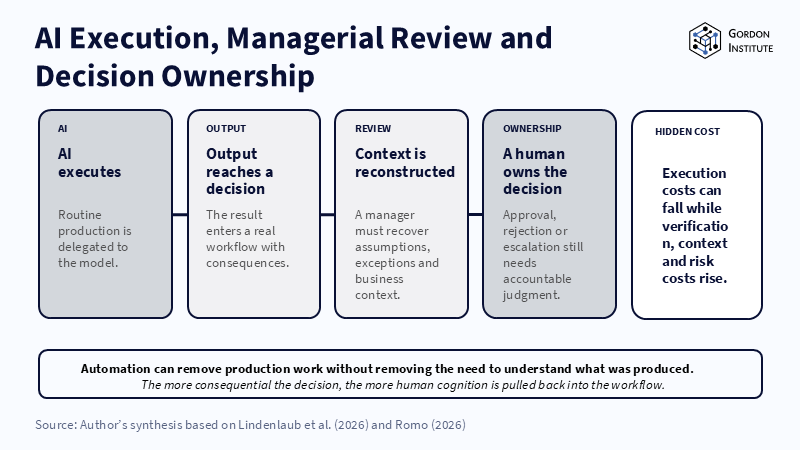
The reviewer may need to reconstruct enough of the reasoning to detect an important error. For a financial analysis, that can involve assumptions, data provenance and sensitivity to exceptional conditions. For code, it may involve requirements, security and behaviour beyond the available tests. A polished presentation can make this task harder if it encourages confidence before inspection. The amount of reconstruction depends on the output and the consequences of misuse. Routine checks can sometimes be automated; contextual choices may require domain knowledge. The organisational challenge is to preserve that knowledge while making review proportionate, rather than require every reviewer to repeat the entire task or assume that every generated result deserves acceptance.
Adoption statistics do not show this distribution of effort. Adoption studies compare firm-level use with workers’ reported use, but their different units prevent a direct inference about replacement. An employee may use a tool occasionally inside a largely unchanged process, while a company may integrate it into a critical workflow. Both arrangements can appear under adoption. Research needs observations about completed tasks, review time, exceptions and final quality. Those measures would reveal whether assistance reduces work overall or shifts it between people. They would also help institutions avoid interpreting increased interaction with a model as sufficient evidence of improved productivity.
When More Production Creates More Review
Lower costs can expand demand, a mechanism often discussed through Jevons' paradox. For labour, the analogy requires care: greater demand for a service does not necessarily increase employment or human effort. The outcome depends on how much work each unit requires and how demand responds. The Philippine call-centre example shows that exposed work can continue to employ people, but does not prove that AI caused growth. For review capacity, the useful question is whether cheaper output encourages more requests, proposals or actions than the organisation can competently assess. Expansion can be beneficial while still creating a bottleneck at the stage where someone must decide what deserves attention.
A tenfold increase in drafts does not necessarily require tenfold human review. Better filtering, checks and selective scrutiny may prevent much of that burden. Conversely, an institution that treats every draft as ready for approval can create an expanding queue. The relevant variable is the volume and difficulty of consequential decisions, not the number of generated tokens. Reviewers need criteria for prioritisation and a way to reject unsuitable work early. Automation should therefore be designed together with its acceptance process. Research can compare alternative arrangements and determine where increased generation improves useful throughput, rather than merely increasing the amount of material waiting to be examined.
Customer-service evidence illustrates assistance within human work. The study examined here reports higher resolution productivity among agents using AI, particularly less experienced workers. That result concerns a specific deployment and does not establish how review demands change everywhere. One possible mechanism is that routine tasks become easier while difficult cases remain with people. Another is that suggestions help workers recognise established solutions more quickly. The balance should be measured. Productivity and cognitive intensity can move differently: someone may complete more cases while spending more of the day on exceptions. Understanding that distribution matters for training, staffing and the sustainability of the work.
Keeping Knowledge Inside the Organisation
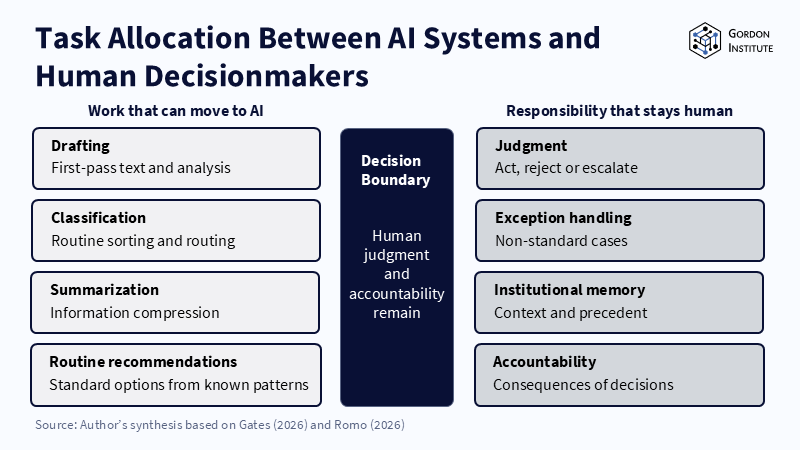
When judgment returns at approval, the organisation needs to know who can exercise it. A reviewer may not need to perform every operation, but must understand the criteria that make the result acceptable. In technical and scientific work, exceptions can be especially consequential because a familiar procedure may cease to apply. Review should examine those boundaries. Assigning responsibility without time, expertise or authority creates a weak control. The human role should therefore be specified as a set of capabilities and decisions, supported by tools and documentation. A signature at the end of an opaque process is a poor substitute for that arrangement.
Costs also include the consequences of errors that escape review. Some mistakes are frequent and inexpensive; others are rare and serious. An average time saving can conceal changes in that distribution. Organisations should therefore assess relevant error types, the chances of detection and the resources needed for correction. Review effort may be spread across meetings, revisions and interruptions, making it less visible than a software invoice. Measuring the complete process can identify where the real burden lies. This is an empirical question about a particular workflow, rather than a universal claim that AI necessarily costs more than the people it assists.
Institutional knowledge supports those checks. Experienced workers may recognise unusual cases through context that has not been documented in a manual. Removing them can reduce both production capacity and the ability to evaluate an automated replacement. That risk is not inevitable: deliberate documentation, training and retained expertise can preserve relevant knowledge. The transition should be examined before the organisation discovers a gap through failure. Useful questions include which exceptions require experienced judgment, whether alternative reviewers can identify them and how new staff acquire the necessary understanding. Automation becomes more sustainable when learning and oversight are treated as continuing organisational functions.
Responsibility Beyond Factual Accuracy
Even a factually accurate system does not resolve every decision. It may predict an outcome correctly while the institution chooses an inappropriate objective, risk threshold or application. A recommendation can also omit a consequence outside the supplied information. These are questions of purpose and context, rather than hallucination alone. Improvements in factual reliability should reduce some review costs, but do not establish that every responsibility can be delegated. Institutions need people able to judge whether the system is solving the right problem and whether its proposed action fits the situation. That capability should be cultivated rather than assumed to appear automatically at approval.
The next assessment of AI productivity should include how organisations turn generated material into actions they can explain and defend. Lower production costs may expand useful activity, but benefits depend on review capacity, retained knowledge and the quality of the acceptance process. Some checks can be automated and others made more efficient through better design. The point is to measure them as part of the system. For Gordon Institute's Science Forum, the human review bottleneck is a question about attention and competence under technological change. Progress means increasing the amount of reliable work that can be completed, while preserving the ability to recognise when an apparently good output should not be used.
This Science Forum article is adapted from material published within Gordon Institute’s network. It presents editorial analysis and does not constitute professional advice or an official institutional policy.
관련기사
















