Europe's AI Research Gap: Compute, Access and Scientific Opportunity

입력
수정
Europe's research strengths coexist with limited access to AI infrastructure
Compute capacity and the skills to use it must develop together
Shared facilities should be assessed by the scientific opportunities they create

Europe's position in artificial intelligence is often described through investment totals, startup valuations and dependence on foreign technology. For science, the same discussion begins with a more practical question: which researchers can obtain the tools needed to investigate an important problem? The source analysis reports that Amazon, Microsoft and Google account for about 70 percent of Europe's cloud market, while the European Union hosts roughly 5 percent of estimated global AI compute capacity. These figures concern different markets and should not be treated as interchangeable measures. Together, however, they point to a research environment in which access often depends on infrastructure and services controlled elsewhere. The issue is wider than the nationality of a supplier. It includes the price, reliability and flexibility of access, and whether smaller laboratories can turn promising ideas into experiments without resources available only to the largest organisations.
Research Strength and Infrastructure Scale
Bruegel's infrastructure estimates, based on the Europe2031.ai dataset, place operational EU AI compute capacity at about two gigawatts in 2026, compared with 35 in the United States and five in China. Its projections leave the European share at 5.6 percent in 2031. These are estimates of infrastructure capacity rather than direct measures of scientific productivity; gigawatts do not describe how efficiently equipment is used or who receives computing time. The original market analysis also highlights a concentration of frontier-model development and a much smaller European share of AI venture capital. Those commercial measures matter to science because they influence the surrounding supply of tools, expertise and employment. They do not establish that European researchers are less capable. A region can produce strong scholarship while lacking the facilities and institutions needed to pursue the most demanding computational experiments.
Public initiatives seek to expand that infrastructure. The European Commission's July 2026 call for up to seven AI Gigafactories envisages up to €10 billion in public funding and at least €20 billion in private investment, with selection expected in early 2027. The programme complements smaller AI Factories and associated support services. From a scientific perspective, the important test begins after an announcement: how much usable access reaches universities, research institutes and smaller teams, under what conditions, and for which tasks? Capacity reserved for major commercial customers is different from capacity available for exploratory research. Equipment, software support and allocation procedures must also work together. A large installation can expand regional capacity without proportionately widening the community able to use it.
Compute and Capability Develop Together
The supply constraint includes electricity, grid connections, equipment and the time required to bring facilities into operation. The original analysis cites a comparison of approximately 24 months for US data centres and 42 months in Germany, while recognising considerable uncertainty around the estimates. Such averages cannot predict every project, but delays matter to research programmes with fixed grants and limited personnel. A laboratory unable to secure computing time may reduce its experiments or move them elsewhere. Physical capacity also differs from usable scientific access: a facility can exist without offering appropriate software, data safeguards or technical support. Expanding infrastructure should therefore be understood as building a service for research, with power and hardware as necessary foundations. The value appears when researchers can actually run, inspect and reproduce their work.
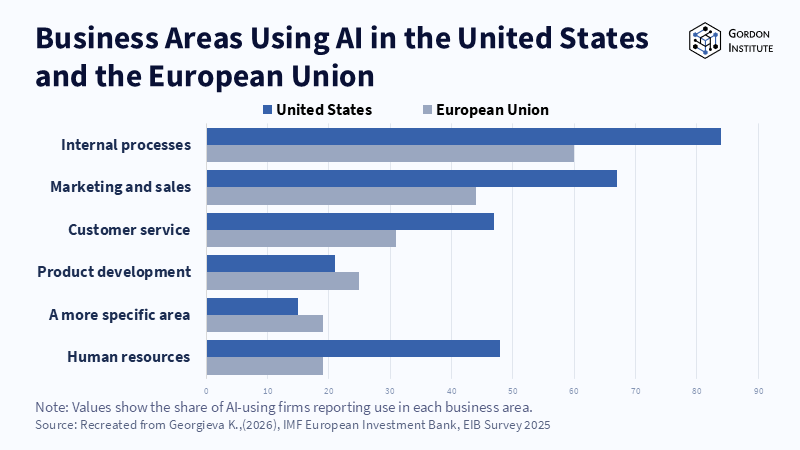
The demand constraint concerns the ability to make productive use of available tools. Evidence from a European Investment Bank study of more than 12,000 EU and US firms associates AI adoption with productivity gains concentrated in organisations making complementary investments in data, software and training. The result concerns firms, but suggests a question for research institutions: does access come with the capabilities needed to use it well? A small laboratory may face substantial costs in preparing datasets, adapting software and maintaining workflows. A research group with an account on a powerful system may still lack the staff to develop a robust experiment. Aggregate adoption statistics also leave smaller organisations poorly represented. Scientific access should be assessed through the resources required to complete a project, rather than through possession of an account or occasional use of a model.
The Scientific Value of AI Adoption
The source article describes a European debate between prioritising practical applications and competing in frontier-model development. Science benefits from examining the relationship between these objectives. Researchers in medicine, agriculture and engineering may achieve valuable results through existing models adapted to their domains. Others require the ability to train or inspect models in ways that commercial interfaces do not permit. Neither route can represent every scientific need. An effective infrastructure strategy would recognise differences in scale, sensitivity and experimental control. Applied research can reveal where specialised capability is missing, while foundational research can create methods that improve subsequent applications. The challenge is to connect these activities without making every institution pursue the same technological ambition.
The IMF's estimates of AI's potential contribution to global growth provide economic context, but do not measure the scientific value of individual applications. A tool that helps identify a material, improve a clinical study or model an energy system may produce benefits through pathways not immediately visible in annual productivity statistics. Equally, a promising demonstration may fail to survive independent validation. Scientific evaluation should ask whether AI changes the quality, cost or feasibility of investigation, and whether the resulting knowledge can be examined by others. Public investment carries uncertainty, so research programmes need evidence of progress beyond expenditure and adoption. Useful measures might include reproducible results, experiments made possible for previously excluded teams, and improvements in the time required to test competing explanations. These connect infrastructure to its intended intellectual contribution.
Europe's industrial and scientific base offers opportunities in robotics, chemistry, manufacturing and energy. The original analysis cites substantial research employment, research-and-development spending and annual production of science and engineering graduates. These strengths can support AI applications grounded in physical processes and domain knowledge. A model used in a factory or laboratory must contend with measurement error, safety constraints and relationships that cannot be resolved through fluent text alone. Scientific expertise is therefore an input to AI development, not simply a pool of users waiting for a finished product. The opportunity is conditional: domain knowledge must be connected to suitable data, computing resources and experimental facilities. Strong universities and industrial experience provide a foundation, but do not automatically create accessible systems or transferable discoveries.
Building Demand for Accessible Infrastructure
Demand from research institutions could help sustain a broader infrastructure ecosystem. Shared facilities serving universities, hospitals and industrial laboratories may support repeated experimentation while spreading technical costs across users. Public procurement can provide stable demand, but the objective should be useful capability and credible access rather than purchasing local technology regardless of performance. Allocation rules matter: established teams often have an advantage in preparing proposals and estimating resource requirements. Smaller groups may need introductory support, modest trial allocations and training before they can compete for larger projects. The proposed reinforcing cycle between users, providers and investment should therefore be judged by participation as well as scale. More demand is valuable when it translates into better services and wider scientific opportunity.
There is a serious counterargument to treating subsidies as the principal solution. Bruegel reports that most planned European AI infrastructure capacity is privately financed and identifies permitting and grid access as major constraints. Additional public capital may achieve little if it does not address the actual bottleneck. Restrictions designed around technological sovereignty could also raise costs or limit access to useful systems. For science, the appropriate response is to separate objectives. Expanding physical capacity, protecting sensitive data, maintaining continuity of access and supporting independent experiments may require different interventions. Foreign investment can contribute to infrastructure located in Europe, while a domestically owned service can still offer restrictive terms. Ownership is relevant, but the conditions under which research can proceed are the more direct test of scientific capability.
Programmes designed to widen access need to follow users beyond an initial demonstration. The original discussion of smaller firms recommends measuring sustained use and participation rather than event attendance; a similar principle applies to research support. Institutions could examine whether smaller laboratories complete projects, whether training leads to independent use, and whether results remain reproducible after funding ends. Shared expertise can reduce the fixed cost of preparing data and configuring experiments. Regional institutions may benefit from common support teams rather than each attempting to recruit scarce specialists. Researchers themselves should help identify the obstacles: delays in allocation, incompatible software and inadequate documentation may be as important as the headline amount of compute. Access becomes meaningful when these practical barriers are removed.
Europe's AI research gap should therefore be assessed through the relationship between infrastructure and inquiry. Capacity totals and investment announcements describe resources, but do not show who can use them or what knowledge they produce. The same facilities that support commercial expansion could widen access for universities and smaller scientific teams, provided their allocation and support arrangements make that possible. The two sides must develop together: useful resources attract research demand, while capable users justify and improve the services around them. The longer-term objective is a scientific community able to test ideas, examine models and share credible findings. For Gordon Institute's Science Forum, that is the central measure of AI infrastructure: the opportunities for investigation it creates, including for those currently excluded by cost or scale.
This Science Forum article is adapted from material published within Gordon Institute’s network. It presents editorial analysis and does not constitute professional advice or an official institutional policy.
References
Aldasoro, I., Gambacorta, L., Pál, R., Revoltella, D., Weiss, C. and Wolski, M. (2026) ‘AI adoption, productivity and employment: Evidence from European firms’, EIB Working Paper 2026/02. Luxembourg: European Investment Bank.
European Commission (2026) ‘EU launches AI Gigafactories call to boost Europe’s computing capacity and unlock more than €30 billion in investment’, 30 July.
Eurostat (2026) Digitalisation in Europe: 2026 edition. Luxembourg: Eurostat.
Georgieva, K. (2026) ‘Europe and the Global AI Race’, remarks at the Informal Meeting of Economic and Financial Affairs Ministers, Dublin, 21 September. Washington, DC: International Monetary Fund.
INSEAD (2026) ‘Europe’s Historic Second Chance: Leading AI’s Next Wave’, INSEAD Knowledge.
Martens, B. and Schenk, T. (2026) How Can Europe Address Its Pressing AI Compute Infrastructure Shortfall? Policy Brief 18/2026. Brussels: Bruegel. IDEAS/RePEc
OECD (2026) ‘AI use by individuals surges across the OECD as adoption by firms continues to expand’. Paris: OECD.
Rabrenović, J. (2026) ‘Europe’s AI Divide Is Already an Enlargement Problem’, Social Europe, 28 September.
Sheftalovich, Z. (2026) ‘EU’s top AI adviser urges commissioners to use the technology to fix bloc’s economy’, POLITICO Europe, 24 September. Muck Rack
Thomson, A. and Mackenzie, T. (2026) ‘Mistral AI raises at €21 billion valuation in Samsung-led round’, Bloomberg, 8 September.
관련기사
















