From AI Capability to Adoption: Cost, Scale and the Demand Response

입력
수정
Technical exposure does not establish an economical case for automation
Adoption depends on complete costs, complementary skills and organisational scale
Demand responses make employment effects conditional rather than automatic

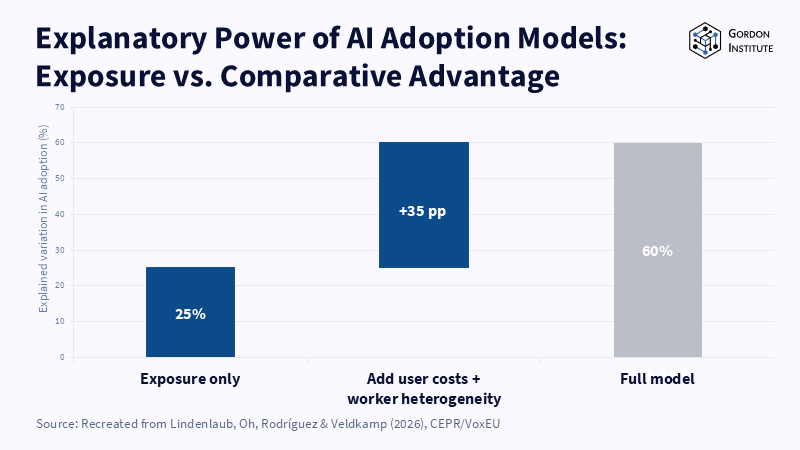
A system's ability to perform a task does not establish whether an organisation will use it. The difference is central to understanding AI adoption scientifically. In the German sample of 9,835 employees examined here, a model based on technical exposure explains considerably less variation in adoption than one incorporating costs and relative worker productivity. The reported explanatory power rises from roughly 25 percent to nearly 60 percent. These findings concern a particular model and dataset, but identify a broader question: how do technical capabilities become workable production arrangements? Licences, integration, review and organisational knowledge can change the comparison. Science Forum should examine the mechanisms linking capability to adoption before drawing conclusions about substitution or employment from lists of tasks a model can perform.
Capability and Economic Advantage Are Different Measures
Comparative advantage directs attention to relative costs and productive arrangements, rather than a contest over which participant is intrinsically superior. In applications of AI, the relevant comparison includes humans working with tools as well as humans or systems considered separately. The German study examined here finds disagreement between exposure-based and economic measures for occupations representing a substantial share of employment. A highly exposed task may remain costly to automate, while a less conspicuous use becomes attractive because implementation is straightforward. The result cautions against assuming that benchmark improvement translates directly into adoption. Researchers need to specify the unit of output, the quality required and the costs included. A cheap draft and a reliable completed service are different products, and comparing them without adjustment can misstate the advantage.
The computer-vision study examined here offers a bounded example. Under its assumptions and costs, approximately 23 percent of the wages associated with technically exposed vision tasks were estimated to be economical to automate. The analysis distinguishes what a system could perform from what an organisation could justify purchasing and deploying. It should not be generalised to all AI or treated as a permanent share: hardware prices, implementation costs and workflow design can change. Its scientific value is the method of comparison. Researchers make the cost assumptions explicit and estimate the consequences rather than infer adoption from capability alone. Similar work can examine how sensitive the conclusion is to quality requirements, scale and the availability of complementary human expertise.
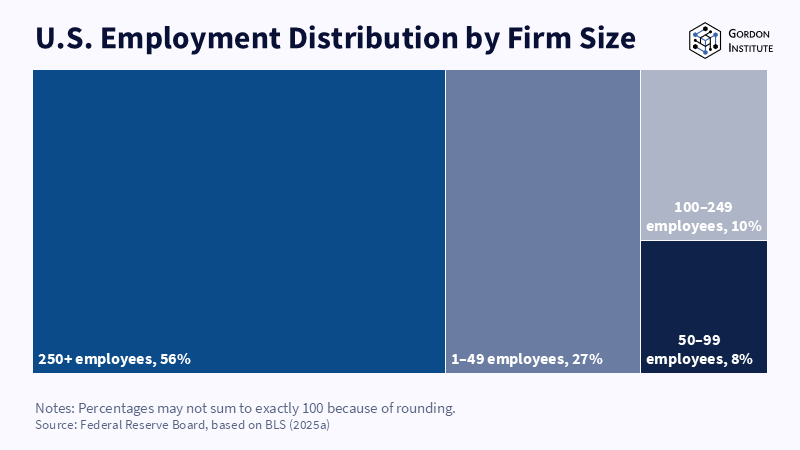
Organisational scale affects the comparison because some costs are fixed or only partly sensitive to volume. A large network may spread development, security and integration over many transactions. A smaller organisation may lack enough repeated activity to justify the same system. However, shared services, standardised tools and external support can change those constraints, so scale is neither destiny nor a complete explanation. Researchers should investigate which costs diminish with volume and which increase with complexity. The same technology can be attractive in one environment and unsuitable in another. Adoption studies become more informative when they describe these environments, including the stability of the task and the cost of maintaining an effective implementation after the initial launch.
Efficiency and the Demand for Services
Efficiency can also change demand. Jevons' paradox describes cases in which an efficiency improvement increases total use of a resource through the resulting expansion of activity. Applying it to AI and labour requires care. Lower unit costs may increase the quantity of a service purchased, but the effect on employment depends on the human input needed per unit. Demand may also be constrained by time, regulation or saturation. The mechanism is useful because it challenges forecasts that hold output constant while reducing labour requirements. It is not a general law that automation creates more jobs. Research should examine how prices, service quality and available markets change, and whether those changes are large enough to offset any saving in human effort.
Published accounts describe continued employment growth in Philippine customer-service work despite high apparent exposure to conversational AI. This observation shows that technical exposure does not automatically coincide with contraction. It does not isolate AI's effect: outsourcing, wages, market expansion and changes in the services provided may all contribute. A stronger causal analysis would need a credible comparison and evidence about the timing and form of adoption. The example is therefore best used to motivate the question rather than answer it. Researchers should examine how assistance changes costs and output, then investigate whether customers purchase more service and how employment adjusts. Observing growth in an exposed sector is not sufficient proof of a Jevons effect.
The production unit may be a worker supported by AI. A tool can summarise a history, suggest a response or perform a routine step while the person handles the wider interaction. If this combination provides better service at lower cost, adoption can occur without removing the human role. Yet the role may change, including through greater emphasis on exceptions and verification. Studies should therefore follow the distribution of tasks as well as headcounts. More employment can coexist with changed skill requirements, and stable employment can conceal substantial reorganisation. Complementarity and substitution are not mutually exclusive descriptions of an entire occupation; they can occur in different parts of the same job.
Human Skills Within Assisted Production
Wage differences and local institutions further influence adoption. A firm may retain people in one labour market while automating similar activities in another because the complete cost comparison differs. Human knowledge of customers, context and exceptions can also contribute value not captured by an isolated task benchmark. These factors should be examined rather than assumed. A low wage does not establish that a human arrangement is preferable at every quality level, and a technically strong model does not establish that automation is cheaper once implementation is included. Economic advantage belongs to a specified arrangement under specified conditions. This makes cross-country forecasts more demanding than mapping a common exposure score onto employment totals.
The customer-service study of 5,172 agents examined here reports an average productivity improvement of approximately 15 percent, with larger gains among less experienced workers. It provides evidence of assistance in a particular setting. It does not by itself measure the eventual demand response or employment effect. Productivity at a task, firm output and labour-market outcomes are separate stages of the argument. Assistance may transmit useful practices, reduce the time needed for routine work or help workers respond more consistently. Understanding these mechanisms can improve deployment and training. Researchers should also examine whether skills are retained and whether the gains persist as tasks change, rather than treat the initial average as a universal effect of AI on inexperienced labour.
From Task Gains to Employment Outcomes
Demand response can open activities that were previously too expensive. A professional service may reach smaller clients, support more languages or provide additional follow-up. These are plausible channels through which lower costs increase output. Their importance depends on actual price changes, customer needs and the capacity to provide reliable service. Some savings may remain as higher margins rather than lower prices, limiting the expansion mechanism. Others may improve quality instead of reducing cost. Forecasts should state which channel they assume and what evidence supports it. Employment then depends on how the expanded activity combines machine and human inputs. The final outcome cannot be inferred from an isolated saving in task time.
Demand can also respond weakly. A mature market may not purchase substantially more even after a price reduction, or the system may automate enough of the workflow that increased volume requires little additional labour. New tasks and complementary work may offset some displacement without restoring every affected position. Jevons' paradox should therefore be used as a conditional mechanism rather than reassurance about the future. The analytical sequence is to estimate the complete cost change, examine its effect on output and quality, and assess the labour required for the new level of activity. Each stage introduces uncertainty. Transparent assumptions help researchers identify where forecasts disagree and which observations would make one account more credible than another.
Statements about future gains should also be distinguished from realised changes. Relevant evidence includes analysis of corporate earnings calls in which most AI-related productivity statements concern anticipated benefits. Such language reveals expectations and organisational priorities, not measured performance. Broad economic indicators may respond slowly or fail to isolate gains occurring in particular activities. Neither gap proves that the technology lacks value. It means that researchers should match the claim to the evidence available: a deployment study for a task outcome, firm data for production changes and broader designs for employment effects. Combining those levels requires care. Expectations can inform hypotheses, but should not be counted as achieved productivity when estimating an economic mechanism.
Measure the Process Before Predicting Its Effects
Adoption measures likewise describe different populations. Firm surveys may ask about use in business functions, worker surveys about personal assistance and executive surveys about organisations employing large portions of the workforce. Their percentages cannot be directly compared as a time series of replacement. The German model's future adoption scenario also depends on assumed cost changes rather than providing a guaranteed trajectory. Researchers should report those definitions and assumptions alongside the headline estimates. The resulting evidence can show where use is spreading while leaving open what it changes. To investigate consequences, studies need observations about integration, completed work, output quality and the roles humans retain. These make adoption an input to analysis rather than the conclusion itself.
AI's economic effects are best studied through the connection between capability, complete costs and demand. Technical exposure identifies possibilities; adoption evidence reveals choices under actual constraints; outcome studies show what those choices produce. Organisational scale and human expertise help explain differences, while the demand response determines whether efficiency leads to less input, more activity or both. For Gordon Institute's Science Forum, the value of this framework is its discipline. It replaces automatic predictions of substitution or expansion with questions that can be investigated. A useful forecast should explain the arrangement being compared, the mechanism linking its costs to demand and the evidence supporting the resulting claim about work.
This Science Forum article is adapted from material published within Gordon Institute’s network. It presents editorial analysis and does not constitute professional advice or an official institutional policy.
References
Allen, Jeffrey S. (2026) ‘Monitoring AI Adoption in the US Economy’, FEDS Notes, Board of Governors of the Federal Reserve System, 3 April.
Brynjolfsson, Erik, Li, Danielle and Raymond, Lindsey (2025) ‘Generative AI at Work’, The Quarterly Journal of Economics, 140(2), pp. 889–942.
Green, Jemma (2026) ‘AI Costs More Than The People It Replaced’, Forbes, 2 July.
Jevons, William Stanley (1866) The Coal Question: An Inquiry Concerning the Progress of the Nation, and the Probable Exhaustion of Our Coal Mines. 2nd edn. London: Macmillan and Co.
Lab Report (2026) ‘Humans are still cheaper than AI for most work involving tasks that computer vision could technically automate’, edited by Mal James, ScienceBlog, 29 August.
Lindenlaub, Ilse, Oh, Ryungha, Rodríguez, María Alejandra and Veldkamp, Laura (2026) ‘Beyond exposure: Predicting AI adoption based on comparative advantage’, VoxEU, 30 August.
Ozkan, Serdar, Kalyani, Aakash and Sullivan, Nicholas (2026) ‘AI and Productivity: What Firms Are Saying on Earnings Calls’, Federal Reserve Bank of St. Louis, 31 July.
Rogelberg, Sasha (2026) ‘The AI boom hasn’t stopped U.S. companies from hiring cheap offshore labor, and overseas call center employment is still skyrocketing’, Fortune, 29 August.
Svanberg, Maja S., Li, Wensu, Fleming, Martin, Goehring, Brian C. and Thompson, Neil C. (2024) ‘Beyond AI Exposure: Which Tasks are Cost-Effective to Automate with Computer Vision?’, MIT FutureTech Working Paper.
관련기사
















