Journal Accountability: Correcting the Record Without Punishing Correction

입력
수정
Retractions reveal problems and the willingness to address them
Journal evaluation should examine patterns, response times and editorial failures
Transparent correction protects readers while supporting responsible publishers

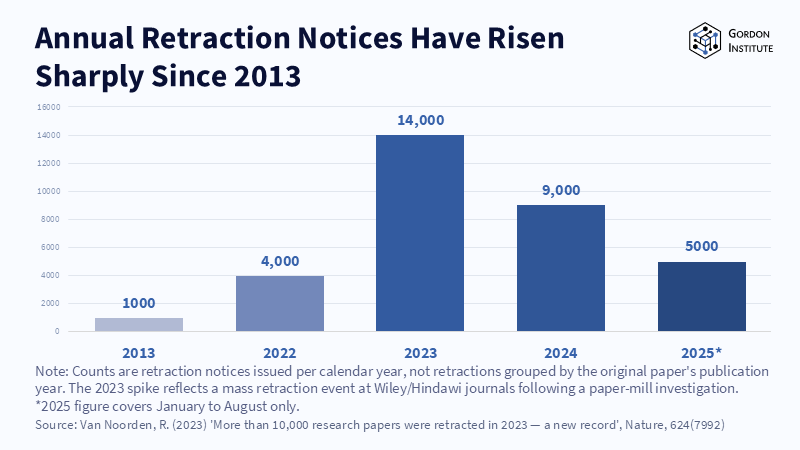
A retraction count is a difficult signal to interpret. It identifies work removed from the scientific record, but also records an institution's decision to correct a problem. A journal with many retractions may have serious editorial weaknesses, be addressing a legacy failure, or be more active than others in identifying errors. The large increase in notices examined here therefore calls for contextual analysis rather than automatic punishment. The 2023 surge included a major concentration of retractions associated with Hindawi; comparing that year with later totals cannot establish a simple, continuous rise in misconduct. Science Forum's question is how publishers should maintain a trustworthy record and how their performance should be assessed. Accountability becomes useful when it encourages timely investigation, transparent correction and better prevention, while avoiding incentives to conceal problems.
Publication Pressure and the Limits of Review
Growth in submissions can place pressure on editorial and reviewer resources, but its effects need evidence. The research discussed here describes substantial expansion at major AI conferences and cites the NeurIPS 2021 consistency experiment. That experiment duplicated a random sample of submissions for independent review; it did not simply resubmit an accepted set. Its results show disagreement, especially around selective decisions, without establishing that acceptance is equivalent to a coin flip or that publication growth caused the uncertainty. For journals, the broader issue is whether review arrangements match the volume and complexity of submissions. Editorial capacity, conflict checks and opportunities to scrutinise important claims matter. A publication's reputation cannot substitute for an account of how those processes operate and how weaknesses are identified.
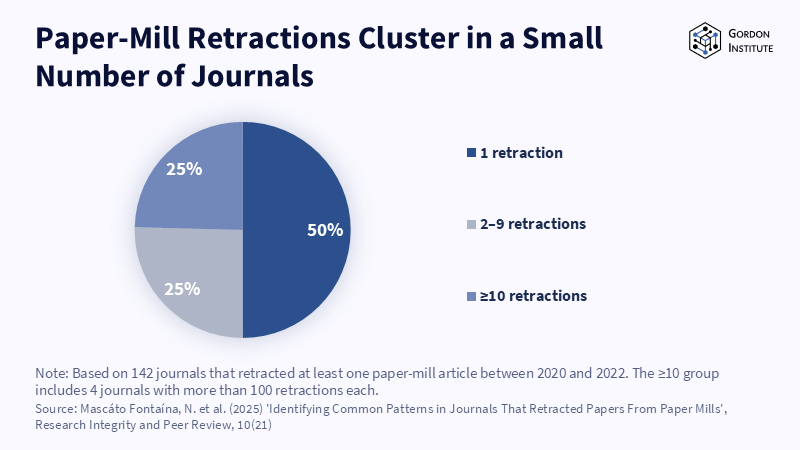
Paper mills create a different challenge from ordinary disagreement in review. They involve manufactured or manipulated scholarship that may exploit gaps in editorial systems. Patterns in language, images, authorship or review behaviour can provide reasons for investigation, but each requires appropriate corroboration. A template alone is not proof of fraud, and national publication growth is not evidence that individual researchers acted dishonestly. Publishers need processes for handling credible signals and distinguishing deliberate fabrication from error or weak methodology. They should also examine incentives within special issues and high-volume publication arrangements. Effective oversight asks where controls failed and how to improve them, rather than use the size of the submission queue as either an excuse or a complete explanation.
When Journal Oversight Responds Too Late
The Hindawi episode examined here illustrates consequences at the level of journals, publishers and indexes. It involved large-scale retractions, indexing decisions and the retirement of a publishing brand. These are substantial institutional responses, so it would be inaccurate to claim that publishers face no consequences. The important question is whether those responses arrived soon enough and addressed the mechanisms that allowed unreliable work to enter the record. Other delisting examples can raise similar questions, but their reasons and timelines should be examined individually. An index change is an assessment of a venue's continuing inclusion, not a finding that every article it published is invalid. Readers, authors and institutions need precise information about what has been established and which work remains under examination.
Delay can allow unreliable claims to circulate before they are resolved. Yet the interval between a complaint and a decision may reflect several activities: assessing evidence, contacting authors, obtaining expert advice and following fair procedures. A rapid outcome is not always a careful one, just as a slow outcome is not necessarily justified. Journal evaluation should therefore examine whether complaints receive prompt acknowledgement, whether investigations progress and whether readers are informed while concerns remain unresolved. Reported figures about journals placed on hold concern a selected group already suspected of problems; they cannot establish how accurately all journals could be classified through a brief review. An effective monitoring system needs both early signals and a process capable of evaluating those signals competently.
Measure Editorial Response, Not Retractions Alone
Transparent reporting can make editorial performance more observable. Publishers could describe corrections, retractions, expressions of concern and investigation timelines alongside the volume of material published. Springer Nature’s reporting of thousands of retractions demonstrates that aggregate disclosure is feasible, but its meaning depends on publication cohorts and reasons. A count of notices issued in one year may refer to papers published across many earlier years. Dividing those notices by current output can therefore misstate a cohort-based risk. Reporting should explain its denominator and classification method. Shared definitions would help readers compare patterns without treating different kinds of notice as equivalent. The objective is to understand both the quality of the record and the responsiveness of the institution maintaining it. Journal-level reporting should also distinguish the age of affected papers and whether a cluster emerged through a retrospective investigation. Readers need to know if the underlying editorial practice continues or has changed. Comparable reports can make those differences visible without pretending that one annual rate summarises the institution’s entire performance.
Punishing retractions automatically would create a perverse incentive. Editors who acknowledge serious problems could appear worse than those who leave similar problems unresolved. A better assessment would examine the underlying failures and the response: repeated patterns, inadequate investigation, missing notices or delayed action without explanation. Retraction reasons also matter. An honest error corrected by authors differs from evidence of coordinated fabrication, although both may require removal of a paper. Thresholds can trigger scrutiny, but should not determine guilt or loss of standing by themselves. A review process needs context, an opportunity to respond and a transparent conclusion. This arrangement encourages institutions to correct the record while making persistent failures visible.
Indexing bodies already provide mechanisms for monitoring and reassessing journals. Those mechanisms can inform a more systematic approach, but their coverage and data access should not be assumed to be complete. Early-warning indicators might combine unusual citation behaviour, clusters of integrity complaints and patterns in editorial response. Such indicators require validation: a trigger that identifies many legitimate journals as problematic can create substantial harm. Public explanations should distinguish an investigation from a final decision and identify what changed. Coordination between publishers, indexes and research-integrity specialists may improve information flows, while preserving independent judgment. Technology can assist with detection and tracking, but accountability depends on the procedures that turn a signal into a justified response. A review trigger should be tested against known cases and revised when it systematically misclassifies legitimate practice. The published outcome could describe the evidence examined, the improvements required and the conditions for reassessment. That makes accountability a process of demonstrated correction, rather than an unexplained change in a journal’s status.
Fairness also requires attention to the researchers affected. Delisting a journal can change how institutions view publications, but should not retrospectively classify every author as responsible for editorial misconduct. Researchers in less-resourced environments may face strong incentives to meet indexed-output requirements and limited guidance about journal quality. That context does not justify fraud, but it matters when designing remedies. Institutions can provide better information, examine individual contributions and avoid relying on country-level retraction rankings as evidence about people. Earlier, clearer reporting may help authors choose venues and respond to concerns. Responsible accountability should protect sound work and give affected researchers a credible way to understand and challenge the implications for their own records.
Universities and funders should assess publications through their substance and any relevant integrity findings, rather than through journal standing alone. A paper in a venue under investigation may remain sound; a paper in a prestigious journal may contain serious errors. Evaluation can consider the available evidence, the author's contribution and whether concerns have been resolved. Institutions should also avoid rewards that make publication volume the overriding objective. Publishers influence the record, but incentives from employment and funding systems influence what enters it. Shared responsibility means each institution examines the part of the process it controls. It does not mean every participant waits for another to act or that an index decision substitutes for reading the research. Assessment committees can also give authors space to explain what a venue-level concern means for their own work. Direct evidence of data integrity, reproducible analysis or appropriate correction may matter more than the index label. This helps institutions retain scrutiny while avoiding a second error: replacing uncritical reliance on journal prestige with uncritical reliance on delisting.
Maintaining a Scientific Record Readers Can Examine
Journal accountability should strengthen the scientific record through prevention, investigation and visible correction. Retraction data can contribute, provided its limitations are understood and honest responses are recognised. The goal is neither to excuse persistent editorial failure nor to make a low retraction count an institutional target. Readers need to know which claims remain supported and how concerns are handled. Authors need clear processes and fair treatment. For Gordon Institute's Science Forum, a credible publication system is one capable of examining its own mistakes and explaining what it did about them. Transparent evidence of that capacity offers a stronger basis for trust than reputation, publication totals or an isolated count of notices.
This Science Forum article is adapted from material published within Gordon Institute’s network. It presents editorial analysis and does not constitute professional advice or an official institutional policy.
References
Beygelzimer, A., Dauphin, Y., Liang, P. and Wortman Vaughan, J. (2021) 'The NeurIPS 2021 consistency experiment', Neural Information Processing Systems Blog.
Casrai (2026) Why journals get delisted from Web of Science. Ottawa: CASRAI.
Chemistry World (2025) 'High profile chemistry journal removed from Web of Science index', Chemistry World, 28 January.
C&EN (2025) 'Ethiopia has highest rate of scientific paper retraction', Chemical & Engineering News, 23 January.
Ioannidis, J.P.A., Pezzullo, A.M., Cristiano, A., Boccia, S. and Baas, J. (2025) 'Linking citation and retraction data reveals the demographics of scientific retractions among highly cited authors', PLOS Biology, 23(1), e3002999.
Kim, J., Lee, Y. and Lee, S. (2025) 'Position: the AI conference peer review crisis demands author feedback and reviewer rewards', in Proceedings of the 42nd International Conference on Machine Learning. PMLR 267.
Retraction Watch (2024) Web of Science puts mega-journals Cureus and Heliyon on hold. New York: The Center for Scientific Integrity.
Retraction Watch (2025) Springer Nature retracted 2,923 papers last year. New York: The Center for Scientific Integrity.
Su, B., Zhang, J., Collina, N., Yan, Y., Li, D., Cho, K., Fan, J. and Su, W. (2024, revised 2025) 'The ICML 2023 ranking experiment: examining author self-assessment in ML/AI peer review', arXiv preprint arXiv:2408.13430.
Van Noorden, R. (2023) 'More than 10,000 research papers were retracted in 2023 — a new record', Nature, 624(7992), pp. 479–481.
관련기사
















