Assessing Critical Thinking: Making Judgment Visible in AI-Assisted Work

입력
수정
A finished assignment is an incomplete measure of the thinking behind it
Assessment can examine evidence, alternatives, uncertainty and revision
Useful AI education should develop judgment that transfers beyond the task

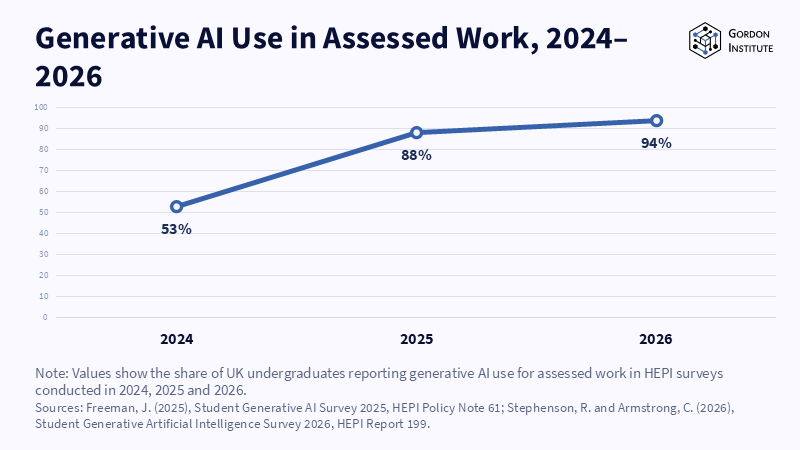
Critical thinking becomes an educational priority when students are asked to demonstrate it in the work that counts. The 2026 HEPI survey examined here reports widespread generative AI use among UK undergraduates, including assessed work. The precise wording of a survey question matters, and a reported percentage should not be treated as a measure of how much thinking students delegate. Nevertheless, easy access to polished output changes what a finished assignment can establish about individual understanding. Assessment needs evidence closer to the intended capability: interpreting a problem, evaluating sources, considering alternatives and defending a conclusion. For Science Forum, the question is how to design tasks that reveal those activities fairly and reliably. AI can remain available while students are required to show the reasoning that makes its contribution useful.
Specify the Thinking an Assessment Should Reveal
Students have always drawn on other people's ideas, and a final text has never been a perfect record of individual thought. AI increases the speed and accessibility of assistance while making its contribution harder to infer from style. This makes an existing assessment problem more visible. A fluent essay may contain a sound argument, or merely the appearance of one. Teachers need to specify which knowledge and judgments an assignment should reveal. Understanding the problem, identifying unsupported conclusions and revising a view when evidence changes are different capabilities from producing smooth prose. They can be examined through carefully designed tasks, but their measurement also needs evaluation. A rubric does not become reliable simply because it uses the phrase critical thinking. Students and assessors need a shared account of what strong reasoning looks like in the subject.
The review examined here describes skills including interpretation, analysis, inference, evaluation, explanation and self-regulation. These categories can help translate an abstract ambition into concrete tasks. A student might explain an ambiguous observation, compare rival arguments or state what evidence would weaken a preferred conclusion. The categories overlap in practice, and their expression varies by discipline. Evaluating a historical source differs from examining a model assumption, even though both require attention to evidence. An assessment should therefore connect general reasoning skills to substantive knowledge. Asking for critical reflection without providing material worth examining may reward rhetorical confidence rather than judgment. Clear tasks can show students where uncertainty lies and give assessors evidence about the decisions made in response to it.
Research on cognitive offloading motivates these questions without settling them. Gerlich's study reports an association between AI use and critical-thinking measures; it does not establish that assistance caused a decline. The small essay-writing study using EEG examined here is also limited by its sample, design and preprint status. A neural measure during one task should not be equated with permanent cognitive damage or a general ranking of learning quality. Educational design can take possible changes in practice seriously while maintaining those distinctions. The relevant research question is whether particular forms of assistance and assessment improve retained understanding. That can be tested through independent performance, transfer and the quality of reasoning. Concerns about offloading should lead to better experiments and teaching practices rather than conclusions stronger than the studies support.
Build Judgment into Ordinary Coursework
Critical thinking need not be confined to a separate course. The research discussed here describes a randomised intervention involving 2,011 eighth-grade students and 21 teachers, with reasoning activities introduced into ordinary English lessons. It reported a small improvement in critical thinking without a corresponding gain in conventional attainment. The result suggests that outcomes can diverge and should be measured separately. It does not imply that every curricular infusion will work. Institutions should examine what was taught, how frequently students practised and which assessments detected the change. If course grades reward only recall or polished presentation, students may reasonably direct their effort there. Alignment between teaching and assessment makes the intended capability visible, while evaluation can establish whether the new arrangement actually develops it.
Collaborative and problem-based approaches provide further evidence, but implementation matters. Relevant evidence includes a meta-analysis of 36 studies reporting positive effects of collaborative problem-solving on critical thinking, and pharmacy-education research with substantial variation across studies. Pooled effect sizes cannot specify the result a particular class will achieve. Group composition, guidance, subject knowledge and the quality of the problem may change the outcome. These approaches are useful when students must compare explanations and justify a choice, rather than merely divide up a task. Teachers also need a way to observe individual understanding within collective work. A student's contribution may be less visible than the group's final answer. Assessment should recognise collaboration while retaining opportunities to examine what each learner can explain and apply.
A good assessment asks for consequential decisions rather than simply more words. In history, students might compare conflicting sources and explain why one account is more credible. In science, they might choose between models fitted to imperfect data and identify a test that could distinguish them. In a practical subject, they might recommend an action under constraints and explain its risks. The final answer still matters, but the task also reveals the reasoning supporting it. Rubrics should distinguish a defensible choice from an unsupported assertion and reward appropriate revision. A student should be able to receive credit for recognising uncertainty instead of pretending that every problem has a single obvious solution. This is how judgment becomes part of ordinary coursework rather than an aspiration stated only in programme descriptions.
Use AI Outputs as Material for Examination
AI can supply material that increases the demand for scrutiny. The study of younger students examined here examined AI-supported activities and knowledge transfer, with 126 participants completing all measurements. Its results concern particular instructional designs rather than a general benefit from exposing students to a chatbot. The useful mechanism is that learners examine, correct and integrate what the system produces. A generated explanation can become an object of analysis: which claim is supported, which premise is missing and what evidence would resolve a disagreement? Teachers should choose outputs appropriate to the learner's knowledge and provide access to trustworthy sources. Otherwise, the exercise may test confidence in challenging the model rather than the accuracy of the challenge. Critical engagement needs information with which to work.
A concise decision record can make the process visible without requiring continuous surveillance. Students might identify the key prompts used, the material accepted or rejected and the sources checked. The record should focus on choices affecting the argument, not every minor edit. An assignment can also include a deliberately imperfect AI answer for everyone to evaluate, reducing differences in access to paid systems. Students could explain the error and produce a corrected account with supporting evidence. Such exercises assess the quality of verification rather than the amount of tool use. A short follow-up discussion may clarify understanding, but should be designed with language and accessibility needs in mind. Documentation and oral performance are evidence sources with limitations, not automatic guarantees that the student has reasoned independently.
The University of Sydney's two-lane assessment approach, examined here, distinguishes controlled demonstrations of capability from open tasks designed for access to assistance. That offers a useful way to connect independent knowledge with competent use of tools. Some skills may need to be demonstrated without outside support; others are appropriately examined through assisted work. Neither lane should be treated as sufficient for every objective. A supervised test can reveal retained knowledge while missing collaborative practice, and an open project can demonstrate practical problem-solving while concealing an individual's gaps. Programmes should specify what each assessment contributes and how the evidence combines. This also helps students understand why different tasks have different rules, reducing the impression that permitted assistance depends only on an instructor's preference.
Evaluate Decisions, Revision and Independent Understanding
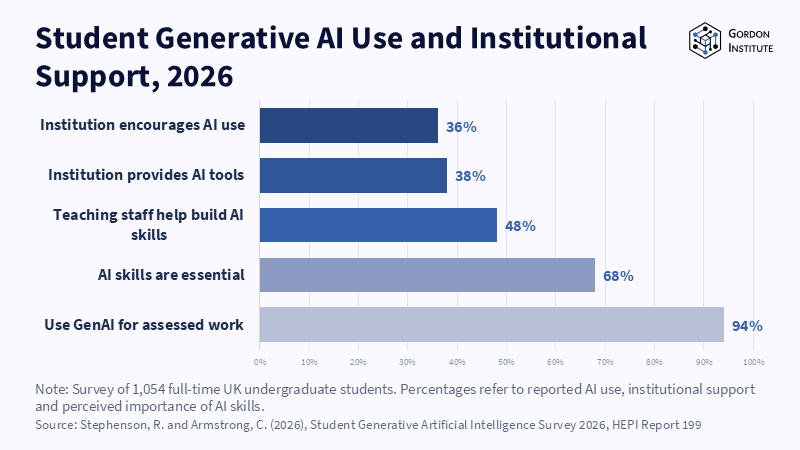
Consistent guidance matters across a programme. The HEPI figures examined here suggest that reported use can outpace institutional encouragement and provision of tools. Such differences raise questions about access and expectations, but the survey does not establish the quality of every student's practice. A common framework can state what good use involves: honest representation, source verification, attention to uncertainty and the ability to explain consequential decisions. Individual disciplines can adapt those requirements to their methods. Institutions should also consider students without equivalent access to software or technical support. Assessment should not inadvertently reward the most expensive subscription. Providing common materials or alternatives can make the intellectual task more comparable while preserving useful experimentation with tools.
Assessment redesign has costs that should be measured rather than dismissed. Oral discussion, draft review and complex tasks require staff time, while poorly designed process checks can add bureaucracy. Institutions may use fewer, more purposeful assessments, short targeted questions and intermediate deliverables to make scrutiny manageable. These are options to evaluate, not universal solutions. Rubrics should focus on the quality of sources, verification, justification, revision and recognition of uncertainty. Assessors need examples and calibration so that students are not judged by inconsistent impressions of maturity. Evaluation should examine learning, fairness, workload and the reliability of judgments. A practice that makes reasoning visible is valuable only if the evidence can be interpreted competently and if the burden remains proportionate to the educational benefit.
Employers' reported demand for analytical thinking adds practical context, but the educational case should not depend solely on a labour-market survey. People need to assess evidence as researchers, professionals and citizens. AI makes that requirement more apparent because plausible answers become easier to obtain. An educational programme should create repeated occasions to interpret, dispute, verify and defend claims, while providing feedback that helps learners improve. Marks can support those incentives, but grades alone do not create thoughtful practice. Students need subject knowledge, workable methods and an understanding of why scrutiny matters. The objective is a capability they can carry into unfamiliar situations, including those where no teacher has supplied a rubric or selected the sources in advance.
Critical-thinking assessment should connect the visible product to the decisions behind it. AI does not make that task impossible, but it exposes the weakness of treating fluent output as sufficient proof of understanding. Institutions can examine reasoning through source comparison, method justification, error analysis and revision, alongside appropriate demonstrations without assistance. They should evaluate whether these practices develop retained competence and work fairly across learners. For Gordon Institute's Science Forum, accessible AI education should help people become more capable judges of evidence. Assessment contributes when it rewards that development and gives learners useful information about their progress. A strong answer then matters together with the ability to explain why it is strong and how it should change when the evidence changes.
This Science Forum article is adapted from material published within Gordon Institute’s network. It presents editorial analysis and does not constitute professional advice or an official institutional policy.
References
Chen, T. et al. (2024) ‘The effect of problem-based learning on improving problem-solving, self-directed learning, and critical thinking ability for pharmacy students’, PLOS ONE, 19(12), e0314017.
Fan, K. (2024) ‘Can the infusion teaching of critical thinking improve Chinese secondary students’ critical thinking and academic attainment?’, Thinking Skills and Creativity, 53, 101597.
Gerlich, M. (2025) ‘AI Tools in Society: Impacts on Cognitive Offloading and the Future of Critical Thinking’, Societies, 15(1), 6.
Kakabadse, N. (2026) ‘Classroom practices that encourage intelligent AI behaviours’, University World News, 25 August.
Kosmyna, N. et al. (2025) ‘Your Brain on ChatGPT: Accumulation of Cognitive Debt when Using an AI Assistant for Essay Writing Task’, arXiv, 2506.08872.
Leopold, T. et al. (2025) Future of Jobs Report 2025. Geneva: World Economic Forum.
Liu, D. and Bridgeman, A. (2023) ‘Embracing the future of assessment at the University of Sydney’, Teaching@Sydney.
Marlett, D. (n.d.) ‘Increasing Critical Thinking in Education: How to Prepare Students for the Future’, Learning-Focused.
Stephenson, R. and Armstrong, C. (2026) Student Generative Artificial Intelligence Survey 2026. HEPI Report 199.
Thornhill-Miller, B. et al. (2023) ‘Creativity, Critical Thinking, Communication, and Collaboration’, Journal of Intelligence, 11(3), 54.
Xu, E., Wang, W. and Wang, Q. (2023) ‘The effectiveness of collaborative problem solving in promoting students’ critical thinking’, Humanities and Social Sciences Communications, 10, 16.
Zhao, G. et al. (2025) ‘Generative Artificial Intelligence Amplifies the Role of Critical Thinking Skills’, Education Sciences, 15(5), 554.
관련기사
















