AI in Early Diagnosis: From Pattern Recognition to Patient Benefit

입력
수정
Clinical studies show how AI can support earlier recognition and screening
Diagnostic accuracy, clinical outcomes and access require different evidence
Patient benefit depends on validation, oversight and timely follow-up
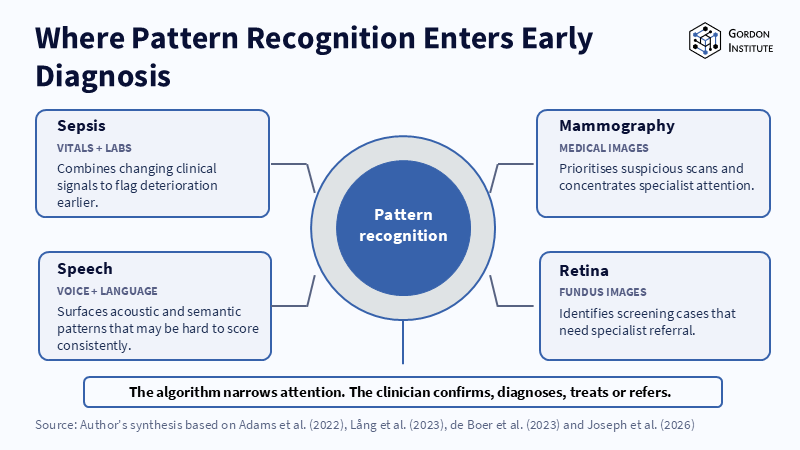
An algorithm that recognises a clinical pattern has completed only part of the work required to improve health. Someone must interpret the signal, decide whether intervention is warranted and ensure that the patient receives appropriate care. A 2022 study in Nature Medicine illustrates this relationship. Across five US hospitals, the TREWS sepsis warning system monitored more than 590,000 patients. Among patients with sepsis flagged before antibiotics began, confirmation of an alert within three hours was associated with lower in-hospital mortality than later or absent confirmation within that window. The finding concerns the interaction between software and clinicians, rather than software acting alone. Studies in breast screening, speech analysis and retinal imaging offer further opportunities to examine how AI-supported diagnosis moves from pattern recognition to meaningful patient benefit.
Sepsis Alerts and the Evidence for Earlier Action
The Targeted Real-time Early Warning System, or TREWS, uses electronic health records to identify patients who may be developing sepsis. The prospective study included 590,736 monitored patients at two academic and three community hospitals. Its principal outcome analysis concerned 6,877 patients with sepsis whose alerts preceded antibiotic treatment. Provider confirmation within three hours was associated with an adjusted absolute mortality reduction of 3.3 percentage points and a relative reduction of 18.7 percent. Antibiotics were also administered earlier. These are clinically important associations, but the comparison was observational rather than a randomised assignment to prompt confirmation. Differences in patients, clinician behaviour and surrounding care may therefore contribute to the measured outcomes. The study supports further investigation of an integrated warning-and-response process; it does not isolate an unconditional effect of the algorithm.
Sepsis is difficult to recognise because early signs such as fever, rapid heart rate and confusion occur in many conditions. A warning system must balance missed cases against unnecessary alerts. Too many false alarms can exhaust attention, while an accurate alert that no one reviews may achieve little. TREWS was embedded in clinical workflows so that staff could assess its recommendations alongside other evidence. This is an important scientific lesson: evaluating a clinical AI system requires examining how it changes attention and action. Prediction quality is one component; the timing, appropriateness and consequences of the response are others. A hospital adopting a similar system would need to assess both its local performance and its effect on care.
Mammography and the Meaning of Better Detection
Breast screening provides a different kind of evidence because the MASAI trial used random allocation. In Sweden, mammograms are ordinarily assessed through double reading by radiologists. The trial compared standard practice with AI-supported screening, in which the system helped triage examinations to single or double reading and provided detection support. The 2023 interim safety analysis included 80,033 women and recorded 244 detected cancers in the AI group, compared with 203 in the control group. Reading workload fell by 44.3 percent, while false-positive rates were similar. This design evaluates an altered screening process, rather than an algorithm on a preselected image collection. Its results suggest that AI can support more efficient allocation of specialist attention, but the number of detected cancers alone cannot establish every dimension of benefit.
A subsequent analysis published in 2025 extended the assessment to nearly 106,000 women. It reported 29 percent more detected cancers and 24 percent more invasive cancers with AI-supported screening, with additional detection including small, lymph-node-negative tumours. Finding disease at an earlier stage can create opportunities for effective treatment. However, detection gains must also be considered alongside interval cancers, overdiagnosis, treatment burden and longer-term outcomes. More diagnoses do not automatically imply a proportional reduction in mortality. The trial's integration into population screening at four sites in southwest Sweden strengthens its practical relevance, while still leaving questions about transfer to other populations, equipment and staffing arrangements. Scientific evaluation should distinguish improved screening performance from the wider health outcomes it is intended to produce.
Speech Markers Remain an Emerging Research Tool
Psychiatric diagnosis presents a more exploratory application. A 2015 US study of 404 patients across 34 community treatment settings found a median duration of untreated psychosis of 74 weeks, with 68 percent experiencing delays beyond six months. Such delays have multiple causes, including access to care, recognition of symptoms and pathways into treatment. Speech analysis is being investigated as one possible additional source of information. Features such as pauses, coherence and articulation may reveal patterns that are difficult to assess consistently by impression alone. The objective is to support clinical understanding and earlier assessment. A speech signal cannot, by itself, explain a person's condition or overcome the service barriers that contribute to delayed care.
A study published in Psychological Medicine analysed 88 acoustic features from recordings of 142 people with schizophrenia-spectrum disorders and 142 matched healthy participants. A random forest classifier distinguished the groups with 86.2 percent accuracy and separated predominantly positive from predominantly negative symptoms with 74.2 percent accuracy. Separate research has explored linguistic coherence and other features extracted from interview transcripts. These findings indicate that speech contains information relevant to psychiatric research. They do not establish a ready-to-use population screening test. Distinguishing previously diagnosed patients from matched controls is a different task from identifying emerging illness among people with varied symptoms. Validation must examine performance across languages, medications, recording conditions and alternative diagnoses, as well as whether additional information improves decisions beyond existing assessment.
Retinal Screening and Access to Care
Diabetic retinopathy illustrates the potential to widen access to screening. People living with diabetes may need regular retinal assessment, yet specialist availability can be limited. An Australian pragmatic trial conducted between August 2021 and June 2023 tested an AI-integrated fundus camera across five primary care and endocrinology sites. Among 863 participants, the system reported 93.3 percent accuracy for referable diabetic retinopathy, with 83.7 percent sensitivity and 96.1 percent specificity. The research appeared online in 2025 and in the 2026 volume of the British Journal of Ophthalmology. These measures answer different questions: sensitivity concerns the cases identified, while specificity concerns those correctly classified as not requiring referral for that condition. Overall accuracy alone is insufficient to judge the consequences of missed disease or unnecessary referral.
The setting matters because screening occurred during ordinary clinical encounters. On-site image analysis can shorten the interval between testing and a referral decision, bringing assessment closer to people who might otherwise struggle to obtain it. However, poor-quality images and uncertain findings still require an appropriate pathway, and a referral must lead to accessible care. For an underserved community, moving a test into primary care may be valuable even without improving every diagnostic metric. Conversely, a technically strong test may have limited impact if patients cannot reach follow-up services. Evaluating access therefore requires tracking the full pathway: who is screened, who receives an interpretable result, who is referred and who ultimately obtains treatment.
From Predictive Performance to Clinical Benefit
The four examples represent different stages and types of evidence. TREWS offers prospective observational evidence from deployed hospital care; MASAI provides randomised evidence about a screening workflow; the Australian retinal study examines performance and feasibility in routine clinics; speech studies largely explore candidate diagnostic signals. Treating all of them as equivalent demonstrations of AI's clinical readiness would obscure what each design can establish. Real-world deployment improves relevance, but does not eliminate bias, confounding or uncertainty about transfer. For Science Forum, the central question is how research design connects a model's prediction to a defensible claim about better care. The strongest evaluation combines technical performance with clinical consequences and an explicit account of the remaining uncertainties.
Speech analysis particularly illustrates the need for diverse validation. Age, language, medication, distress and recording conditions can alter speech without indicating the condition a classifier seeks to identify. Small samples may also give unstable estimates, especially when a model is assessed against a limited range of alternatives. Any move towards routine monitoring would introduce questions about consent, privacy and the consequences of an incorrect label. Similar concerns arise elsewhere in diagnosis when training populations differ from the patients served. Local evaluation and continuing monitoring should therefore examine performance across relevant patient groups. A single average accuracy figure can conceal unequal error rates and different burdens of follow-up.
Implementation should be designed around the clinical pathway being improved. A sepsis alert needs a clear process for review and timely action. AI-supported mammography requires decisions about reading responsibilities and quality assurance. Speech biomarkers need stronger prospective validation before broad diagnostic use. Retinal screening requires routes for ungradable images and reliable referral capacity. In each case, the research question extends beyond whether the system recognises a pattern. It includes whether clinicians can interpret the output, whether errors are detected, and whether the change benefits patients under ordinary resource constraints. Institutions should also preserve the ability to reassess a system as populations, equipment and clinical practice change.
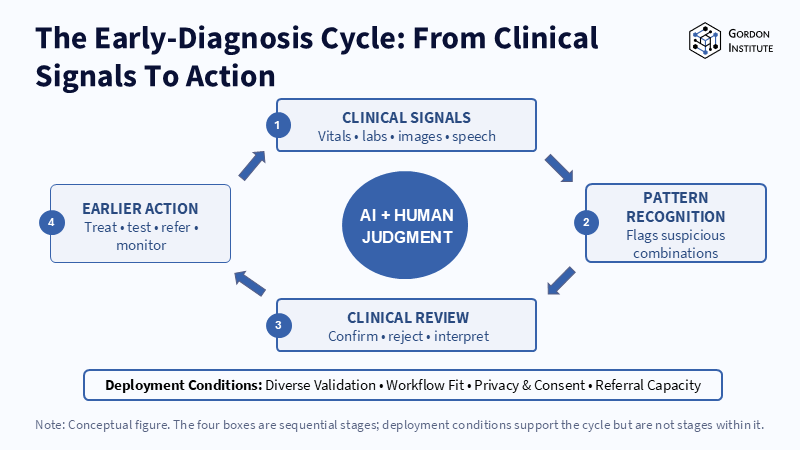
AI can help make important clinical signals more visible and specialist attention more available. The evidence examined here gives reasons to pursue that potential, while also showing why a general promise of earlier diagnosis is too broad. Screening accuracy, detection rates, treatment timing and health outcomes are distinct endpoints. Scientific progress depends on connecting them carefully and testing the assumptions between them. The humanitarian value of clinical AI will be judged through patients who receive appropriate care sooner, including those currently underserved. That requires systems whose limitations are understood, decisions whose reasoning can be examined, and services able to act on the information they receive. Pattern recognition becomes a medical contribution through that complete chain.
This Science Forum article is adapted from material published within Gordon Institute’s network. It presents editorial analysis and does not constitute professional advice or an official institutional policy.
References
Adams, R., Henry, K.E., Sridharan, A. et al. (2022) ‘Prospective, multi-site study of patient outcomes after implementation of the TREWS machine learning-based early warning system for sepsis’, Nature Medicine, 28, pp. 1455–1460.
Addington, J., Heinssen, R.K., Robinson, D.G. et al. (2015) ‘Duration of untreated psychosis in community treatment settings in the United States’, Psychiatric Services, 66(7), pp. 753–756.
de Boer, J.N., Voppel, A.E., Brederoo, S.G. et al. (2023) ‘Acoustic speech markers for schizophrenia-spectrum disorders: a diagnostic and symptom-recognition tool’, Psychological Medicine, 53(4), pp. 1302–1312.
Henry, K.E., Adams, R., Parent, C. et al. (2022) ‘Factors driving provider adoption of the TREWS machine learning-based early warning system and its effects on sepsis treatment timing’, Nature Medicine, 28, pp. 1447–1454.
Hernström, V., Josefsson, V., Sartor, H. et al. (2025) ‘Screening performance and characteristics of breast cancer detected in the Mammography Screening with Artificial Intelligence trial (MASAI)’, The Lancet Digital Health, 7(3), pp. e175–e183.
Joseph, S., Wang, Y., Drinkwater, J.J. et al. (2026) ‘Effectiveness of artificial intelligence-based diabetic retinopathy screening in primary care and endocrinology settings in Australia: a pragmatic trial’, British Journal of Ophthalmology, 110(1), pp. 76–82.
Landon, A. (2026) ‘Listening for schizophrenia: how AI can help with early diagnosis’, Scientific American, 12 September.
Lång, K., Josefsson, V., Larsson, A.-M. et al. (2023) ‘Artificial intelligence-supported screen reading versus standard double reading in the Mammography Screening with Artificial Intelligence trial (MASAI): a clinical safety analysis’, The Lancet Oncology, 24(8), pp. 936–944.
Tang, S.X., Kriz, R., Cho, S. et al. (2021) ‘Natural language processing methods are sensitive to sub-clinical linguistic differences in schizophrenia spectrum disorders’, Schizophrenia, 7, article 25.
관련기사
















