Korea's Gaming Curfew Shows Why Digital Restrictions Need Behavioral Evidence

입력
수정
Korea’s gaming curfew restricted accounts without reliably changing behaviour
Industry decline cannot be attributed to one law but regulation shaped adaptation costs
Social-media controls need behavioural evidence, proportionality and evaluation before expansion

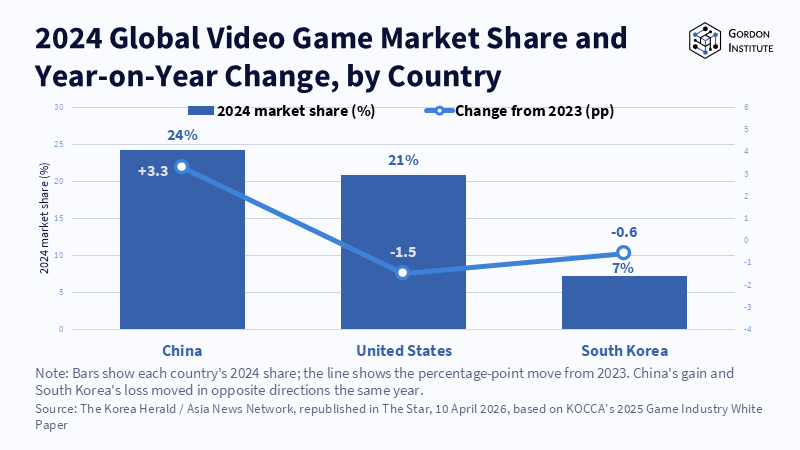
South Korea’s experience with the gaming “shutdown law” offers a rare long-duration case for evaluating digital restrictions on minors. From 2011, users under 16 were prohibited from accessing online computer games between midnight and 6 a.m.; the rule was repealed a decade later without persuasive evidence that it had delivered its intended effect. Over the same broad period, Korea’s global gaming-market share weakened, reaching 7.2 per cent in 2024 as China rose to 24.2 per cent. The market outcome cannot credibly be assigned to one regulation, but the history examined by SIAI’s account of Korea’s curfew and Meta’s new limit demonstrates a recurrent policy problem: governments regulate the account, platform or hour that is easiest to observe, while users redirect behaviour toward identities, devices and services that the rule does not cover.
The Shutdown Law Turned a Social Concern Into a Clock
The law, often called the Cinderella Law, was introduced to protect sleep and reduce excessive gaming among children. It prohibited online computer-game access for users under 16 during six overnight hours and exposed non-compliant companies to substantial fines and possible criminal penalties. A parallel “choice” system allowed parents or minors to select permitted hours, but participation across a sample of games reportedly ranged from only 1 per cent to 28 per cent. The low uptake was sometimes interpreted as weak parental willingness to intervene, although a system requiring separate action across individual games imposed an administrative burden that itself discouraged use.
The measure converted a complex concern—sleep, compulsive use, household conflict and educational performance—into a simple time boundary. That made enforcement legible, but it also narrowed the regulated object to online computer games. Consoles, mobile games, video platforms and other forms of digital entertainment remained outside the same constraint even as youth behaviour shifted toward them. A child awake after midnight could comply with the statute by changing the screen rather than changing the sleep pattern. The policy measured access to a named category, not the welfare outcome that justified intervention.
Workarounds Were a Design Feature, Not an Exception
Teenagers frequently used accounts registered to parents or other adults, defeating an age rule that depended on account identity. The weakness became highly visible when Microsoft changed Minecraft’s account system and Korean minors faced exclusion from a game otherwise considered suitable for children. A petition attracted more than 100,000 signatures, while the government eventually announced repeal in 2021 and completed it in January 2022. The controversy showed that a narrow verification mechanism can create consequences far beyond the intended restriction when global platforms adapt their architecture to the most demanding local rule.
The bypass behaviour also complicates evaluation. If a minor logs in through an adult account, administrative data record fewer underage sessions even when total play is unchanged. Parents and regulators may lose visibility at the moment the dashboard appears to improve. This is not an argument that every rule will be evaded completely, but it establishes a methodological requirement: policy assessment must measure individuals and outcomes, not merely registered accounts. Without surveys, sleep measures, time-use evidence and cross-platform observation, compliance data cannot establish behavioural success.
Industrial Effects Require Careful Causal Claims
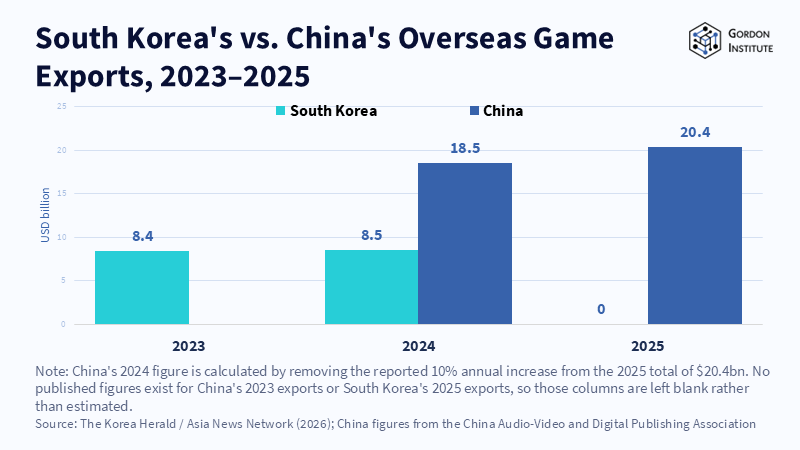
Korea’s gaming industry changed during the period of the law, but its decline relative to China reflects several forces. China invested heavily in web and mobile games, built a large domestic market and channelled capital toward formats growing fastest. Korean firms faced their own strategic and financing choices, global platform shifts, changing consumer preferences and exposure to regulatory obligations. Korea’s gaming exports reached approximately US$8.5 billion in 2024, compared with Chinese exports of US$20.4 billion. Those figures show divergence, but they do not isolate the curfew as the cause.
A more defensible conclusion is that regulation altered the environment in which firms adapted. Compliance costs fell unevenly across technologies, domestic political language framed gaming as a social harm, and uncertainty influenced investment at a moment when mobile distribution was reorganising competition. Later symbolic changes, including the removal of “addiction” language from official treatment of games, could not recreate opportunities already captured elsewhere. Related reporting by The Economy on Korean gaming firms seeking new growth in Poland illustrates how companies now pursue geographic alternatives after losing relative position in Asian markets.
Meta’s Two-Hour Limit Repeats the Observable-Control Logic
Meta’s 2026 settlement with US states places a two-hour daily limit on users under 18, blocks overnight access and restricts notifications during school hours. It also changes feed design, privacy settings, reaction visibility and contact by unfamiliar adults. These broader design interventions distinguish the settlement from Korea’s gaming law, and some may reduce specific harms. Yet the headline time limit retains the older enforcement logic: it attaches to an account whose declared age may not represent the person using it.
The EduTimes account of Meta’s settlement reports that parental approval can lift restrictions and that tighter limits may apply if competing platforms accept comparable terms. This design makes the permissible duration partly contingent on legal negotiation and competitor participation, rather than a fixed evidence-based threshold. It also creates the prospect of cross-platform substitution. A teenager restricted on one service can divide time among several, just as Korean minors moved between accounts and forms of entertainment. Regulation of one platform may change market share without producing the intended change in total behaviour.
Comparative Evidence Shows a Gap Between Accounts and Use
Australia’s restrictions provide early evidence. The share of children under 16 reporting active accounts fell by more than ten percentage points, yet reported usage declined by only 4.4 percentage points. Studies identified false accounts and VPN use among teenagers, suggesting that the difference was partly displacement rather than cessation. Age-estimation tools create another uncertain layer. Digitally altered facial images have caused models to reclassify minors as adults, while stronger identity demands raise concerns about biometric data, misclassification and long-term retention.
International disagreement about age thresholds and control types is equally important. Governments have selected ages of 15 or 16, complete bans or design restrictions, parental consent or no exception, and different night-time rules. The variation reflects legal culture and political judgment as well as evidence. It does not mean that policy is impossible; it means claims should remain proportionate. Where scientific reviews find heterogeneous benefits and harms rather than a uniform population effect, regulation should target identifiable mechanisms—compulsive recommendation, overnight interruption, adult contact or harmful-content exposure—more precisely than total time alone.
Digital Child-Protection Policy Needs an Evaluation Architecture
A credible policy begins by stating the outcome: more sleep, less harmful exposure, reduced compulsive use, safer contact or stronger parental agency. The instrument should then match that outcome, and evaluation should record substitution into other accounts, devices and platforms. Rules should contain review dates and publication obligations so that visible compliance is compared with behavioural evidence. Data requirements must also remain proportionate; a system intended to protect minors should not normalise the collection of sensitive identity information from an entire population without clear retention and appeal safeguards.
| Policy question | Evidence needed | Lesson from Korea and current controls |
|---|---|---|
| What harm is targeted? | Sleep, exposure, wellbeing or contact measures | A clock cannot represent every form of harm |
| Who is actually restricted? | Person-level estimates across accounts and devices | Borrowed identities make account data misleading |
| Where does activity move? | Cross-platform and cross-device time-use evidence | Narrow scope encourages substitution |
| What does verification cost? | Error, privacy, retention and appeal statistics | Stronger enforcement can create a second policy risk |
| When should the rule change? | Independent review against a published baseline | Long operation without evaluation entrenches weak design |
Industrial impact should form part of this evaluation but not substitute for child welfare. Governments can examine whether compliance burdens favour large incumbents, discourage innovation or redirect activity toward less regulated foreign services while still maintaining safeguards. The relevant test is proportionality: whether a measure produces a demonstrable benefit large enough to justify its economic, privacy and administrative costs. Korea’s experience warns that symbolic toughness can coexist with weak behavioural evidence and long-lived distortions.
The Lesson Is Better Regulation, Not Regulatory Withdrawal
The repeal of Korea’s shutdown law does not prove that governments should leave children’s digital environments entirely to platforms or families. Companies design recommendation systems, notifications and social incentives at a scale individual households cannot negotiate. Public rules can establish privacy defaults, transparency, access to data for researchers and responsibility for contact or content risks. The lesson is that those rules should be directed toward mechanisms supported by evidence and should remain capable of revision when behaviour does not change.
Korea’s market-share decline, borrowed-account workarounds and eventual repeal together show why account restrictions need humility in both design and evaluation. Meta’s limit may be more sophisticated, but it faces the same boundary between the identity recorded by a platform and the person acting behind it. A policy that cannot observe substitution may claim success precisely when users have moved beyond its field of vision. The public purpose is not to produce fewer underage accounts on a report; it is to improve young people’s welfare without imposing costs that the evidence cannot justify.
This article reflects the analytical judgment of the Gordon Institute Policy Forum and does not constitute policy advice or the official position of any affiliated institution.
References
eSafety Commissioner (2026) Survey Evidence on Under-16 Social-Media Accounts and Usage in Australia.
Hwang, M. (2021) ‘Shut Down Korea’s Shutdown Law’, The Granite Tower, 4 September.
Im, E. (2021) ‘Korea to Ax Games Curfew’, The Korea Herald, 25 August.
Korea Creative Content Agency (2025) 2025 Game Industry White Paper. Seoul: Korea Creative Content Agency.
Lee, J. (2026) ‘Meta Imposes Two-Hour Social Media Limit on Teens, but Can It Stop AI Age Manipulation and VPN Workarounds?’, The EduTimes, 28 August.
National Academies of Sciences, Engineering, and Medicine (2023) Social Media and Adolescent Health. Washington, DC: National Academies Press.
Swiss Institute of Artificial Intelligence (2026) ‘What Korea’s Gaming Curfew Reveals About Meta’s Two-Hour Limit’, SIAI Review, September.
The Korea Herald (2026) ‘China Winning in Gaming Race as South Korea Stumbles on Policy’, The Star/Asia News Network, 10 April.
관련기사
















