Evaluating Science in the AI Era: Beyond Publication Counts

입력
수정
AI-assisted writing makes manuscript volume a less informative measure of contribution
Writing assistance, research quality and misconduct are different questions
Evaluation should combine substantive review with transparent, contextual indicators

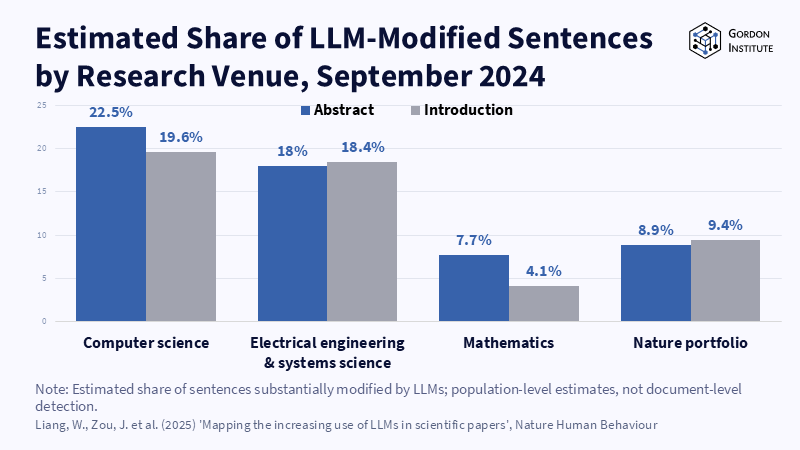
What does an increase in published papers tell us about scientific progress when preparing manuscripts becomes easier? AI can help researchers communicate findings, revise language and organise material. Those benefits are real possibilities, but they make output volume an increasingly ambiguous proxy for intellectual contribution. Studies using vocabulary patterns estimate substantial growth in AI-assisted scientific prose, including in computer science and biomedicine. Such estimates concern writing assistance; they do not establish that the experiments, analysis or ideas were generated by a machine. The distinction is central to evaluation. A system that counts papers cannot readily tell whether it is observing more discovery, better communication, fragmented reporting or greater capacity to produce plausible manuscripts. Science Forum should examine how institutions can assess contribution without confusing any of these possibilities with the others.
Writing Assistance and the Meaning of Productivity
Research on AI-assisted publication suggests that writing tools can reduce barriers to communicating work. The research discussed here describes studies linking adoption to increased publication output, including analysis of large preprint collections. These findings motivate questions about productivity, but manuscript counts do not measure the complete research process. Drafting may accelerate while data collection, experimental design or verification remains demanding. A researcher can also use saved time to investigate more carefully rather than publish more frequently. Institutions should distinguish the production of text from the production of knowledge. The useful contribution of assistance is the effort it frees for scientific work and the communication it improves, including for scholars writing in an additional language. Measuring that contribution requires outcomes beyond the number of manuscripts appearing after adoption.
Word-frequency studies provide evidence of a change in scientific writing, with estimates varying by field, section, dataset and method. Relevant evidence includes work by Andrew Gray and Dmitry Kobak, alongside analyses of abstracts and cancer-research publications. These estimates should not be added together or treated as interchangeable measures of AI use. A signal in an abstract differs from a signal in a methods section or review report. A change in vocabulary also leaves uncertainty about the particular tool and extent of assistance. These methods can describe aggregate patterns more credibly than adjudicate the authorship of an individual paper. Their significance for evaluation is that the relationship between visible prose and the effort required to produce it is changing. Whether scientific quality improves, declines or remains stable needs separate investigation.
Volume Incentives and Weak Review
The vulnerable point is review that treats the appearance of scholarship as sufficient evidence of substance. A manuscript can contain plausible headings, polished language and conventional references while making a weak or unsupported contribution. AI may make that appearance cheaper to produce, but the problem predates it. Journals vary widely in their standards and resources; describing all lower-ranked venues as superficial would obscure that variation. Evaluation should ask whether the evidence supports the claims, whether the method is appropriate and whether the work adds something worth knowing. Those judgments require attention to the content rather than confidence in its style. Assistance that improves expression can make valid research more accessible, while equally fluent expression can conceal poor work. The same surface feature therefore supports very different interpretations.
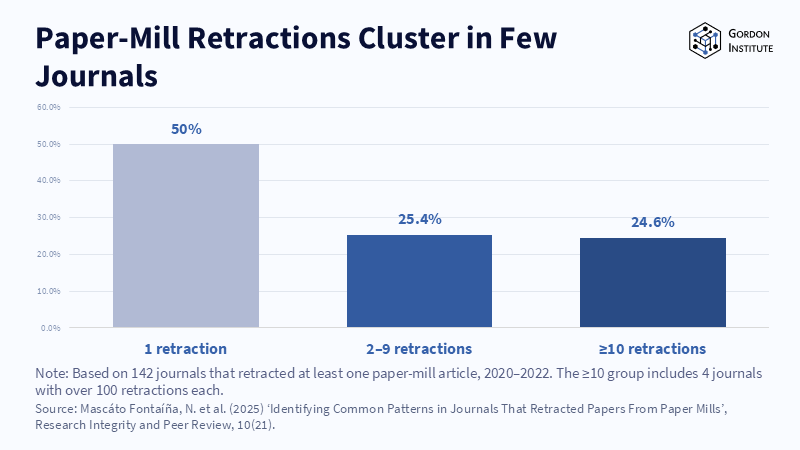
Paper mills illustrate a separate integrity problem: the organised production or sale of fraudulent scholarship. Relevant evidence includes the large Hindawi retraction episode and a study of 142 journals with paper-mill retractions. Such evidence shows that failures can cluster within particular editorial environments. It does not demonstrate that every AI-assisted manuscript is fraudulent or that AI caused the historical pattern. Manuscript volume, review capacity and institutional rewards may interact with deliberate misconduct in different ways. The relevant question for research evaluation is how to avoid rewarding outputs that have not received adequate scrutiny. Retraction data can identify concerns, but raw counts need denominators, reasons and information about correction. A journal with many retractions may be confronting a legacy problem, while one with none may simply have failed to detect it.
What Publication Metrics Actually Measure
Publication counts have long been convenient because they are easy to collect and compare. Their limitations were present before generative AI. Fields differ in authorship practices, publication frequency and the relationship between one paper and one substantial contribution. National output also changes with research investment, field composition, database coverage and collaboration. Growth in the number of papers does not establish a corresponding increase in insight, nor does it prove a change in research integrity. Evaluation should investigate those relationships rather than use national volume as a shortcut to judgments about quality or motive. The same caution applies to institutions: a rising publication total can reflect stronger research, more effective communication or different incentives. Distinguishing these explanations requires information about the work itself and the environment in which it was produced.
AI makes these existing limitations more consequential. If publication volume becomes easier to increase, incentives built around it may reward behaviour that does not proportionately increase knowledge. Possible responses include dividing findings into more papers, prioritising familiar formats or directing effort towards topics likely to produce rapid outputs. These are mechanisms to investigate, not effects that should be assumed for every researcher. A raw count remains useful for describing activity, provided it is not asked to establish what it cannot measure. Committees should inspect the substance of selected contributions and the work supporting them. The purpose is to understand what a researcher or institution has achieved, rather than treat every additional citable item as an equivalent unit of scientific value.
Evaluating Contributions That Withstand Scrutiny
A stronger evaluation system would combine informed review with a small number of contextual indicators. Field-normalised citations can provide information about uptake, but also respond to fashion, citation practices and manipulation. Independent replication can strengthen confidence where feasible, yet cannot be expected for every type of scholarship. Open data, usable code, methodological contributions and careful negative findings may also have value. No single measure captures these dimensions. Institutions should state which contributions they seek and how evidence about them will be interpreted. AI disclosure can help clarify the research process when consequential assistance is involved, without being treated as a mark against legitimate use. The appropriate standard is defensible scholarship, regardless of whether a writing tool helped express it.
Verification should focus on evidence and claims rather than on speculative authorship detection. A citation check can establish whether a source exists, but still requires examination of whether it supports the sentence. Reproducibility review can test a calculation without settling the importance of the result. Expert assessment can examine a contribution while acknowledging disagreement. These checks should be proportionate to the field and the claim. Process-oriented review may also reduce barriers for researchers whose language is less polished but whose work is strong. The institutional objective is to align rewards with useful, trustworthy contributions. A change in writing technology is an opportunity to improve that alignment, rather than replace publication counts with another easily manipulated ranking.
Scientific evaluation should remain interested in output without equating output with achievement. AI assistance can improve communication and reduce repetitive work; it can also increase the supply of manuscripts whose substance is uncertain. The evidence needed to distinguish these outcomes lies in methods, findings, verification and informed use by others. Metrics can support that judgment when their limits are explicit. For Gordon Institute's Science Forum, the central question is whether institutions reward the creation of knowledge that can withstand examination. A larger publication total may accompany that achievement, but cannot establish it. Evaluation becomes more credible when it explains what the work contributes and why the available evidence justifies confidence in it.
This Science Forum article is adapted from material published within Gordon Institute’s network. It presents editorial analysis and does not constitute professional advice or an official institutional policy.
References
American Association for Cancer Research Journals (2025) Disclosure and Detection of AI-Generated Text in Cancer Research Publishing. Philadelphia: AACR.
Gray, A. (2024) Quantifying the Prevalence of AI-Assisted Writing in Scientific Literature Using Word-Frequency Analysis. London: University College London.
Kobak, D., González-Márquez, R., Horvát, E.-Á. and Lause, J. (2025) ‘Delving into LLM-assisted writing in biomedical publications through excess vocabulary’, Science Advances, 11(27), eadt3813.
Mascáto Fontaíña, N., Candal-Pedreira, C., García, G., Ross, J.S., Ruano-Ravina, A. and Martin-Gisbert, L. (2025) 'Identifying common patterns in journals that retracted papers from paper mills: a cross-sectional study', Research Integrity and Peer Review, 10(21).
Quincy Institute for Responsible Statecraft (2025) China's Historic Rise to the Top of the Scientific Ladder. Washington, DC: Quincy Institute.
Retraction Watch (2023) Hindawi Reveals Process for Retracting More Than 8,000 Paper Mill Articles. New York: The Center for Scientific Integrity.
Retraction Watch (2024) Springer Nature Retracted 2,923 Papers Last Year. New York: The Center for Scientific Integrity.
South China Morning Post (2025) China Overtakes US in Medical Research Amid Science Balance of Power Shift. Hong Kong: SCMP.
Kusumegi, K. et al. (2025) ‘Scientific production in the era of large language models’, Science. doi: 10.1126/science.adw3000.
Liang, W. et al. (2024) ‘Mapping the increasing use of LLMs in scientific papers’, arXiv:2404.01268.
관련기사
















